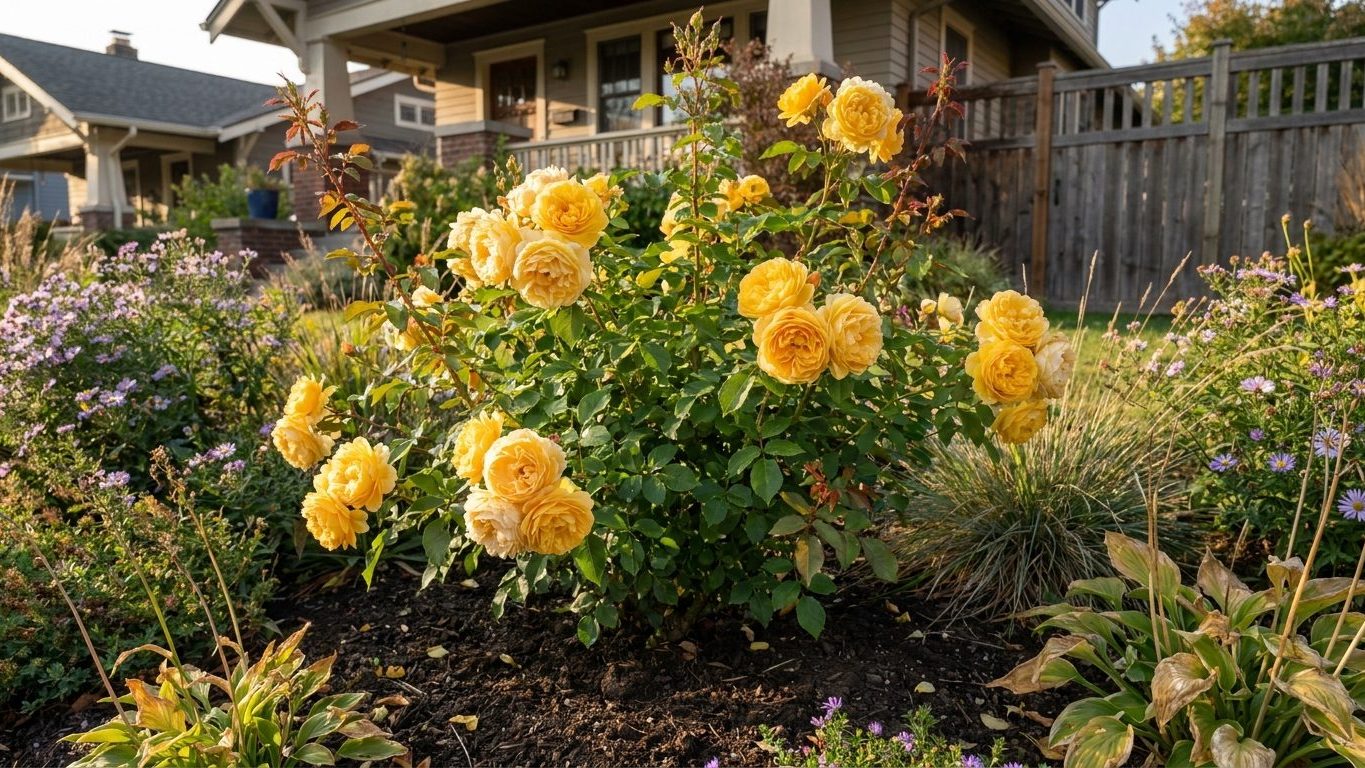

Graham Thomas is a David Austin shrub rose (registered as ‘AUSmas’), bred for large, double, bright yellow blooms carried in loose clusters with heavy fragrance. It flowers on new wood, which is the single fact that decides when and how hard you can cut it back, and it’s rated hardy from USDA zone 5a through 11b, according to the North Carolina Extension Gardener Plant Toolbox.
What Graham Thomas actually is
Start with the wood, because it changes everything downstream. Graham Thomas blooms on new wood, meaning the canes it produces this season are the ones that carry this season’s flowers. That’s why the source is specific about pruning strategy: light pruning only, because hard pruning costs bloom. Cut too aggressively in late winter and you remove the framework the plant needs to push the new growth that flowers arrive on.
Beyond that, the documented range for the genus gives the outer limits any Rosa can reach: 1 to 8 feet tall, 1 to 6 feet wide, depending on cultivar. That’s a genus-wide figure, not a Graham Thomas-specific one, so treat it as a ceiling rather than a prediction. Check the nursery tag or your state’s page for the actual mature footprint.
Growth rate is listed as medium, and overall maintenance as high, which tracks with a repeat-blooming shrub rose that flowers on new growth: it rewards attention (feeding, deadheading, a yearly pruning pass) more than it forgives neglect. Full sun, at least six hours of direct light a day, is non-negotiable. Soil can be clay or loam, with a pH anywhere from acid (below 6.0) to neutral (6.0 to 8.0).
What Graham Thomas is good for

Most gardeners buy this rose for two things: the color and the scent, and the description backs up both. The catalogue calls the flowers “grandes fleurs doubles jaune vif, très parfumées”. Rose flower parts come in multiples of five, and a bloom counts as double once it carries more than 20 petals rather than the 5 of a single form. A double, bright yellow, heavily scented flower is a cut-flower and border rose first, built for volume and fragrance rather than the tidy, uniform look of a hedge planting.
The source names five general fragrance families across the genus: old rose, fruity, tea, myrrh, and musk. It doesn’t slot Graham Thomas into one of them specifically, so anyone naming an exact family for this cultivar is going beyond what NC State documents. What’s confirmed is that it’s strongly fragrant.
If you plan to cut blooms for a vase, timing matters: cut once the sepals have folded back and the first one or two petals are starting to unfurl. A bud cut tighter than that often never opens indoors.
The rose hip is an edible accessory fruit that turns from green to red in fall, but a repeat-flowering shrub like Graham Thomas is usually deadheaded to keep pushing new blooms, which means hips rarely get the chance to form. If hips matter to you, that’s a trade-off against continued flowering, not something this cultivar is bred to deliver.
Where it ripens in time, and where it is a gamble
A hardiness range of 5a through 11b is wide, but wide doesn’t mean uniform. The span covers everything from winters that regularly drop well below zero to climates that barely see frost at all, and Graham Thomas doesn’t perform the same way at both ends.
The comfortable middle
Through the middle of that range, where winters are cold enough to give the plant a real dormant period but not so severe that the wood is at constant risk, a shrub rose like this one behaves closest to what the catalogue promises: steady new growth each spring, repeat bloom through the season, and a yearly pruning that stays light. This is the band where “high maintenance” means feeding, deadheading, and watching for disease, not fighting the climate itself.
The cold edge and the warm edge
At the cold edge, near zone 5a, winter is the gamble. The wood needs to have ripened and the plant needs to be fully dormant before hard cold arrives, and whatever structure is below the snowline (the graft union on a budded plant, the crown on an own-root one) needs protection specific to that zone. This page won’t give you a mounding depth or a date; your state’s page is where that number lives.
At the warm edge, near zone 11b, winters may be too mild to give the plant a genuine rest, and disease pressure (the leaf spots, powdery mildew, and blights the source lists for the genus) can persist through more of the year, since there’s rarely a cold snap to interrupt it.
| Zone band (within 5a-11b) | What typically happens | What it costs you |
|---|---|---|
| Cold edge (near 5a-6a) | Real winter dormancy, risk to the union or crown | Winter protection each year, later spring start |
| Comfortable middle (roughly 6b-9b) | Regular dormancy, steady new-wood growth | Routine feeding, deadheading, one light pruning pass |
| Warm edge (near 10a-11b) | Little true dormancy, extended disease season | Closer disease watch, less predictable rest period |
The two ways a season goes wrong
A hardiness zone map tells you whether the plant can survive winter where you live. It doesn’t tell you about two things that quietly undercut a rose even inside a technically compatible zone.
The first is soil chemistry. The documented pH range for this genus runs from acid (below 6.0) to neutral (6.0 to 8.0). Push past that into strongly alkaline soil, above roughly 7.5, and the risk is iron chlorosis: leaves yellow between the veins because the plant can’t take up iron efficiently, even though the zone, light, and water are all correct. This has nothing to do with cold or heat and everything to do with what’s under the mulch.
The second is light. Six or more hours of direct sun a day is the stated minimum, and it isn’t a soft target. A Graham Thomas planted where a fence or a maturing tree shades the bed part of the day will still leaf out and may still bloom, but the flowering wood it depends on will be weaker, the flowers fewer, and disease pressure from botrytis or powdery mildew higher in the resulting damp, shaded canopy.
Of the two, light is the more common practical failure, because gardeners routinely underestimate how much a bed’s sun exposure changes as nearby plantings grow. A soil pH problem shows up on a test; a shade problem creeps in over several seasons and often gets blamed on the rose rather than the site.
What it resists, and what it does not
The North Carolina Extension source lists diseases and pests recorded across the Rosa genus rather than a resistance grade for Graham Thomas specifically, and that distinction matters. The diseases named are botrytis, blights, powdery mildew, leaf spots, and anthracnose. The pests named are the Fuller rose beetle, the Japanese beetle, the rose chafer, rose thrips, and two mite species, the southern red mite and the two-spotted mite. Because mites are arachnids, not insects, treating them with an insect-only product misses the target entirely.
What the source does not do is rank Graham Thomas as more or less resistant to any of these than another cultivar. Disease resistance in roses is documented per cultivar, not per group, and this page’s facts carry no specific rating for Graham Thomas. What you can do instead is watch for the documented list directly: leaf spots and powdery mildew are the ones a shrub rose in a humid climate is most likely to meet, and both call for the same basics, air circulation, avoiding wet foliage at night, and removing infected leaves rather than composting them.
Black spot overwinters both in fallen leaf litter and in lesions on the canes themselves, so raking up leaves without pruning out infected wood only solves half the problem. Powdery mildew, by contrast, overwinters in dormant buds and on the stems, not in the leaf litter at all, which is why cleaning up the bed does nothing against it on its own.
Growing it without the usual mistakes
The mistake this cultivar invites most often is over-pruning, precisely because it flowers on new wood and gardeners assume a harder cut means more new growth means more flowers. It doesn’t work that way here: a light pruning pass, done in late winter, shapes the plant and removes damaged canes without stripping the framework it needs to push this year’s blooming wood. The exact month depends on your zone, so treat this page’s guidance as the principle and your state’s page as the calendar.
Deadheading is where the second common mistake hides. Every cut you make to remove a spent bloom pushes the plant to send out a new shoot, which is exactly what you want in June and exactly what you don’t want six weeks before your first fall frost. Stopping deadheading late in the season is what keeps the plant from putting out soft new growth that has no time left to ripen before cold arrives.
Check the plant’s tag before deciding how to protect it over winter. Many hybrid teas, grandifloras, and climbers, categories close to where a David Austin shrub rose like this one sits in habit, are budded onto a rootstock, which means the graft union near the base is the vulnerable point. A growing number of landscape shrub roses today are sold own-root instead, with no union at all, in which case it’s the crown you’re protecting. The tag or receipt is the fastest way to know which one you have.
When you do prune, resist cutting every dead-looking cane back to ground level. Remove what’s diseased or clearly unsafe, but stems cut back to 12 to 24 inches and left standing give stem-nesting native bees a place to overwinter, a small trade that costs you nothing in bloom.
Common questions
Are Graham Thomas rose’s thorns dangerous?
They’re prickles, not true thorns. Prickles grow from the outer skin of the stem, which is why they snap or rub off sideways rather than staying rigid the way a true, woody thorn would. They can still break skin, so gloves are worth it at pruning time, but there’s no toxin or barb involved.
Does Graham Thomas need a different pruning schedule than other roses in my yard?
It needs a lighter hand, not a different calendar. Because it flowers on new wood, hard pruning removes the growth that would have carried this season’s blooms. Ramblers, by contrast, flower on old wood and are pruned on an entirely different logic, so don’t copy a rambler’s routine onto this shrub rose.
Can I grow Graham Thomas in a container instead of the ground?
The source doesn’t document container performance specifically, so treat that as unconfirmed rather than assumed safe. What is documented is the sun requirement (six-plus hours) and the pH range (acid to neutral), both of which apply just as much to a large container as to a bed.
Why didn’t my Graham Thomas produce rose hips this fall?
Most likely because it was deadheaded through the season. Removing spent blooms pushes new flowering shoots instead of letting the plant set hips, so a rose kept in constant repeat bloom rarely carries fruit into autumn. Hip formation and continued flowering are a direct trade-off, not two things you get at once.