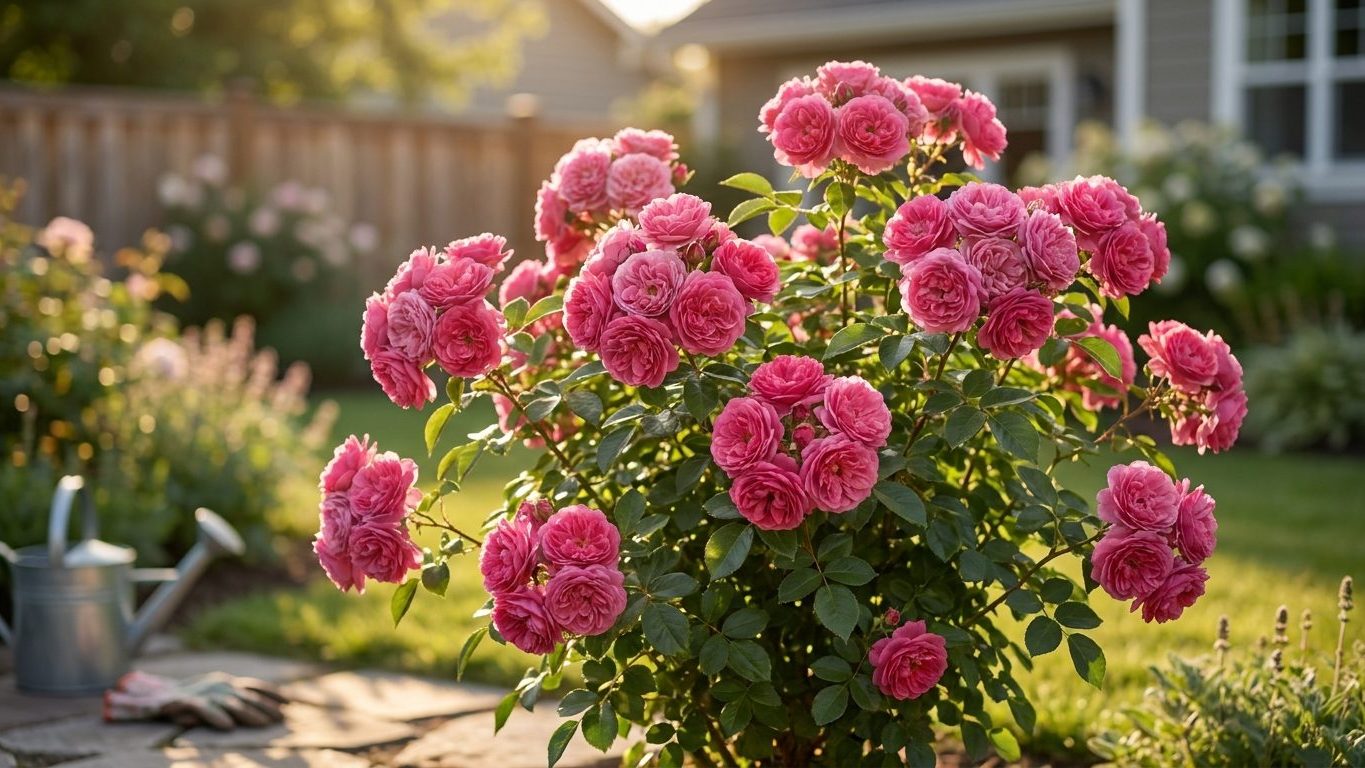

Bonica is a shrub rose that blooms on new wood, which means light pruning only, since cutting hard removes the very growth that would have carried flowers. It’s hardy from USDA zones 5a through 11b, wants full sun, and asks for more maintenance than a set-and-forget landscape plant. Whether it fits a given yard comes down to zone, soil pH, and how much pruning attention the grower is willing to give it each year.
What Bonica actually is
Bonica belongs to the shrub group, one of the eleven rose groups typically recognized, alongside hybrid tea, floribunda, climbing, rambling, and others. The catalogue description from NC State Extension’s Plant Toolbox calls it a producer of dense clusters, up to 20 large double flowers in deep rose-pink, registered under the breeder code ‘MELmodac’. Double simply means the flower carries more than 20 petals, since rose flower parts always arrange in multiples of five.
The fact that decides how this plant gets pruned is its flowering wood. Bonica flowers on new wood, the growth the plant produces during the current season, not on wood that overwintered from last year. That single detail is why a heavy late-winter cutback doesn’t set the plant back the way it would a rambler blooming on old wood. The exact calendar date for that light prune depends on the reader’s zone, and the state-level page is where that date lives.
As for size, NC State documents the genus range at 1 to 8 feet tall and 1 to 6 feet wide, depending on cultivar. That’s a wide spread, and the source doesn’t narrow it down to a specific figure for Bonica itself, so treat it as a mid-sized shrub and confirm the mature spread against the nursery tag before deciding on spacing.
What Bonica is good for

Because Bonica flowers on new wood rather than old, it keeps producing fresh flushes through the growing season instead of delivering one big show and stopping. Each round of new growth carries its own set of buds, so as long as the plant keeps pushing new wood, it keeps blooming.
For anyone cutting stems for a vase, timing matters more than the tool. The right moment to cut is once the sepals have folded back and the first one or two petals are starting to unfurl. Cut tighter than that, and the bud often never opens indoors.
Deadheading stretches the bloom window, because every cut pushes the plant to send out another round of new wood, and that new wood is what flowers. The catch is timing that habit to the calendar: stopping the cuts as the season winds down is what keeps the plant from pushing soft new growth that has no chance to Ripen Before Frost.
The rose hip, the swollen accessory fruit left behind once a bloom isn’t deadheaded, is edible and turns from green to red in fall. That’s a genus-level fact from NC State rather than something documented specifically for Bonica’s flavor. Left in place, hips also give the plant a second season of interest once the flowers are gone, and the shrub’s overall form, dense and rounded with clustered blooms, is exactly the profile growers reach for in hedges and mass plantings rather than as a single specimen bush.
Where it ripens in time, and where it is a gamble
Bonica’s documented hardiness range, zones 5a through 11b, covers nearly the entire continental United States plus warmer coastal and southern pockets. That’s an unusually wide span for a single cultivar, and it means the plant itself can survive winter almost anywhere in the country. What changes from one end of that range to the other isn’t whether the rose lives, but how much of the growing season it gets to use for producing the new wood it flowers on.
At the cold edge, zone 5a, the frost-free window is short by national standards, and because Bonica only flowers on wood grown during the current season, the plant has to break dormancy, push new growth, and mature that growth into flowering wood all inside a compressed stretch of warm months. The question a gardener there should ask isn’t whether the rose survives winter, since it’s hardy that far north, it’s whether there’s enough season left after the last spring frost for new wood to grow, flower, and ripen again before the first fall frost. Push growth too late into autumn with feeding or heavy deadheading, and that final flush of soft wood won’t have time to ripen before cold hits.
At the warm edge, zone 11b, barely any frost occurs at all. There the rose can keep producing new wood and cycling through bloom flushes across most of the calendar, so the constraint isn’t season length. It shifts instead to how humidity and sustained heat interact with the diseases the genus is documented to carry.
| Zone position | Reference climate | What decides success here |
|---|---|---|
| 5a (cold edge) | Central Minnesota, northern Vermont | Whether new wood has time to grow, bloom, and ripen before fall frost |
| 7b to 9a (mid-range) | Much of the mid-Atlantic, the lower Midwest, coastal Pacific Northwest | Longest practical bloom season with the least risk on either end |
| 11b (warm edge) | Florida Keys, warmer Hawaiian coasts | Disease pressure from sustained heat and humidity rather than frost |
The two ways a season goes wrong
In the cold half of Bonica’s range, the failure mode isn’t the plant dying outright, since zone 5a is within its documented hardiness. It’s soft, late-season growth that never gets the chance to ripen. Wood that hardens on its own, given enough warm weeks, is winter-tough; wood still soft when frost hits is not. Feeding late or letting deadheading run right up to the first cold snap is what pushes that risky late flush.
In the warm half of the range, the risk shifts from cold to disease. Sustained heat paired with humidity favors several of the diseases NC State names for this genus, including powdery mildew and various blights and leaf spots. Powdery mildew in particular overwinters in dormant buds and on the stems themselves, not in fallen leaf litter, so a gardener who rakes up debris each fall and assumes the problem is handled is missing where the disease actually persists.
For Bonica specifically, given that it flowers continuously on new wood rather than in one short flush, the cold-edge risk matters more day to day. A plant that keeps pushing tender new growth through a compressed northern season has more opportunities for that growth to get caught unripened than a once-a-year bloomer would.
What it resists, and what it does not
The source used for this page doesn’t publish a cultivar-specific disease resistance rating for Bonica. What it does provide is a list of pests and diseases documented at the genus level, and since resistance varies by cultivar rather than by group, that genus list is the honest baseline here rather than a guarantee either way.
The diseases named are botrytis, blights, powdery mildew, leaf spots, and anthracnose. The pests named are Fuller rose beetle, Japanese beetle, rose chafer, rose thrips, southern red mite, and two-spotted mite. Worth flagging: the last two aren’t insects at all. Spider mites and the southern red mite are arachnids, and treating them with an insecticide meant for beetles or thrips often misses the target entirely.
Disease resistance is a cultivar-by-cultivar question, not a group-wide one. Some classic ramblers are notoriously mildew-prone, while a shrub rose like Knock Out was bred specifically for resistance. Since Bonica’s own resistance profile isn’t graded in this source, the practical move is to watch the plant through its first couple of seasons rather than assume protection that hasn’t been documented.
Growing it without the usual mistakes
The single biggest mistake to avoid with Bonica is pruning it like a hybrid tea. Because it flowers on new wood, a hard late-winter cutback doesn’t ruin the season the way it would on an old-wood bloomer, but going in aggressively still removes growth that could have carried flowers sooner. Light pruning is the rule; the exact calendar window depends on the reader’s zone.
Give it full sun, 6 or more hours of direct light daily, and plant it in clay or loam soil with a pH somewhere between acid (below 6.0) and neutral (6.0 to 8.0). Strongly alkaline soil, above roughly 7.5, is where iron chlorosis shows up on roses, so a soil test is worth the ten minutes if the ground runs limey.
Check the plant tag to find out whether the specific Bonica being planted is budded onto rootstock or grown own-root, since most landscape shrub roses sold today, including well-known names like Knock Out and Drift, are own-root with no graft union at all. That distinction changes what winter protection is actually for: shielding a graft union on a budded plant, or the crown itself on an own-root one.
When cutting back dead or damaged stems, leave what’s cut down to 12 to 24 inches standing rather than removing every dead cane to the ground. Those hollow stubs are nesting sites for stem-nesting native bees, and clearing them away entirely trades a pest-control benefit for a pollinator one.
Common questions
Are Bonica’s thorns dangerous?
They’re prickles, not true thorns. Prickles grow from the outer skin of the stem, which is why they can be rubbed off, unlike a true thorn, which is a modified stem woody to the core. They still scratch, so gloves are worth it when working close to the plant.
Does Bonica rose need hard pruning?
No. It flowers on new wood, so light pruning is what the growth habit calls for; a hard cutback removes wood that would otherwise have bloomed. The exact timing depends on your USDA zone, so check the state-level page for a specific date.
Is Bonica grafted or grown on its own roots?
It depends on the individual plant, not the variety name alone. Most landscape shrub roses sold today are own-root, but budded stock still exists in the trade. Check the tag before deciding what part of the plant, the graft union or the crown, needs winter protection.
Can you eat Bonica’s rose hips?
Rose hips are documented as edible accessory fruit that turn from green to red in fall. That’s a genus-level fact rather than a tasting note specific to Bonica, so treat it as general information rather than a claim about how this particular cultivar’s hips taste.