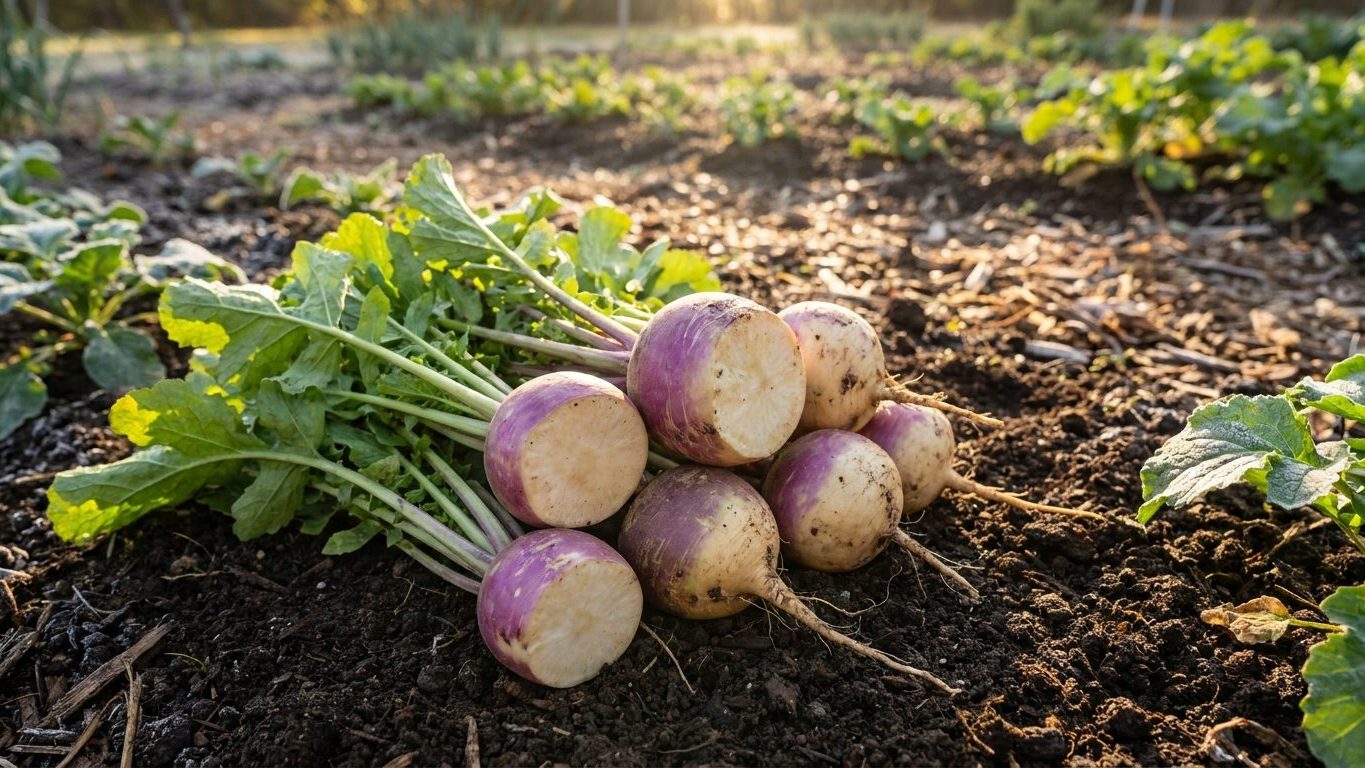

In most of Alberta, Turnips and Rutabaga go into the ground once the soil has warmed past the risk of a hard freeze, roughly the third week of May around Calgary, and come out in fall before the ground locks up for winter. The province sits in Canadian hardiness zone 4a at the reference station, a short, cool window that rewards early sowing and rutabaga’s tolerance for frost more than any other single factor.
When the soil is warm enough in Alberta
The date most gardeners want is simple enough: the average last spring frost at Calgary Int’l A runs to May 21, per Environment and Climate Change Canada’s 1981-2010 Climate Normals. That’s the number worth writing on the seed packet, but it needs a caveat attached every time it’s used: it is a mean, not a promise. In one year out of two, frost at that station actually lands later than May 21. Treat it as the midpoint of a window, not a green light.
Frost dates matter less for Turnips and Rutabaga than for tender crops like tomatoes, because both roots tolerate a light frost just fine. What actually holds up sowing is soil temperature, and soil warms on its own schedule, usually a week or two after the air stops dropping below freezing at night. A gardener working clay soil in central Alberta will feel that lag directly: the ground stays cold and wet under a spring sky that already looks like summer. Waiting for soil that crumbles rather than clumps, and that feels merely cool rather than cold to the wrist, is a better test than any calendar date.
Because Calgary Int’l A is one station and Alberta is not one climate, districts north of Edmonton or up in foothill country run their own version of this date, often later. Anyone gardening outside the Calgary area should treat May 21 as a general reference point and confirm timing against local conditions, not as a fixed rule for the whole province.
Once soil is workable, turnips and rutabaga both go in directly as seed; neither transplants well, since disturbing the taproot early tends to produce forked or split roots later. Direct sowing into loosened, stone-free soil, then thinning seedlings once they’re a few inches tall, gives straighter, more even roots than any attempt to start them indoors and move them.
One thing worth setting straight before the season gets going: turnips and rutabaga are brassicas, in the same family as cabbage, kale, and mustard. That means they share the same soil-borne diseases and the same pest pressure, from root maggot to clubroot. Planting them into a bed that grew cabbage or kale the year before isn’t rotation, it’s the same risk under a different name. The rotation page covers how to space brassica plantings across a multi-year cycle so the same soil-borne problems don’t build up bed after bed.
Later in the season, once roots are lifted, the same family logic applies to storage: never judge a root safe just because the outside looks clean. A soft patch, a weeping spot, or a mouldy crown means that root goes into the compost, not the root cellar, whatever the rest of the batch looks like.
How long the season lasts here
Subtract May 21 from September 16, the average first fall frost at the same Calgary Int’l A station, and Alberta’s frost-free window comes out to roughly 118 days. Both figures are ECCC 1981-2010 averages for the same reference station, so the subtraction is fair, but the same caution applies to both ends: in half of all years, one or both dates will shift, usually toward a longer real-world frost-free stretch, occasionally toward a shorter one.
It’s also worth flagging that these Canadian normals cover 1981-2010, while the US frost-date figures used elsewhere on this site cover 1991-2020, a different 30-year baseline. Any side-by-side comparison with a US territory page is comparing two different measurement periods, not just two different places.
118 days is not a long season by the standards used elsewhere on this site, but it is enough to grow turnips and rutabaga properly, since neither crop needs anywhere near that long to mature from seed to harvestable root. What it changes is whether a second sowing makes sense. In a longer window, a gardener could sow turnips in spring for an early summer harvest, then sow a second round in mid-summer for a fall crop timed to sweeten after frost. In Alberta’s shorter window, that math gets tight: a spring-sown turnip crop and a full rutabaga crop timed for fall harvest can both fit, but stacking three sowings the way a gardener in a milder territory might risks the second round running out of season before it finishes.
Rutabaga in particular wants the long end of the window, since it generally needs more time from seed than turnip does, and gardeners in Alberta are better served treating it as a single planting timed for a fall harvest than trying to fit in a second round afterward. Turnip, being quicker, tolerates a second sowing more comfortably, especially one aimed at a fall crop that develops its best flavor once temperatures start dropping.
That timing question, how many sowings fit and when to place each one against the two frost dates, is exactly what the succession sowing guide works through in more detail, with the same logic applied across different season lengths.
Transplanting doesn’t change this math much, since both roots resent it, but in a season this short, some gardeners look at raising early starts under cover to gain a week or two at the front end. That gain has to be weighed against the root check that comes with early transplants: any seedling whose taproot gets bent or broken in the tray tends to fork or split once it’s in the ground, which in a short season leaves no time to resow and still finish before fall frost.
Heat and water in Alberta
This site tracks two summer figures for most territories: days above 90°F and summer rainfall. Neither is part of the verified record for Alberta at the reference station used for this page, so this page won’t guess at them. What’s worth saying plainly is that Calgary’s growing season simply doesn’t produce many 90°F days to begin with, and turnips and rutabaga are cool-season crops that don’t need them. A cool, damp Alberta summer is far more likely to bring mildew and slow, drawn-out ripening than heat stress, and that’s the risk to watch for rather than scorch or bolting.
The two figures that actually govern this crop in Alberta are cold ones, and both come straight from the verified record. The coldest month here averages a daily minimum of 8.2°F, per ECCC’s 1981-2010 normals for the Calgary reference station. That number decides whether roots can stay in the ground under a thick mulch through part of the winter, or whether they need to be lifted and moved into storage before the ground locks up hard. At 8.2°F, Alberta’s winter is cold enough that leaving a full crop in the ground and hoping for the best isn’t a realistic storage strategy; lifting before a hard, sustained freeze is the safer plan for most of the harvest.
What the hardiness zone number actually means here
The other cold fact worth knowing is the hardiness zone itself: 4a, in the Canadian system, for the reference city named in these facts. That’s worth flagging clearly because it is not a USDA zone and doesn’t convert to one on a simple scale. Natural Resources Canada builds its zones from seven climate variables rather than the one the USDA system uses, and a Canadian zone 4a can overlap anywhere from USDA zone 3a to zone 7a depending on which variable is driving the number in a given location. Anyone comparing Alberta to a US territory on this site should read that zone number as a description of Alberta’s own conditions, not a stand-in for an American zone map.
For turnip and rutabaga specifically, the practical upshot of these two cold facts is that frost is welcome rather than feared here. Both roots convert starches to sugars once temperatures drop, and a light frost before harvest generally improves flavor rather than damaging the crop. The window for that sweetening in Alberta is real but not endless: once the ground itself starts to freeze, the harvest opportunity closes regardless of how well the roots have sweetened up to that point.
Which turnips and rutabaga suit Alberta
None of this points to a specific variety, and that’s deliberate. The right choice for an Alberta garden is a matter of type, not brand name, and the varieties actually trialled for this climate are listed by Alberta’s own agriculture service, not by a general gardening site written for a continent’s worth of climates. Alberta’s Ministry of Agriculture and Irrigation publishes that guidance directly, and it’s the right first stop before buying seed.
That said, the territory’s own facts point toward some sensible criteria. With a season running about 118 days between average frosts, the earliest-maturing turnip types have an edge, since they leave the widest margin for a slow spring or an early fall frost to eat into the timeline without threatening the harvest. Rutabaga, needing more time, is better suited to a single, well-timed fall planting than to squeezing in extra rounds.
Because summer here tends toward cool and damp rather than hot and dry, disease resistance, particularly against the mildews and rots that thrive in damp foliage, matters more in Alberta than heat tolerance ever will. That’s a different priority than a gardener in a hot, humid US state faces, and it’s worth asking about directly when checking variety trial results, rather than assuming a variety that performs well in a warm climate will behave the same way here.
The winter cold that defines this territory, down to an average coldest-month minimum of 8.2°F, also shapes the harvest decision more than the variety choice does. Whatever type gets planted, the safer plan is lifting the crop before a hard, sustained freeze locks the ground, rather than counting on mulch alone to carry roots through an Alberta winter outdoors.
Storage afterward comes down to inspection, not variety and not appearance at first glance. Any root going into storage should be checked over, and any one showing a soft patch, a weeping spot, or a mouldy crown should be pulled from the batch rather than kept on the chance it still looks fine on the outside.
Because turnip and rutabaga are brassicas, whatever variety gets chosen still needs to sit somewhere in a rotation that keeps it away from ground that grew cabbage, kale, or mustard the year before; the rotation page lays out how to plan that across a multi-year bed cycle. For the seed itself, Alberta Agriculture and Irrigation is the service to check.