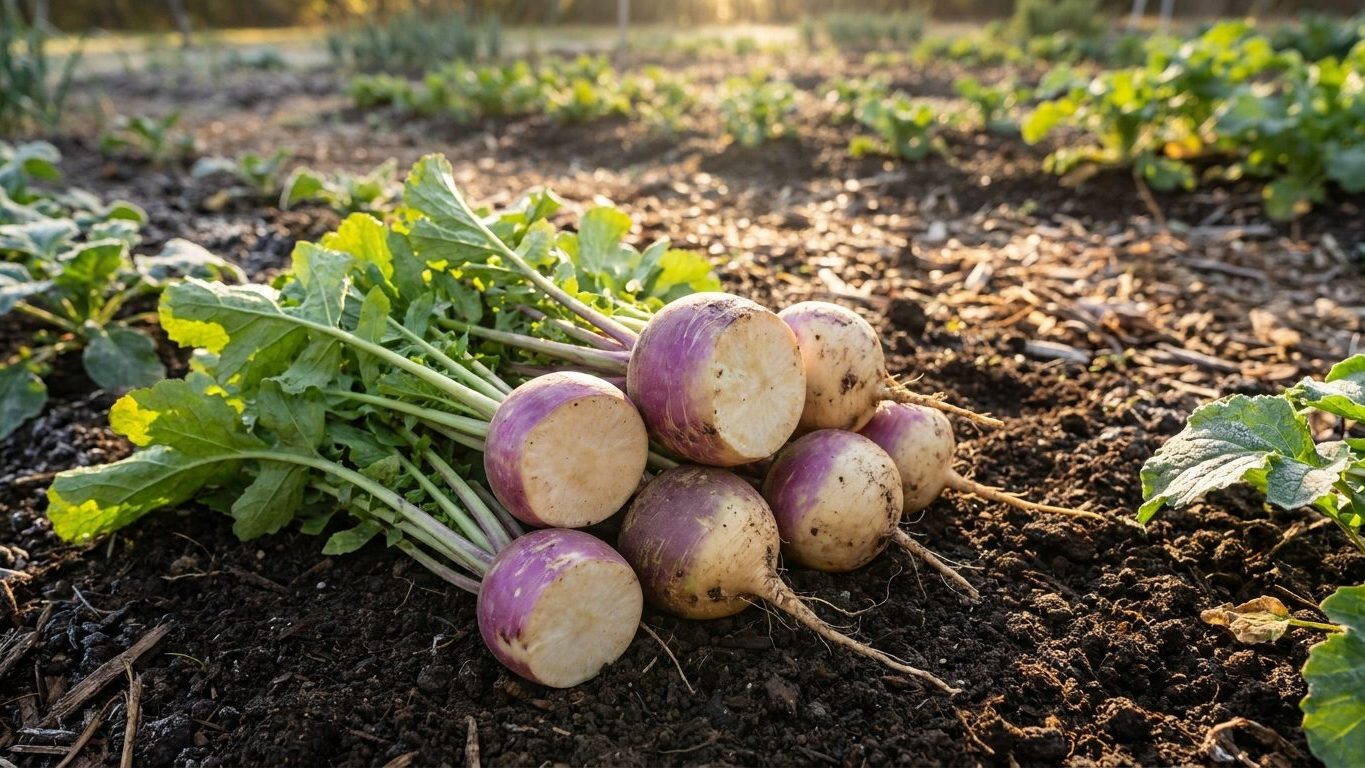

Connecticut’s growing window works against turnips and rutabaga less than gardeners assume: this is a cool-season crop built for the very cold snaps that end the tomato harvest. Sow turnip in mid-to-late summer for a fall crop, timed backward from the first frost; rutabaga goes in earlier because it needs the full season to bulk up its root before the ground hardens.
When the soil is warm enough in Connecticut
The last spring frost at Bridgeport (station USW00094702) falls between April 2 and April 12, based on NOAA’s 1991-2020 Climate Normals for the 30-70% freeze-probability band. That’s a coastal reading, and it’s the mildest one in the state. Inland and northwest Connecticut freeze noticeably later in spring and earlier in fall, so a gardener in Litchfield County working from a Bridgeport date alone is planting on borrowed time.
A frost date is a probability, not a promise. Half the years in the record miss it in one direction or the other, so treat April 2 to April 12 as a signal to start watching the soil, not a calendar appointment. Turnips and rutabaga don’t actually care about air temperature at 3 a.m.; they care about soil temperature at seed depth, and soil lags behind air by days to weeks depending on how wet and shaded the bed is. A raised bed with dark mulch pulled back on a sunny afternoon warms faster than a low, wet spot in the same yard, frost date be damned.
For a spring root crop, direct-seed once the soil can be worked and isn’t waterlogged, understanding that a late cold snap after the risk window closes can still nip young seedlings without killing the stand outright. Most Connecticut gardeners skip the spring gamble for rutabaga altogether and use that early window instead for turnip greens or a quick baby-turnip crop, saving the real planting for the fall run described in the next section.
Whichever window is used, resist the urge to reach for a named variety from a seed rack that promises quick results here; the types that actually perform on Connecticut soils vary by county, and the UConn Extension service keeps that trial data current in a way this page can’t. Ask them which types are being grown successfully near you before buying seed.
One more thing worth saying plainly: turnips and rutabaga are brassicas, in the same family as cabbage, kale, and mustard. Any bed that grew one of those crops in the past two or three seasons carries the same soil-borne pressures, so treat the planting site with the same rotation discipline described on the brassica rotation guide. Planting turnips where cabbage grew last year isn’t rotation, it’s the same problem in a different disguise.
How long the season lasts here
Put the two frost dates together and the frost-free window in Connecticut runs from roughly 199 to 222 days depending on which end of each range actually verifies in a given year, since both the spring date (April 2 to April 12) and the fall date (October 28 to November 10) come from the same Bridgeport normals. Call it somewhere around seven months in an average year, coastal side. Inland gardens should shave time off both ends.
That’s a genuinely long window for a root crop that typically needs a fraction of it to mature. The practical upshot: a Connecticut gardener isn’t limited to one turnip sowing. A window this size allows an early planting for baby roots or greens, a gap, and a second, larger sowing timed to finish just as the fall frost work begins, when turnips actually get sweeter rather than damaged. The details of staggering that second sowing so it doesn’t collide with the first crop’s harvest, or with rutabaga’s longer requirement, are covered on the succession sowing guide.
Rutabaga changes the math because it needs most of that window in one continuous run rather than splitting it. Where a short season elsewhere might force a transplanting shortcut to save time, Connecticut’s roughly seven-month window makes direct seeding the more reliable choice for rutabaga, since the crop has room to finish without corners cut. Transplanting a taprooted crop always risks a forked or stunted root if the check happens at the wrong stage, and a long season removes the pressure that makes gardeners take that risk in the first place.
The practical takeaway is that Connecticut’s season length isn’t the limiting factor for either crop. What actually decides the outcome, as the next section covers, is what happens to the crop once it’s sitting in the ground through the cold end of that window rather than the warm start of it.
Heat and water in Connecticut
Summer heat isn’t the story for turnips and rutabaga here, and that’s worth saying directly rather than reaching for numbers that don’t apply to a fall crop. Both roots are planted to mature into autumn on purpose, so the two figures that actually decide how the crop performs are cold ones: the coldest month’s average minimum, and the hardiness zone that minimum sits inside.
At Bridgeport, the coldest month averages a daily minimum of 24.4°F, per NOAA’s 1991-2020 Climate Normals. That single number decides two practical questions at once. First, whether roots left in the ground under a heavy mulch layer can survive the winter for a later harvest, or whether they need to be lifted and moved to storage before the ground locks up hard. Second, how much frost-sweetening the crop gets before that happens, since turnips and rutabaga convert starches to sugars in response to cold exposure right up until the ground freezes solid.
Connecticut sits across USDA Hardiness Zone 6a-7b on the 2023 map, a range built from one variable: the average annual extreme minimum temperature. That’s a statewide spread, not a single number for every yard, and the reference point above is Bridgeport specifically, the mildest corner of the state. A garden in the northwest hills or the Litchfield uplands runs colder than that reading suggests, which means mulching heavier, lifting roots earlier, and not counting on the ground staying workable as late in the season as a coastal garden would.
Where a warmer, drier territory would need a paragraph about bolt risk and irrigation timing, that’s the wrong conversation for Connecticut. The real risk in a cool, damp New England fall is the opposite one: slow-drying foliage that stays wet longer after rain, which favors mildew and other foliar disease rather than heat stress. Good spacing for airflow between plants matters more here than shade cloth ever would.
Whatever roots come out of the ground, the storage decision comes down to inspection, not guesswork. A root that looks sound on the outside can still be compromised; check for a soft patch, a weeping spot, or a moldy crown, and set that root aside rather than storing it. Looking fine is not the same as being fine, and one bad root in a storage bin can spread the problem to its neighbors.
Which turnips and rutabaga suit Connecticut
None of this points toward a single best variety, and that’s the honest answer rather than a dodge. A roughly seven-month frost-free window on the coast, shorter inland, a cold winter minimum in the mid-20s, and a humid fall that favors foliar disease over heat stress: those three facts together point toward a type of turnip and rutabaga, not a brand name on a seed packet.
A shorter effective season, which is what inland Connecticut gardens actually have compared to the Bridgeport reading, favors earlier-maturing turnip types over long-season ones, since there’s less margin for a slow finisher to catch up before hard frost. A humid growing region, which coastal New England is for most of the fall, makes disease resistance the first thing to check on a seed label rather than an afterthought, given how readily brassica foliage holds moisture through a cool, wet October. And because this is fundamentally a cold-climate crop here, types bred or selected for good storage character after cold exposure make more sense than types selected for heat tolerance, which simply isn’t the pressure Connecticut puts on the crop.
Naming an actual variety on this page would be a guess dressed up as advice. The turnip and rutabaga types that perform well in a UConn trial plot in Storrs may not be the same ones that do best in a home garden on the Sound, and neither this page nor any general guide has that county-level data. The UConn Extension service does, and asking them which types have performed well locally this season is a better use of five minutes than trusting a seed catalog’s national marketing copy.
Whatever type gets chosen, remember it’s still a brassica sharing pest and disease pressure with any cabbage, kale, or mustard grown nearby. Keep it out of a bed that grew those crops recently, and check the rotation guide before deciding where this year’s planting goes.