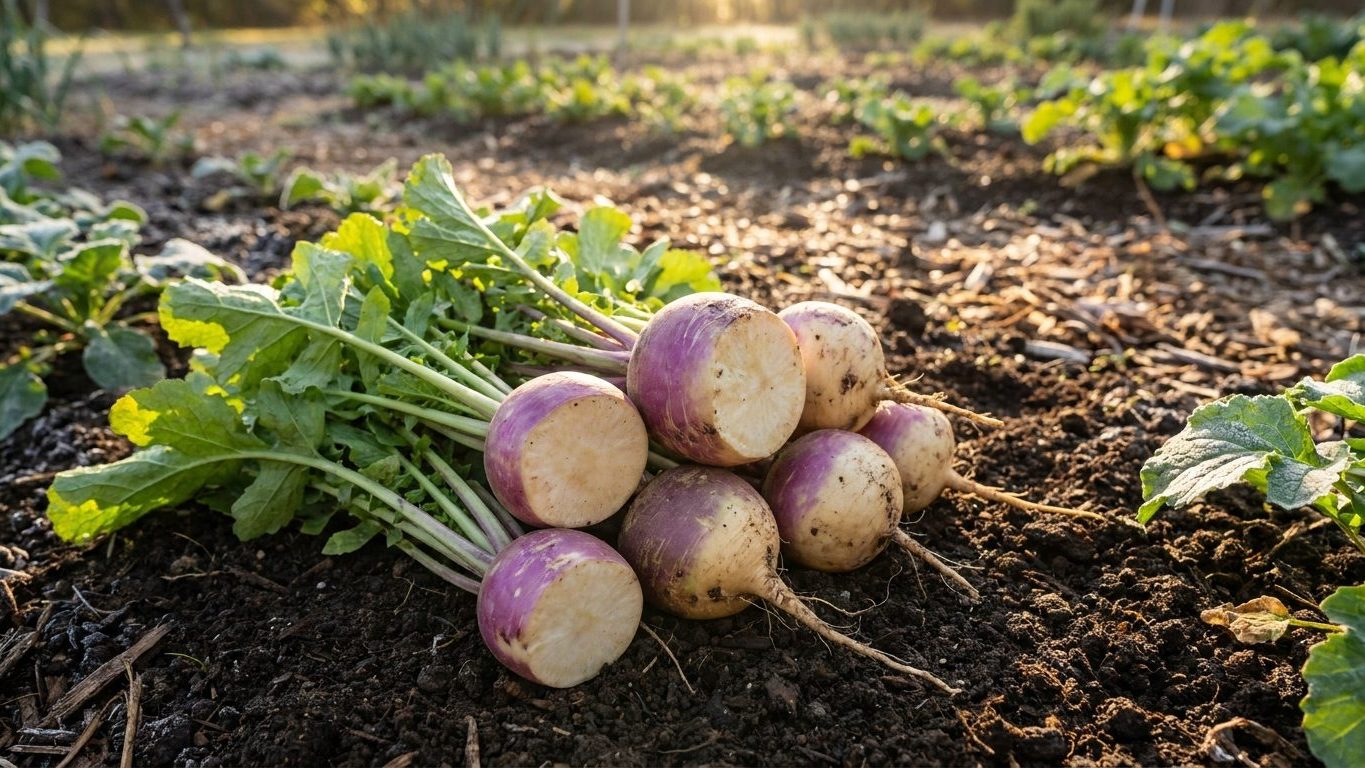

Turnips and Rutabaga in Arkansas are best treated as a fall crop, not a spring one. The state’s mild autumns let roots size up in cool weather and sweeten after a few light frosts, while its warm, often humid spring pushes a spring-sown crop toward bolting and disease before it ever fills out. Timing the fall sowing correctly matters more here than chasing an early spring start.
When the soil is warm enough in Arkansas

The date question sounds simple, but it hides two different clocks. For central Arkansas, NOAA’s 1991-2020 Climate Normals put the last spring 32F freeze, at the 30-70% probability band, somewhere between March 12 and March 28, based on station USW00013963. That’s a real number from a real weather station, and it’s worth naming exactly like that rather than rounding it to “mid-March,” because the range itself is the honest answer: some years the freeze risk clears earlier, some years later.
What that date does not tell you is when the soil is ready. Frost dates track air temperature at a set height above the ground; soil temperature lags behind, sometimes by two or three weeks, especially in a clay-heavy bed that holds cold longer than it holds heat. Turnip and rutabaga seed will germinate in cool soil, colder than most tender vegetables need, which is part of why these roots tolerate an earlier start than tomatoes or peppers. But “earlier” is relative. Treat the frost window as a probability, not a promise, and check the soil itself, crumbly, no longer cold to the touch at a few inches down, before committing seed to the ground.
There’s a second, tighter figure worth knowing if you’re tempted to set out any tender transplants alongside your roots. The National Weather Service office in Little Rock gives a light-frost (36F) window of April 3 to October 31, which is narrower than the 32F dates above. Turnips and rutabaga don’t need that tighter window since they shrug off light frost, but anything tender in the same bed does.
Both crops are brassicas, in the same family as cabbage, kale and mustard, and they carry the same pest and disease pressure: root maggot, flea beetle, clubroot, and the fungal leaf spots that build up wherever brassicas grow in the same soil year after year. A gardener who follows turnips with kale, or plants them into last year’s cabbage bed, hasn’t rotated anything. Space brassica plantings on a real rotation, and lean on cultural practices, row cover for flea beetle, wide spacing for airflow, rather than reaching for a pesticide by name.
How long the season lasts here
Arkansas doesn’t lack for growing time. NOAA’s 1991-2020 Normals put the first fall 32F freeze, at the same 30-70% probability band and the same station, between November 7 and November 20. Paired with the last spring freeze of March 12 to March 28, that stretches the frost-free window somewhere between roughly 224 days, in the tighter case, and 253 days in the more generous one. Either figure is well over seven months, closer to eight and a half in a good year.
That length changes what’s worth attempting. A short window, the kind you’d see farther north, forces a single sowing and makes every week of it count. Arkansas’s window is long enough to support a spring sowing for an early summer harvest, a deliberate gap through the hottest weeks, and a second, larger fall sowing timed to mature as the nights cool. Most gardeners here get more out of the fall planting: the roots size up in shortening days and mild temperatures instead of racing against midsummer heat, and the flavor is better for it, since a few frosts convert starches to sugars in the root.
Whether transplanting makes sense also depends on this calendar. With this much season, direct-seeding twice, spring and fall, usually beats fussing with root-crop transplants, since turnip and rutabaga roots resent disturbance and a transplanted root is more likely to fork or stall. If you want the specifics of spacing out a spring sowing, a summer gap, and a fall sowing so they don’t all mature at once, the succession sowing guide on this site walks through the timing in more detail than a single territory page can.
Heat and water in Arkansas

This page doesn’t have a verified count of days above 90F or a summer rainfall total for Arkansas, and rather than guess at numbers, it’s more useful to say plainly why those figures matter less here than they would for a summer crop. Turnips and rutabaga, grown for a fall harvest, spend their real growing weeks after the worst of the state’s heat has broken. The facts that actually govern this crop in Arkansas are cold ones, and there are two of them.
The first is the coldest month’s mean daily minimum, 30.9F at the Little Rock reference station, drawn from NOAA’s 1991-2020 Climate Normals. That’s not a record low and not a monthly average; it’s the typical overnight low across the coldest stretch of winter, and it’s the figure that decides whether roots left in the ground under a mulch layer will make it through, or whether they need to be lifted and moved into storage before the ground locks up hard. At just under 31F on average, most winters in central Arkansas allow roots to stay put under a few inches of straw or leaf mulch, though a harder cold snap can still catch a bed that’s been left unprotected.
The second figure is the USDA hardiness zone, 6b-8a across the state, built on the average annual extreme minimum temperature. That’s a territory-wide range, not one number, and it matters here because Arkansas stretches from the cooler Ozark highlands to the warmer Delta lowlands. A gardener in the northern part of the state is working closer to zone 6b conditions; someone farther south or east is closer to 8a. For a dated planting decision, it’s worth checking your specific county against the current USDA Plant Hardiness Zone Map rather than assuming the state-wide range applies evenly.
Where a summer is cool and unusually damp, the bigger risk isn’t heat at all, it’s mildew and slow ripening on any brassica planting held too late into the wet season. Arkansas summers run warm and often humid, which is exactly the setup that favors fungal leaf disease if a spring-sown crop lingers past its window. That’s one more reason the fall sowing, timed to grow through drier, cooler weeks, tends to do better here than pushing a spring planting deep into summer.
Which turnips and rutabaga suit Arkansas
Arkansas’s long frost-free window and mild fall favor the same conclusion for both crops: choose by type, not by a specific cultivar name, and let your local trial data make the final call. A gardener working with a shorter season elsewhere might lean hardest on the earliest-maturing types just to beat the first freeze. Arkansas’s roughly 224-to-253-day window removes that pressure. There’s room here for early types sown for a spring harvest and for later, larger-rooted types sown for fall storage, since the season is long enough to accommodate both without a rush.
Heat and humidity shift the priority toward airflow and disease resistance rather than speed. Wide spacing that lets air move around the root shoulders reduces the rot and mildew pressure that builds in Arkansas’s warm, humid stretches, and any type bred with resistance to common brassica leaf diseases is worth favoring over one bred purely for size or earliness. This is also where the rotation point comes back around: turnips and rutabaga are brassicas, sharing susceptibility to clubroot, flea beetle and leaf spot with cabbage, kale and mustard, so whatever type you choose, plant it where no brassica has grown in at least the past two seasons.
This page won’t name a cultivar, and that’s a deliberate choice rather than an omission. Variety trials run by the state’s own extension service reflect what actually performs against Arkansas’s soils, humidity and disease pressure, in a way a generic list never can. The University of Arkansas System Division of Agriculture Cooperative Extension Service publishes current variety recommendations and planting guides suited to specific counties across the state, and that’s the source worth checking before buying seed.
Storage deserves the same caution as variety choice. No matter how well a root has grown, don’t judge its keeping quality by looks alone. Before storing any harvested turnip or rutabaga, check for a soft patch, a weeping cut or bruise, or a moldy crown, and set aside anything showing those signs rather than storing it with sound roots. A root that looks fine on the outside can still be failing underneath, and that’s not a risk worth taking with food headed for a root cellar or a refrigerator crisper drawer.