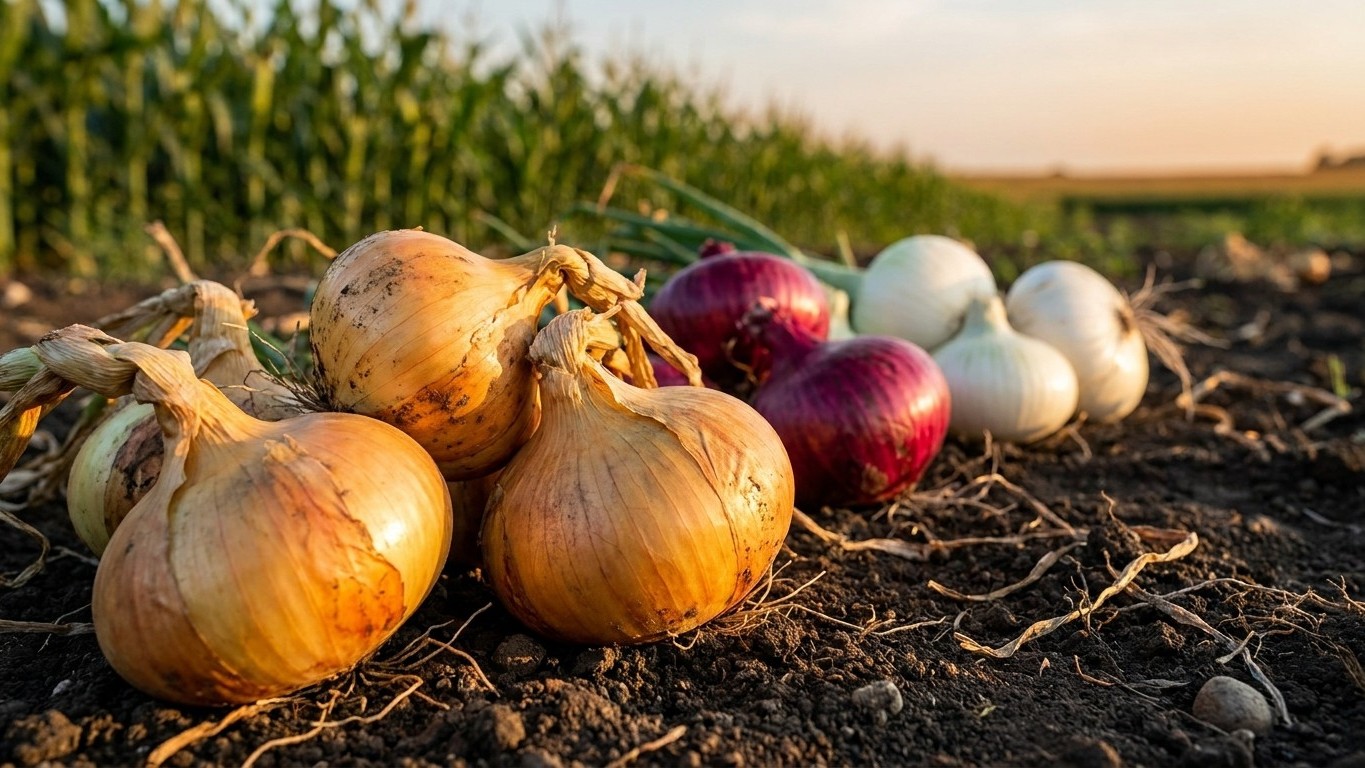

NDSU Extension publishes fact sheets on six insects common enough across North Dakota to warrant tracking: apple maggot, boxelder bug, Colorado potato beetle, corn earworm, emerald ash borer, and yellowheaded spruce sawfly. None of them feeds on an onion bulb or leaf. That’s the honest answer for anyone standing in a garden row worried about chewed onion tops this season. The real trouble for North Dakota onions tends to come from day length mismatches and storage failures, not from insects on the state’s public pest list. Here’s how to sort what you’re actually seeing.
Which pests attack onion in North Dakota
NDSU Extension’s public pest catalog for the state names six species with dedicated fact sheets: apple maggot, boxelder bug, Colorado potato beetle, corn earworm, emerald ash borer, and yellowheaded spruce sawfly. Every one of them has a job, and none of those jobs involves an onion.
Why each one is off the table
Apple maggot lays its eggs inside the flesh of apples, crabapples, and hawthorn fruit. Its larvae need a fleshy fruit to tunnel through as they develop, and an onion bulb doesn’t offer that. It’s built from layered leaf bases, not fruit tissue, so the maggot has nothing to work with there.
Boxelder bug feeds mainly on the seeds of boxelder maple and ash trees, and shows up on the sunny side of houses each fall looking for a place to overwinter. It occasionally pierces soft, ripe fruit for the sugar, but has no reason to touch a bulb crop growing at ground level.
Colorado potato beetle specializes in the nightshade family: potato, tomato, eggplant, and their wild relatives. Its larvae are built to handle the specific alkaloids those plants carry. Onion belongs to the allium family instead, and its defense chemistry runs on volatile sulfur compounds rather than nightshade alkaloids, the same compounds behind the sting in a fresh-cut onion and the reason pungent varieties outlast sweet ones in storage. That chemistry seems to make onion foliage unappealing to a beetle wired for potato leaves.
Corn earworm needs an ear of corn, or another fruiting structure like a tomato, to bore into once it hatches. Onion doesn’t grow fruit or an ear; it grows hollow, tubular leaves and a bulb underground, so the moth’s egg-laying instincts have nowhere to land.
Emerald ash borer and yellowheaded spruce sawfly are both tied to a single kind of tree, ash for the borer and spruce for the sawfly. Their larvae feed on bark tissue or needles. Neither has any biological connection to a vegetable bed.
Sorted this way, the list of NDSU-documented pests with an actual appetite for onion comes to zero. That’s not the same as saying onion in North Dakota gardens is pest-free; it means the state’s flagship, publicly tracked species all specialize elsewhere. Before treating anything in an onion row for one of these six, confirm which plant is actually damaged, because a wandering potato beetle or a boxelder bug resting on a nearby onion leaf isn’t evidence of feeding.
When each one shows up, and what it does first
Onion in North Dakota runs on its own clock, and that clock is set by daylight, not by any insect’s schedule. Onion doesn’t decide to stop growing leaves and start building a bulb because of a date on the calendar; it responds to how many hours of light hit the leaves each day. Short-day varieties trigger bulbing at around 12 hours of daylight, and long-day varieties wait until they see something between 14 and 16 hours before they’ll fatten up at all.
The bulbing clock that actually matters
At the latitude of Fargo, 46.93 degrees north, the longest day of the year delivers 15 hours and 41 minutes of daylight. That’s enough to satisfy even a long-day variety’s threshold, which is why northern gardens like North Dakota’s are built around long-day types. Plant a short-day variety here instead, and it will hit its 12-hour trigger almost as soon as the days lengthen past early spring, forming a small bulb well before the plant has grown enough leaf mass to feed it. What a gardener sees first isn’t a pest at all: it’s tops flopping over early and bulbs that stall out undersized.
The six species NDSU tracks statewide follow their own calendars, and those calendars mostly miss the onion patch entirely. Colorado potato beetle adults emerge from the soil once the ground warms and head straight for potato and tomato foliage; if one is spotted crossing into a nearby onion row, it’s passing through, not feeding. Corn earworm moths fly in during the height of summer to lay eggs on corn silk, timed to when ears are forming, and have no reason to linger on onion leaves that never produce anything resembling silk or fruit. Boxelder bugs appear in numbers in early fall, well after most onion bulbs are already curing on a porch or in a shed, and their presence has nothing to do with the crop.
What a North Dakota onion grower should actually watch for on a calendar is the bulbing switch itself: leaf growth for the first several weeks after transplanting, then a shift toward bulb swelling as the days lengthen toward the solstice. Anything that interrupts that shift, tops dying back too soon, bulbs splitting, growth stalling, deserves a closer look before it gets blamed on a chewing insect.
Telling the damage apart from everything else
A gardener who spots trouble in the onion row usually assumes an insect first, because a bite mark feels like the most obvious explanation. In North Dakota, several of the most common onion problems have nothing to do with chewing insects at all, and the difference usually shows up in the pattern of the damage rather than in any single symptom.
Symptom, cause, and what settles it
| What you see | Likely cause | What distinguishes it |
|---|---|---|
| Bulbs form small and early, tops flop over ahead of schedule | Day-length mismatch, often a short-day variety planted too far north | Happens across the whole bed at once, no holes or larvae, timing tracks the solstice rather than any single week |
| Bulbs turn soft or sprout early in winter storage | A sweet, low-sulfur variety that was never built to store | No tunnel marks or feeding scars, smell is fermented rather than damp and rotten, and it hits the whole batch evenly |
| Leaves wilt despite regular watering, papery streaks appear | Fungal or bacterial disease | Spreads plant to plant over days rather than appearing all at once, and needs lab confirmation rather than a visual guess |
| Leaf tips shredded or torn raggedly | Wind, hail, or cultivation damage | Damage concentrated on one side of the plant, appears right after a storm or a pass with a hoe |
| Holes in leaves with no insect in sight | A nighttime feeder rather than any of the daytime species listed above | Check after dark with a flashlight, look for slime trails or droppings near the base |
None of this replaces an actual look at the plant in front of you. A soft bulb that failed in storage points to variety, not to pest damage, and that one distinction saves a lot of wasted worry about insects that were never involved. When the cause still isn’t obvious after checking these patterns, a local extension office can look at an actual sample instead of guessing from a description.
What actually works here, and what is a waste of time
Because none of NDSU’s six documented species specializes in onion, the most effective move in a North Dakota garden has nothing to do with treating for any of them. It has to do with matching variety to latitude before the first seed goes in the ground.
What’s worth doing
Choosing a long-day variety, since the region’s summer solstice delivers up to 15 hours and 41 minutes of daylight, sidesteps the early-bulbing problem entirely and removes the single biggest source of disappointing bulbs in northern gardens. Rotating onion away from other alliums, garlic, leeks, shallots, in the same bed year after year keeps generic soil-borne problems from building up, and it costs nothing but a little planning. Clearing old plant debris out of the bed at the end of the season removes hiding spots for the nighttime feeders that do occasionally show up, without needing to identify them by name first.
What isn’t
Treating an onion bed for any of the six species NDSU documents statewide wastes both time and money. Spraying near a vegetable garden for emerald ash borer or yellowheaded spruce sawfly does nothing for onion, since both insects stay on their host trees regardless of what’s growing nearby. Treating for Colorado potato beetle in an onion row because one was spotted crossing through wastes a trip on an insect that was never going to feed there. Even watching the calendar for corn earworm moths near onion misses the point, since the moth’s egg-laying instinct is tied to corn silk and fruiting vegetables, not to onion leaves.
Where to check this for your own county
Everything above comes from what NDSU Extension documents at the state level, and a state-level list can’t say what’s actually crawling around a specific garden in Cass County versus one in Williams County. North Dakota spans a wide range of growing conditions, from the Red River Valley in the east to the drier plains in the west, and pest presence shifts with that terrain the same way it shifts with soil and rainfall.
Start with your county office
The way to get an answer specific to one garden is to go through NDSU Extension itself, starting with the county office nearest that garden rather than relying on the general state fact sheets. County agents deal with what’s actually turning up in local gardens that particular season, which changes year to year in ways a fixed published list never will. Bring more than a description if possible: a photo of the actual damage, a sample of an affected leaf or bulb sealed in a bag, and a note on when the problem was first noticed all give an agent something concrete to work from.
Call or email the county extension office with a photo before treating anything, especially before spending money on a product aimed at an insect that may not even be present in that particular garden. The state’s documented pest list is a starting point for understanding what’s out there generally, not a diagnosis for one specific row of onions this season.