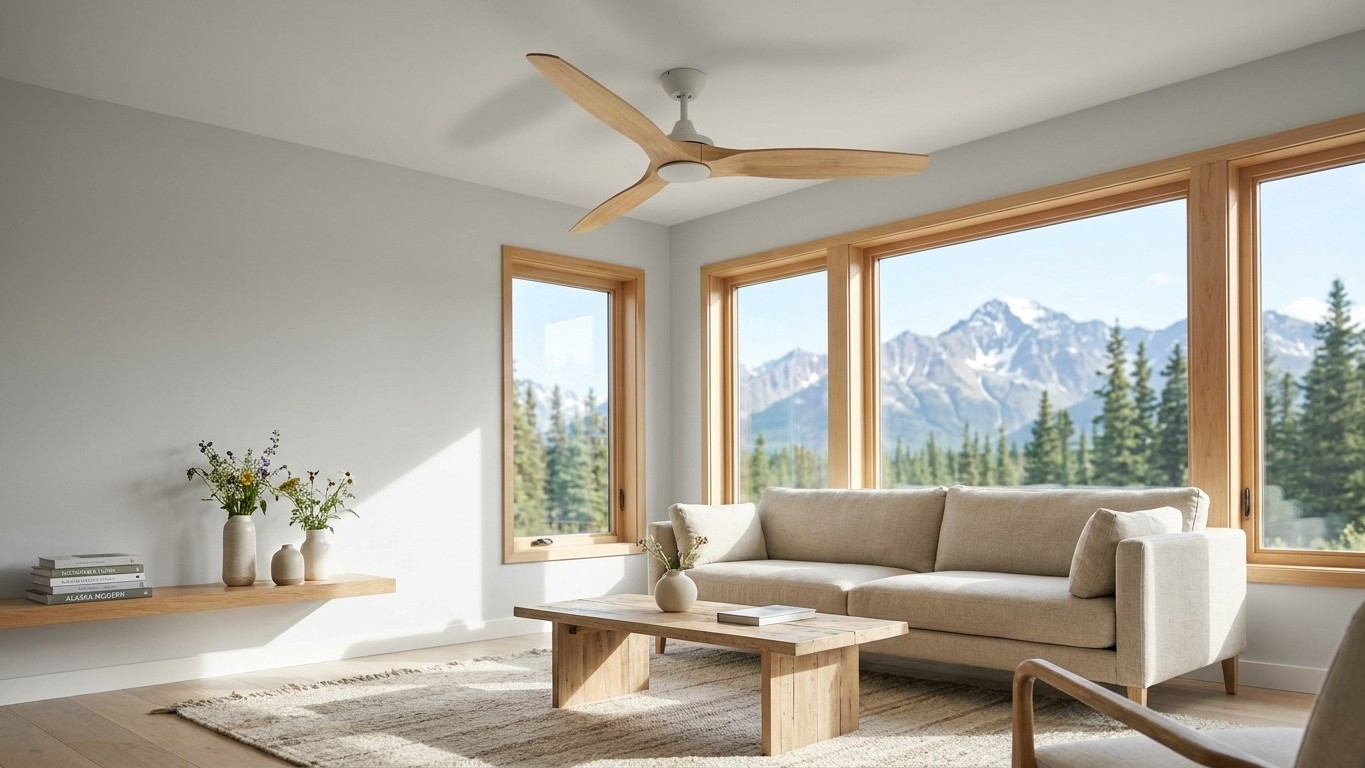

In Washington, just over half of homes run some form of air conditioning: 53% of households have cooling equipment of some kind, 30% rely on a central system, and 25% use an individual unit such as a ductless mini-split, a window or wall unit, or a portable. Ceiling fans show up in 44% of homes, often doing quiet work on the mildest days.
What homes in Washington actually cool with
Those three numbers from the U.S. Energy Information Administration’s Residential Energy Consumption Survey tell a story that isn’t obvious at first glance. 53% of homes in Washington use air-conditioning equipment of some kind, but only 30% of homes run a central system. The rest, 25% of homes, cool with an individual unit: a mini-split, a window box, a portable rolled in for August, or something bolted into a wall.
That gap between “has air conditioning” and “has a central unit” is the whole point. It’s the share of the state running on equipment that plugs into an outlet rather than into ductwork. In some states that gap is enormous; in others central systems dominate almost completely. Washington falls closer to the individual-equipment end than a lot of people assume. With 30% central and 25% individual, the two categories are nearly the same size. That split usually reflects how a state’s housing stock got built. Homes with forced-air heating already had the ductwork in place when central cooling became affordable, so adding AC was a simple add-on. Homes built or renovated without ducts, or that added cooling later as a retrofit, tend to land on a mini-split or a window unit instead, since running new ductwork through finished walls and ceilings is expensive and disruptive.
None of this is a recommendation about what a homeowner should install. A share like 53% or 30% describes what’s already there, which followed what was affordable and practical when a house was built or upgraded, not what performs best. A newer highly insulated home with a mini-split can outperform an old central system running through leaky ducts, and the reverse is just as true. The ceiling fan figure, 44%, is worth noting too: fans don’t cool air, they move it, but in a state where heat load runs low much of the year, a fan paired with an open window covers a surprising number of days without any compressor running at all.
How much cooling the year actually asks for
NOAA’s climate normals for the Seattle reference station put the mean number of days a year reaching 90°F or higher at 3.0. That’s a count of days at one weather station over the 1991-2020 period, not a statewide average and not a measure of how hot a typical summer afternoon feels. It answers a narrower question: how often does the thermometer cross a threshold that starts stressing a house, a garden, and a person’s patience.
Three days a year is a low number, especially against states in the Southeast or the desert Southwest, where 90-degree days run into the double or triple digits. That’s the useful context for reading the equipment numbers above.
Here’s the interesting part. A heat load of 3 days a year is mild by any national standard, yet 53% of homes in the state still run air conditioning, and nearly half of that cooling comes from individual units rather than central systems. If equipment always tracked heat load neatly, a state with this few 90-degree days might be expected to have far less AC installed overall, or to lean almost entirely on fans. It doesn’t work that way here, because what gets installed follows the age and design of the housing stock as much as it follows the climate. A lot of Washington’s air conditioning looks like it arrived as an add-on: a mini-split mounted on a wall, a window unit for a bedroom that gets afternoon sun, equipment chosen because a central retrofit wasn’t worth the expense for a handful of genuinely hot days a year.
A very low heat load doesn’t mean cooling isn’t installed, it means the cooling that is installed gets used sparingly, and the choice between individual and central equipment gets made more on cost and convenience than on how brutal the summer is expected to be.
Wet heat or dry heat, and what it changes
Summer here is dry. NOAA’s monthly normals for the same reference station put June, July, and August combined at about 3.0 inches of rain, against 39.3 inches for the full year. July is the driest month of the twelve, averaging just 0.6 inches. June comes in at 1.45 inches and August at 0.97. Those are precipitation totals, nothing more; they say nothing directly about relative humidity or dew point, and they shouldn’t be read as either.
What the rainfall figure does tell you, combined with basic knowledge of how an air conditioner works, is where the machine’s effort goes. Every air conditioner does two jobs at once: it lowers air temperature, and it pulls moisture out of the air as that air passes over a cold coil. Removing moisture takes run time, because water has to condense out gradually rather than all at once. In a genuinely humid summer, a large share of a unit’s operating hours goes toward wringing water out of the air, which is part of why oversized units perform so badly in humid climates: they cool the room fast, shut off, and never run long enough to do the drying part of the job, leaving a space that reads cold on a thermostat but feels clammy to skin.
A dry summer changes that balance. With less moisture in the air to begin with, an air conditioner’s job leans almost entirely toward lowering temperature, and the dehumidifying side of its work matters less. That doesn’t make sizing unimportant, it changes what a homeowner should prioritize.
- Size for temperature control first. In a low-humidity summer, matching the unit to the room’s cooling load matters more than leaving margin for moisture removal.
- Don’t chase a bigger unit “for humidity.” With rainfall this low across summer, there’s less airborne moisture to remove in the first place, so oversizing buys nothing but short cycling and higher energy use.
- Let the fan run on the setting that suits comfort rather than moisture control, since drying the air isn’t the dominant job here the way it is in a humid state.
Sizing a room unit, from the published chart
For anyone shopping for a window unit, a portable, or sizing one room of a mini-split system, ENERGY STAR publishes a straightforward starting chart matching room area to cooling capacity.
| Area to be cooled (square feet) | Capacity needed (BTU per hour) |
|---|---|
| 100 up to 150 | 5,000 |
| 150 up to 250 | 6,000 |
| 250 up to 300 | 7,000 |
| 300 up to 350 | 8,000 |
| 350 up to 400 | 9,000 |
| 400 up to 450 | 10,000 |
| 450 up to 550 | 12,000 |
| 550 up to 700 | 14,000 |
| 700 up to 1,000 | 18,000 |
| 1,000 up to 1,200 | 21,000 |
| 1,200 up to 1,400 | 23,000 |
That’s the full chart as ENERGY STAR publishes it, and it stops at 1,400 square feet; it isn’t meant to be converted into a flat rate per square foot, since the relationship between room size and required capacity isn’t linear. This is a starting point for a single room unit, not a substitute for a proper load calculation on a whole-house central system, which accounts for insulation, window area, orientation, and duct layout in ways a simple area chart never will.
That distinction matters more here than in a state where central systems run nearly everything. With 25% of Washington homes cooling on an individual unit, this chart is the practical tool a lot of them will actually reach for when replacing a window unit or adding a mini-split head to a bedroom. An oversized unit is a fault, not a safety margin: it cools the room quickly, cycles off, and never runs long enough to do the slower work of pulling moisture out of the air, leaving the space cold in spots and stale everywhere else.
What actually needs looking after here
Maintenance in Washington splits along the same line as the equipment mix: 30% of homes are keeping ducts sealed and a central system tuned, 25% are keeping a mini-split or window unit clean, and a fair number of households are doing both. ENERGY STAR’s guidance covers each piece.
On filters, the instruction is unambiguous: “Inspect, clean, or change air filters once a month in your central air conditioner, furnace, and/or heat pump.” That’s monthly, not seasonally, and it applies across all three systems together, which matters for anyone who assumes filter care is only a furnace chore. A dirty filter doesn’t just choke airflow, it drags down efficiency across the board: ENERGY STAR notes that “airflow problems can reduce your system’s efficiency by up to 15 percent,” a real cost from a part that takes minutes to check.
For the 30% of households running a central system, there’s a second maintenance item that doesn’t apply at all to the 25% on individual units, since a window unit or mini-split has no ductwork to leak. ENERGY STAR states plainly: “In a typical house, however, about 20 to 30 percent of the air that moves through the duct system is lost due to leaks, holes, and poorly connected ducts.” That’s air a central system paid to cool, lost before it ever reaches a vent, which is one reason a central-cooled Washington home can run constantly and still feel uneven room to room.
- Check or change filters monthly across central AC, furnace, and heat pump, per ENERGY STAR’s schedule, before the season’s first real warm stretch.
- If the home runs central air, have ducts inspected for leaks and poor connections, especially in an attic or crawlspace, where losses run 20 to 30 percent by ENERGY STAR’s own figure.
- If the home runs an individual unit, clean or replace that unit’s filter on the same monthly schedule and confirm the unit is sized to the room using the ENERGY STAR chart above, not oversized “for margin.”
- Before summer’s brief 90-degree stretches arrive, test the system once under real load rather than waiting for the first hot week to find a problem.
For equipment-specific detail beyond this seasonal pass, this site’s guides on central systems, heat pumps, and ductless mini-splits go deeper into each one.