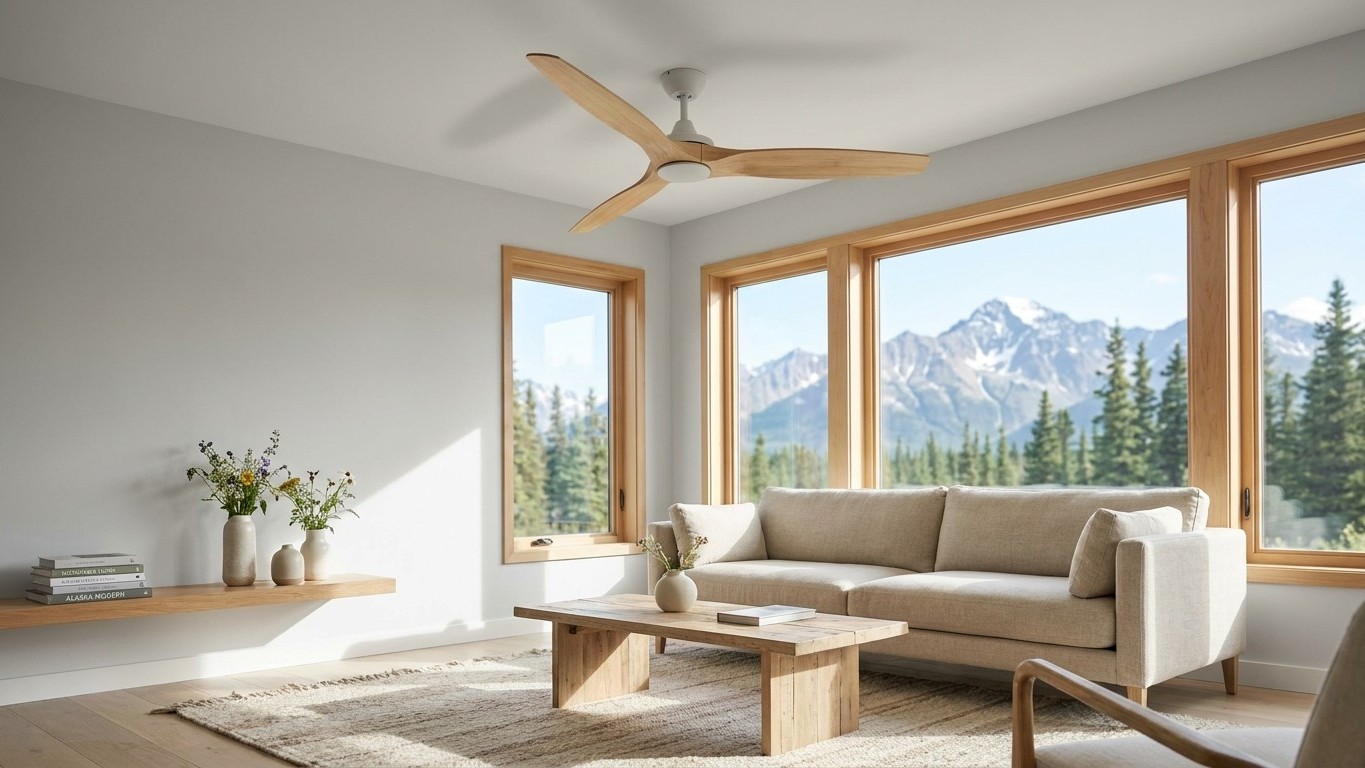

North Dakota homes cool mostly with central air, but the state still leans harder on window units and mini-splits than you’d guess from a place known more for its winters than its summers. Ceiling fans get almost as much use as the compressors do.
What homes in North Dakota actually cool with
Start with the plain numbers from the U.S. Energy Information Administration’s Residential Energy Consumption Survey: 93% of North Dakota homes use some form of air-conditioning equipment. Of those, 58% run a central air-conditioning unit, the kind tied into ductwork and a thermostat on the wall. Separately, the survey finds 37% of homes use an individual air-conditioning unit, meaning a ductless mini-split, a window or wall unit, or a portable machine wheeled into a bedroom for July. Ceiling fans show up in 62% of homes, doing quiet work alongside whatever’s actually cooling the air.
The interesting part is the space between “has air conditioning” and “has a central unit.” In North Dakota that gap is real but not huge, since central systems already cover well over half the housing stock. Compare that to a state like Connecticut, where 90% of homes have air conditioning but only 34% run central, meaning most of the state’s cooling comes from individual units stacked in older housing that was never built for ductwork. North Dakota isn’t that story. Its 58% central figure sits closer to a state like Alabama, where 94% of homes have air conditioning and 81% run central, a housing stock built or retrofitted with ducts already in place.
None of this is a recommendation, it’s a record of what got installed and when. A share this high on central air generally tracks with newer construction or homes that already had forced-air heating and picked up cooling as an add-on to the same ductwork. The individual-unit share, at 37%, is the folks in older farmhouses, apartments without ducts, or additions and outbuildings where running a duct line never made financial sense. Read the 58% central figure as the baseline for what a North Dakota home is likely to have, then treat the other 37% as the households where window units and mini-splits are doing real work, not just supplementing what’s already there.
Nothing here is marked “Q,” so none of these figures are suppressed for small sample size. That’s worth flagging only because it’s not always true state to state, and a missing number in this survey means the data wasn’t there to publish, not that the equipment doesn’t exist.
How much cooling the year actually asks for
The heat load number for North Dakota comes from NOAA’s Climate Normals at the Fargo reference station: 11.7 days a year reaching 90°F or higher. That’s a count of days at one weather station over the 1991-2020 normals period, not a statewide average and not a measure of how hot the average summer day feels. It’s the number that tells you how often a cooling system actually gets pushed to its limit, as opposed to just running on a mild setting through a string of 78-degree afternoons.
Here’s where it gets useful. Equipment mix and heat load don’t always line up, and when they don’t, it tells you something about how a state’s housing stock got built rather than how hot its summers actually run. A state with a short, mild cooling season can still be almost entirely on central air if its houses were built in a boom that included ductwork as standard. Conversely, a hot state can lean heavily on individual units if its housing predates the assumption that air conditioning was a given.
North Dakota mostly matches. 11.7 days above 90°F is a modest heat load, on the lower end for a U.S. state, and the equipment mix reflects a state where central air, at 58%, is common but not dominant, alongside a real 37% share still on individual units. That’s roughly what you’d expect from a place where summers are short and the heat load doesn’t force every household toward a full central retrofit. There’s no real mismatch here between how hot it gets and what people installed. The cooling season is brief enough that a lot of households get by on a window unit in the bedroom and a ceiling fan everywhere else, which the 62% fan-use figure backs up.
What this number doesn’t tell you is anything about humidity, wind, or how the heat feels walking outside. It’s a count of days crossing a threshold at a single station, useful mainly as a proxy for how hard a cooling system gets worked over a typical year.
Wet heat or dry heat, and what it changes
Summer rainfall at the same reference station runs about 10.0 inches across June, July and August, out of 23.9 inches for the year. June is the wettest of the three months at 4.29 inches, July follows at 3.07, and August is the driest at 2.6 inches. That’s precipitation, measured in inches falling from the sky, not a humidity reading and not a dew point. It says how often the ground gets wet, not how heavy the air feels.
Still, rainfall matters to how a cooling system spends its time, because an air conditioner does two separate jobs at once: it drops the temperature and it pulls moisture out of the air. Removing moisture takes run time, more of it than just cooling air that’s already dry. In a summer where rain is light and infrequent, most of a machine’s work is temperature, plain and simple. In a wetter, more humid stretch, a much bigger share of that run time goes toward drying the air, which is exactly why an oversized unit becomes a real problem in humid climates: it blasts the room cold, shuts off before it’s pulled any real moisture out, and leaves things feeling damp even though the thermostat reads comfortable.
North Dakota’s summer rainfall, at roughly 10 inches over three months, sits on the moderate-to-dry side rather than the soaked, humid pattern you’d see farther south or east. That doesn’t mean zero humidity concern, since a wet June at 4.29 inches is a real month of rain, but it does mean the cooling job here leans more toward temperature than moisture removal compared to a Gulf Coast or Mid-Atlantic summer.
Given that pattern, here’s what to prioritize:
- Size equipment to the room rather than rounding up, since North Dakota’s summers don’t demand the extra drying capacity a bigger unit provides.
- Keep the fan setting on “auto” rather than “on” during the drier months, so the system has a chance to remove what moisture is there rather than recirculating it.
- Watch the wetter stretch in June and early July more closely, when a slightly longer run time actually earns its keep.
Sizing a room unit, from the published chart
For anyone shopping for a window unit, a portable, or a single mini-split head, ENERGY STAR publishes a straightforward starting chart matching room area to cooling capacity:
| Area to be cooled (square feet) | Capacity needed (BTU per hour) |
|---|---|
| 100 up to 150 | 5,000 |
| 150 up to 250 | 6,000 |
| 250 up to 300 | 7,000 |
| 300 up to 350 | 8,000 |
| 350 up to 400 | 9,000 |
| 400 up to 450 | 10,000 |
| 450 up to 550 | 12,000 |
| 550 up to 700 | 14,000 |
| 700 up to 1,000 | 18,000 |
| 1,000 up to 1,200 | 21,000 |
| 1,200 up to 1,400 | 23,000 |
This is a starting point published by ENERGY STAR for a single room unit, not a formula you can stretch further or shrink into a per-square-foot rate. The jumps between tiers aren’t even, which is the tell that this isn’t linear math, it’s a real-world chart built around how room units actually perform. It also doesn’t size a central system. A central air conditioner gets sized through a proper load calculation that accounts for the whole house, insulation, windows, and ductwork, not a room-by-room lookup.
That distinction matters more in a state like North Dakota, where 58% of homes already run central air. For that majority, this chart is close to irrelevant, since their cooling decisions were made (or should be made) through a whole-house calculation, not a tabletop lookup. Where this chart earns its keep is with the 37% of North Dakota households on individual units, the window-unit and mini-split crowd choosing equipment room by room. For them, an oversized unit isn’t a safety margin, it’s a fault: it cools the room fast, shuts off, and never runs long enough to actually dry the air, leaving a room that reads cold on the thermostat but still feels clammy.
What actually needs looking after here
Maintenance here splits along the same line as the equipment mix. With 58% of North Dakota homes on central air and a real 37% on individual units, both camps need attention, but not the same attention.
ENERGY STAR’s filter guidance applies to nearly everyone with a central system: “Inspect, clean, or change air filters once a month in your central air conditioner, furnace, and/or heat pump.” That’s a monthly check, not a seasonal one, and it covers all three pieces of equipment together, which matters for anyone who assumed filter care was a furnace-only chore. Skipping it has a real cost: ENERGY STAR notes that “airflow problems can reduce your system’s efficiency by up to 15 percent,” which is the kind of loss a homeowner never sees on a gauge, just on a bill that’s higher than it should be for a unit running perfectly otherwise.
For the majority of North Dakota’s central-air households, there’s a second issue worth checking, one that has nothing to do with the unit itself. ENERGY STAR points out that “in a typical house, however, about 20 to 30 percent of the air that moves through the duct system is lost due to leaks, holes, and poorly connected ducts.” That’s air conditioned at real cost, then lost into an attic or crawlspace before it ever reaches a vent. It’s why a room that never quite cools down isn’t always a broken compressor, sometimes it’s a duct problem upstream of the register.
None of this applies to the state’s window-unit and mini-split households, since a room unit has no ducts to leak. For that 37%, the filter and airflow points still stand, just applied to a smaller machine instead of a whole-house system.
A practical seasonal pass looks like this:
- Check or change filters monthly through the cooling season, for central systems and individual units alike.
- Have ductwork inspected for leaks if the house runs central air, since a fifth to nearly a third of conditioned air can be lost before it reaches a room.
- Confirm outdoor units and window units have clear airflow around intake and exhaust before the first hot stretch hits.
- Check this site’s equipment-specific guides for central systems, mini-splits, and window units for the deeper maintenance steps beyond the seasonal basics.