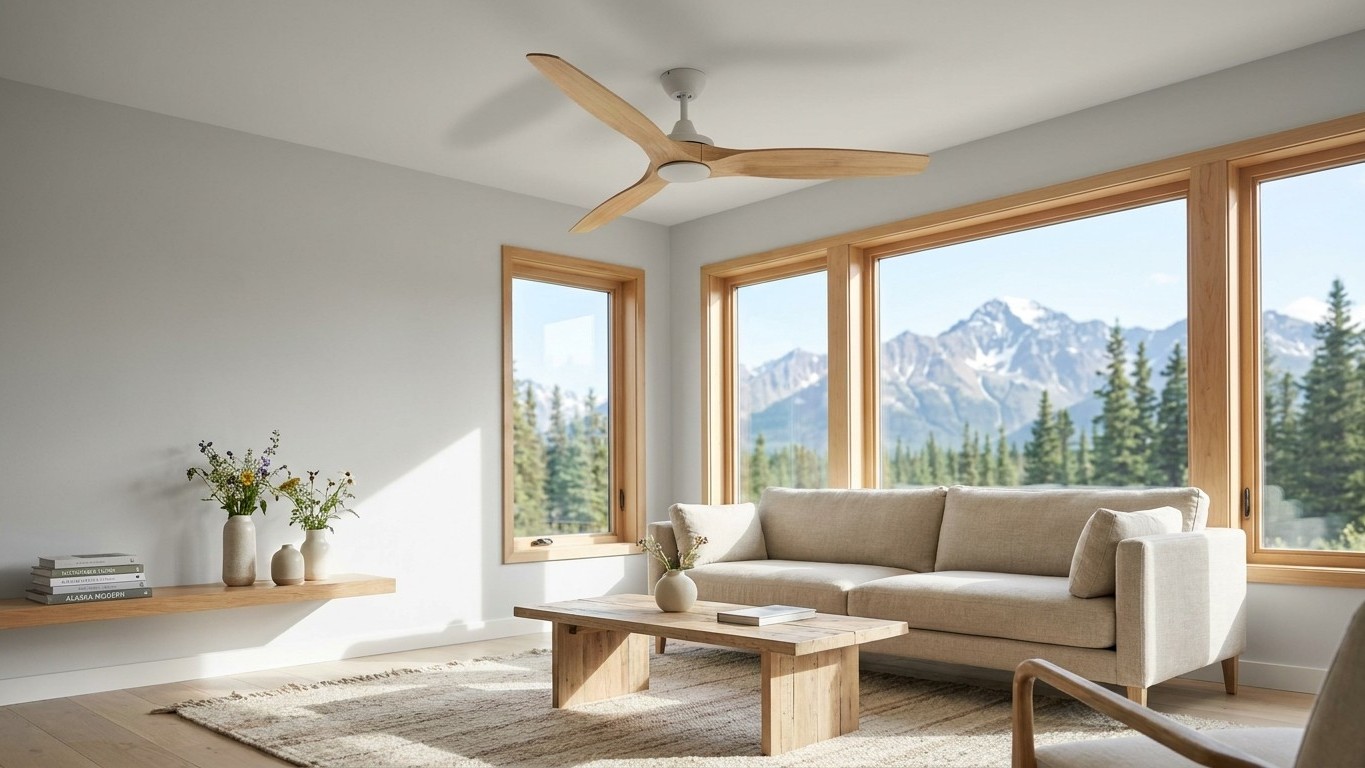

Air conditioning barely registers in Alaska. Just 7% of homes run any kind of cooling equipment at all, and almost every one of those is an individual unit rather than a central system. Ceiling fans, at 46% of homes, do far more of the state’s summer comfort work than anything plugged into a compressor.
What homes in Alaska actually cool with
The numbers from the U.S. Energy Information Administration’s 2020 Residential Energy Consumption Survey are stark. Only 7% of Alaska homes use air-conditioning equipment of any kind. Of that small slice, 6% run an individual unit, meaning a ductless mini-split, a window or wall unit, or a portable. The share running a central air-conditioning unit is not published; the sample was too small for the survey to report a reliable figure. That doesn’t mean zero, only that whatever exists is a rounding error next to the 6% on individual equipment.
That near-total overlap between “has air conditioning” and “has an individual unit” is itself the story. Whatever cooling exists here leans overwhelmingly toward small, standalone equipment that a homeowner can install without touching ductwork.
Ceiling fans tell the other half of the story. At 46% of homes, they outnumber air-conditioning households by more than six to one. That ratio reflects what actually gets built into Alaska housing stock: fans are cheap, need no refrigerant line, and handle the handful of genuinely warm days most of the state sees in a given summer. Air conditioning, by contrast, wasn’t something builders had much reason to wire in when the housing stock went up, and retrofitting a house for central cooling here is a bigger project than most owners have ever needed to take on.
None of this is a verdict on comfort. It’s a record of what got installed when it got installed, shaped by a climate that rarely demands mechanical cooling in the first place. A share like 7% describes the housing stock, not a recommendation for what any individual home needs today.
How much cooling the year actually asks for
NOAA’s Climate Normals for the Anchorage reference station put the mean number of days a year reaching 90°F or higher at 0.0. That’s a count of days at one station over the 1991-2020 normal period, not a statewide average and not a summer temperature reading. It says how often the air genuinely pushes into hot territory, and at this station the answer is essentially never.
This is one of the cases where the equipment mix and the heat load actually line up. A near-zero count of 90-degree days sits next to a 7% air-conditioning rate, and both point the same direction: there’s little heat load to design around, and little equipment installed to meet it.
That consistency matters for anyone deciding whether to add cooling to an Alaska home. The case for installing any air conditioning at all rests less on days above 90°F and more on other factors: a room that traps heat from west-facing windows, appliances that run hot, or a stretch of unusually warm weather that doesn’t show up in a 30-year normal. The state’s cooling equipment, where it exists, tends to be small individual units addressing a specific room or a specific problem, not a whole-house system built to fight a summer that reliably comes in around or below the 90-degree mark, year after year, for three decades running.
It’s worth being precise about what a normal like this can’t tell you. A 1991-2020 average smooths out any single unusually hot week a given year might bring, and a reference station in one location doesn’t speak for a lodge in the Interior or a home along the Panhandle’s coast. The 0.0 figure describes the norm at the measured station, not a guarantee for every corner of the state.
Wet heat or dry heat, and what it changes
Summer in Alaska, measured at the same reference station, brings about 5.8 inches of rain across June, July and August, against 16.4 inches for the full year. June is the driest of the three months at 1.02 inches, rising to 1.82 in July and 2.93 in August. That’s a measure of precipitation, not humidity. A rain gauge tells you how much water fell from the sky; it says nothing about how much moisture is hanging in the air on any given afternoon.
What that rainfall pattern does tell you, alongside the near-absence of 90-degree days, is that summer here rarely puts a cooling system’s dehumidifying job to the test. An air conditioner does two jobs at once: it drops the temperature, and it pulls moisture out of the air as warm, humid air passes over its cold coil. Removing that moisture takes run time, not just cold air, which is why a machine sized too big for the room can drop the temperature fast, shut off, and leave the space feeling cold and clammy rather than dry and comfortable.
Alaska’s summer rainfall numbers don’t describe that kind of muggy climate on their own, and cross-referenced with the state’s near-zero count of hot days, there’s little reason to expect long, humid stretches that would demand serious dehumidification from a cooling unit. Still, a rain gauge on a specific piece of ground is what actually settles the question for any one house. Coastal exposure, a low spot that holds moisture, or a wooded lot near the Panhandle can behave differently than a 30-year normal at a single reference station suggests.
Given that, priorities for anyone running a unit here look different than they would in a genuinely wet, hot climate:
- Size for the room’s temperature swing rather than for humidity control, since drying capacity matters less here than in muggier climates.
- Skip the aggressive fan-speed settings meant to maximize moisture removal; a moderate fan setting suits a climate where cooling, not drying, is the main job.
- Resist the instinct to oversize “just in case.” A unit that’s too large still cycles on and off too quickly to do steady work, whatever the climate.
Sizing a room unit, from the published chart
For anyone buying an individual unit, which is effectively the only kind of air conditioning found in Alaska homes, ENERGY STAR publishes a straightforward starting chart matching room area to cooling capacity.
| Area to be cooled (square feet) | Capacity needed (BTU per hour) |
|---|---|
| 100 up to 150 | 5,000 |
| 150 up to 250 | 6,000 |
| 250 up to 300 | 7,000 |
| 300 up to 350 | 8,000 |
| 350 up to 400 | 9,000 |
| 400 up to 450 | 10,000 |
| 450 up to 550 | 12,000 |
| 550 up to 700 | 14,000 |
| 700 up to 1,000 | 18,000 |
| 1,000 up to 1,200 | 21,000 |
| 1,200 up to 1,400 | 23,000 |
This chart is a starting point for a single room unit, not a formula that scales past its last line and not a per-square-foot conversion. Doubling the square footage doesn’t double the BTU requirement; the relationship isn’t linear, which is exactly why ENERGY STAR publishes fixed steps instead of a rate. It also doesn’t size a central system, which is handled through a proper load calculation accounting for insulation, window orientation, and duct layout.
That distinction matters more in Alaska than almost anywhere else, since the state’s air-conditioning rate of 7% is made up almost entirely of individual units rather than central systems. This chart is squarely the tool most Alaska households would reach for, because central AC design questions simply don’t come up for the overwhelming majority of homes here.
An oversized unit is a real fault in this table, not a safety margin. Buying one step up “to be sure” produces a unit that blasts the room cold, shuts off, and never runs long enough to manage moisture properly, leaving the room cold in spots and stale in others rather than evenly comfortable.
What actually needs looking after here
With individual units carrying nearly all of Alaska’s cooling load, maintenance here centers on the equipment itself rather than a duct system most homes don’t have. ENERGY STAR is direct about the single biggest lever: “Inspect, clean, or change air filters once a month in your central air conditioner, furnace, and/or heat pump.” That’s a monthly habit, not a seasonal one, and it applies across the board, whether the equipment in question is a furnace, a heat pump, or the central AC that a small handful of Alaska homes run.
The payoff for that habit is bigger than it looks. ENERGY STAR notes that “airflow problems can reduce your system’s efficiency by up to 15 percent,” which means a unit can be running, cooling the room, and still working significantly harder than it should because of a dirty filter or blocked vent. That’s the case for checking filters even on the individual units that make up most of Alaska’s cooling equipment, since a clogged filter drags down a window unit or mini-split just as it does a central system.
Duct leakage is a different matter, and it belongs up front here rather than tucked at the end: ENERGY STAR’s finding that “in a typical house, however, about 20 to 30 percent of the air that moves through the duct system is lost due to leaks, holes, and poorly connected ducts” only applies to homes with ductwork in the first place. A home running a window unit or a ductless mini-split, which describes nearly all of Alaska’s air-conditioned households, has no ducts feeding that cooling equipment at all. This caution matters more for the state’s heating systems, which are far more likely to run on ducted furnaces, than for the state’s cooling equipment.
A reasonable seasonal check for an Alaska home looks like this:
- Check and clean or replace filters on any air conditioner, furnace, or heat pump monthly, per ENERGY STAR’s schedule.
- Confirm vents and returns on any individual unit aren’t blocked by furniture or curtains, since restricted airflow can quietly cost up to 15% in efficiency.
- If the home does run a central system, have ductwork checked for leaks and poor connections rather than assuming the unit itself is at fault when performance drops.
- For details specific to each piece of equipment, from mini-splits to furnaces, check this site’s individual heating and cooling equipment guides rather than relying on a one-size-fits-all checklist.