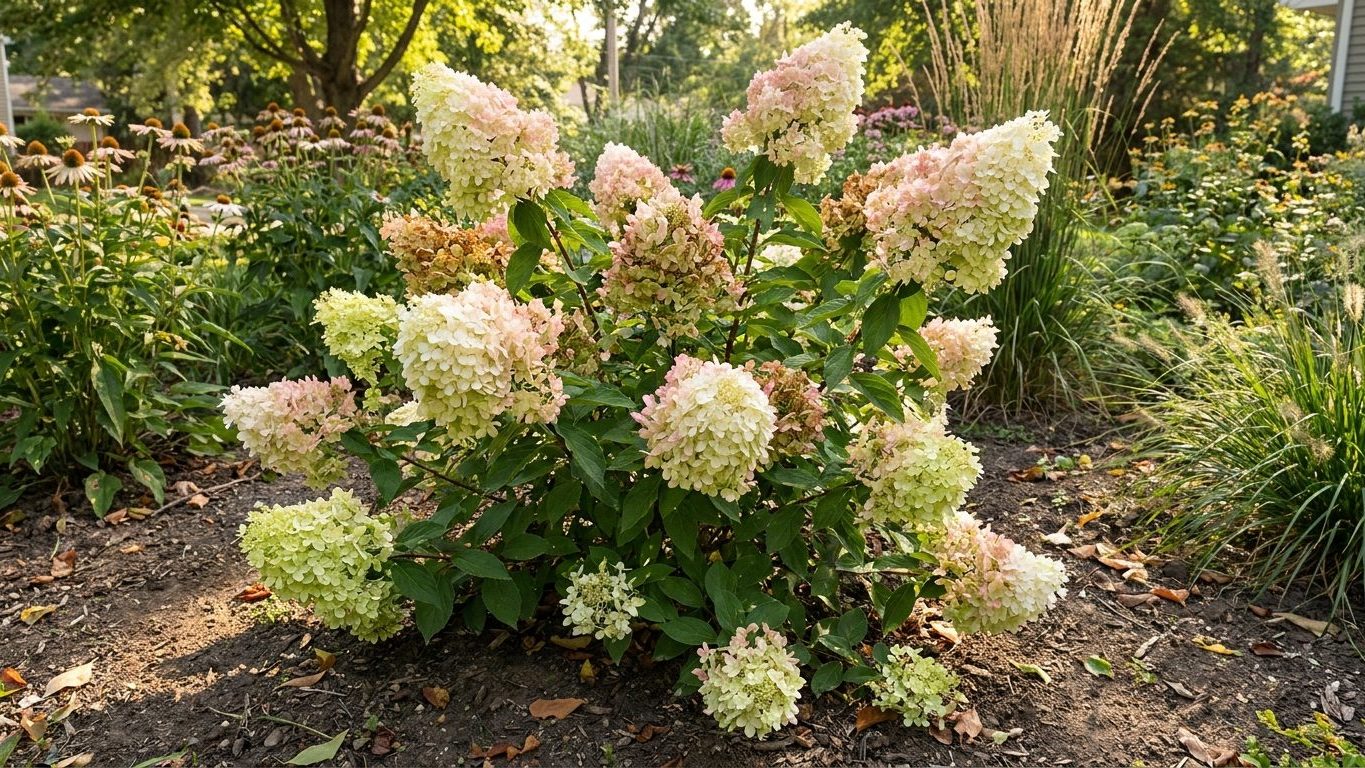

Little Lime is a dwarf panicle hydrangea (Hydrangea paniculata), hardy from USDA zone 3a to 8b, a range that covers nearly every U.S. garden except the coldest interior mountains and the hottest coastal pockets of the Deep South. It flowers on the current season’s growth, so it can be cut back hard each winter and still bloom by midsummer. The color runs lime green to white cream, aging to pink and tan, and none of that shifts with soil pH the way it does on bigleaf hydrangeas.
What Little Lime actually is
Little Lime is a scaled-down selection of the panicle hydrangea Limelight, and its hardiness spans USDA zones 3a through 8b according to the North Carolina Extension Gardener Plant Toolbox. The panicle group is the only hydrangea type that takes full sun well, and it’s also the type most gardeners in cold-winter states reach for when a bigleaf hydrangea won’t survive the winter at all.
The source describes Little Lime only as a dwarf version of Limelight, without publishing an exact mature height. What it does specify is the bloom mechanism: flowers form on the current season’s growth, not on wood laid down the previous year. That’s the opposite of a bigleaf hydrangea, whose flower buds are set the summer before and can be wiped out by a late frost or an ill-timed prune. Little Lime has no such vulnerability, because whatever growth it pushes out in spring carries the flowers that same summer.
The panicle-shaped blooms open a soft lime green, then fade toward white and cream as the season progresses, before aging further into pink and tan tones by fall. Nothing about that sequence depends on soil chemistry; it’s simply the bloom aging on its own clock, which matters because plenty of gardeners spend a season trying to “fix” a color that was never going to change.
What Little Lime is good for

Panicle hydrangeas are the group NC State Extension calls the best substitute for a mop-head hydrangea in places where mop-heads won’t reliably survive winter, and Little Lime inherits that role at a smaller scale. Because it flowers on new wood every year, it doesn’t ask a gardener to protect anything through winter the way old-wood bloomers do. That mechanism is why panicle types succeed as far north as zone 3a while bigleaf hydrangeas stop being reliable around zone 6a.
The dwarf habit is the second reason it earns a spot in the yard. A standard panicle hydrangea can reach 8 to 25 feet, which rules it out for foundation plantings, tight side yards, or anywhere near a walkway. Little Lime was bred to fit smaller footprints while keeping the same full-sun tolerance and bloom mechanism as its larger relatives, which is why it works in mixed borders and low hedges rather than as a standalone specimen.
It also has a practical case for cut flowers, though not for the reason people usually cut hydrangeas. Because the blooms shift color across the season, a single planting gives green, cream, and blush-pink material at different points in summer and fall without needing a second cultivar. Beyond the color progression, the source doesn’t document a specific cut-flower recommendation for Little Lime.
Where it falls short is in exactly the situations bigleaf hydrangeas cover: deep shade, and the classic blue-flower look that depends on soil acidity. Little Lime does neither.
Where it ripens in time, and where it is a gamble
Vegetables have a days-to-maturity number stamped on the seed packet. Hydrangeas don’t, and the North Carolina Extension source doesn’t publish a bloom-day count for Little Lime. What it does publish is the zone range, and for a current-season bloomer, that range carries similar information: it tells you whether a typical summer gives the plant enough warmth to push out new growth and finish flowering before the season turns.
Zone 3a sits at the cold edge, where the ground freezes deep and winter kills the top growth back to the crown. That’s not a survival problem, because the plant is expected to regrow entirely from live wood at ground level each spring. The practical question is whether the regrowth has time to mature and bloom before fall. The compact, dwarf habit helps here: less structure to rebuild each year means less lag before flowering starts.
The comfortable middle of the range covers most of the country a typical reader gardens in, roughly zone 5a to 6b, well inside the 3a-8b band with margin on both sides. Full sun is tolerated there without the shade requirements a bigleaf hydrangea would demand, and a normal-length season gives the plant plenty of runway to grow, set buds on new wood, and carry the color through its green-to-cream-to-pink progression.
The warm edge, zone 7a through 8b, includes the coastal Carolinas, northern Georgia, and much of central Texas. Here the season is long enough that maturity was never the risk. The risk at this end is a different one, covered below.
| Zone band | Example region | What it means for Little Lime |
|---|---|---|
| 3a-4b | Northern Minnesota, northern Maine, high-elevation Rockies | Top growth dies back hard; crown survives and regrows each spring, so bloom timing depends on how much of the short season is left after regrowth starts |
| 5a-6b | Ohio Valley, southern New England, Mid-Atlantic Piedmont | Comfortable margin on both ends of the season; full sun tolerated without stress |
| 7a-8b | Coastal Carolinas, northern Georgia, central Texas | Season length is not the limiting factor; humidity and heat pressure become the real variable |
The two ways a season goes wrong
Little Lime faces two distinct failure modes depending on which end of its range a garden sits in. In the north, the risk isn’t the frost date itself, it’s whether enough warm days accumulate after regrowth starts for new wood to mature into flowering stems. A season can be technically frost-free for months and still deliver too few warm days, particularly after a cool, wet spring that delays active growth.
In the south, the mechanism is different. Tomatoes lose fruit set above roughly 86°F because pollen goes sterile in that heat, but nothing in the documented facts about paniculata hydrangeas describes a comparable heat-sterility threshold for flowering. The real risk the source names for warm, humid zones is disease pressure: paniculata specifically carries documented susceptibility to rust and bud blight in addition to the leaf spot, bacterial wilt, and powdery mildew that affect the whole hydrangea genus. Heat and humidity are exactly the conditions that let those diseases build through a long southern summer.
For Little Lime, the cold-side risk matters less than it might seem, since the plant is documented hardy to zone 3a and its bloom mechanism is built to tolerate hard winter dieback. The more practical, everyday risk for most readers is the warm-end one: disease pressure building over a long, humid season rather than a short season failing to finish the job.
What it resists, and what it does not
The North Carolina Extension source names the diseases that affect this group directly rather than grading them by resistance level. Panicle hydrangeas, Little Lime included, are documented as susceptible to leaf spot, bacterial wilt, and powdery mildew along with the whole genus, and additionally to rust and bud blight, which the source flags specifically for paniculata. No resistance rating is published for Little Lime against any of these, so the practical takeaway is to watch for them rather than assume the plant shrugs them off.
On the pest side, the source lists aphids, scales, nematodes, and mites as documented pests of the genus, describing them as “rarely a problem” in practice. Deer are a separate story: they appear both as a damage agent for hydrangeas and, elsewhere in the same source’s genus overview, under a list framed as resistance to challenges. Those two entries contradict each other. The observed reality, browsing damage on hydrangeas, is the one worth trusting rather than the weaker of two conflicting claims.
Toxicity is worth a plain note too, mostly to rule it out. The documented toxicity concern in the hydrangea genus applies only to Hydrangea macrophylla, the bigleaf type, and only if large quantities are eaten. That doesn’t extend to Little Lime, a different species within the same genus.
Growing it without the usual mistakes
Little Lime shares two traits with its larger panicle relatives: it’s shallow-rooted, and it grows at a rapid rate for low ongoing maintenance. Shallow roots mean mulch does real work here, holding moisture and moderating soil temperature around a root system that doesn’t reach deep to buffer itself. The low-maintenance rating reflects a plant that doesn’t demand frequent feeding or constant attention once established.
Because it flowers on the current season’s growth, Little Lime can be cut back hard while dormant, unlike a bigleaf hydrangea where a hard prune removes next summer’s flowers outright. That’s a real advantage for anyone managing size in a small yard. The exact timing for that cut varies by zone and belongs on a state-specific growing guide, since the right dormant window in zone 3a and zone 8b aren’t the same weeks.
The single most common mistake with this cultivar is trying to change its color. Aluminum sulfate, sulfur, coffee grounds, all of the standard tricks for turning a hydrangea blue work by making aluminum available in the soil, and that mechanism only affects bigleaf and mountain hydrangeas. Little Lime’s green-to-cream-to-pink progression is set by the bloom’s own aging process, so none of those treatments will do anything except waste a season’s effort. The same goes for worrying about high-phosphorus fertilizer pushing flowers toward pink, a real concern on bigleaf hydrangeas that doesn’t apply here.
One more detail worth keeping: if stems are cut back to 12 to 24 inches rather than to the ground and left standing over winter, native bees use the hollow stems to nest. It costs nothing to leave a few uncut through the dormant season.
Common questions
Does Little Lime hydrangea turn blue in acidic soil?
No. Color response to soil pH only applies to bigleaf and mountain hydrangeas. Little Lime is a panicle type, and its blooms progress from lime green to white cream to pink and tan on their own schedule regardless of soil acidity.
Can Little Lime survive a zone 3a winter?
Yes, according to the documented hardiness range of 3a through 8b. Top growth typically dies back in that cold, but the crown survives and regrows each spring, and because the plant flowers on that new growth, it can still bloom the same year.
Is Little Lime deer resistant?
The source’s own listings contradict each other on this point, naming deer both as a damage agent and, separately, under a general resistance list for the genus. The safer assumption is that deer will browse it like other hydrangeas.
Why isn’t my Little Lime’s color changing after I added aluminum sulfate?
Because that treatment doesn’t work on panicle hydrangeas at all. It shifts color only in bigleaf and mountain types by making aluminum available in acidic soil. Little Lime’s color change is tied to bloom age, not soil chemistry.