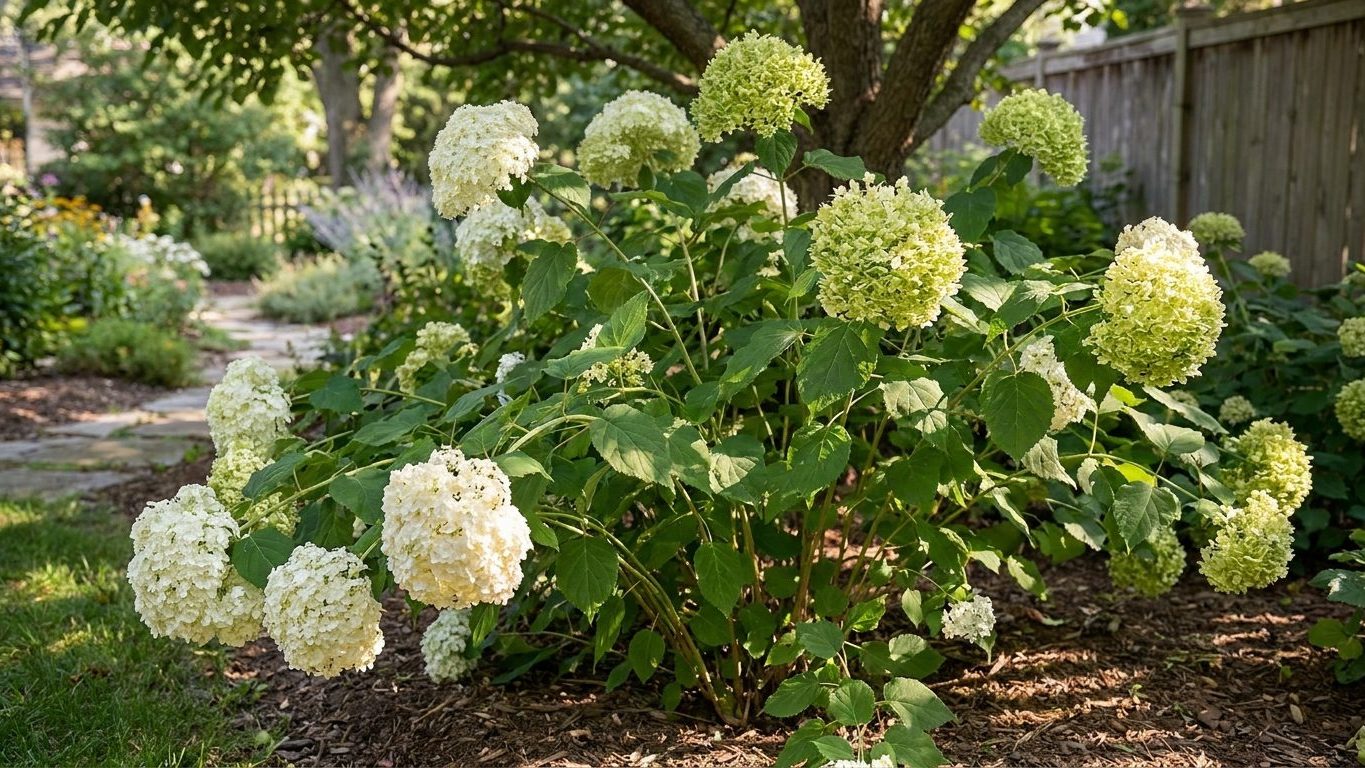

Incrediball is a smooth hydrangea, sold as an improved Annabelle with thicker stems that hold up the huge white blooms instead of collapsing after a rainstorm. It flowers on the current season’s growth, so winter dieback doesn’t cost you the season’s flowers the way it does with a mophead. That single trait decides most of the care questions that follow.
What Incrediball actually is
Incrediball belongs to Hydrangea arborescens, the smooth hydrangea group. The North Carolina Extension Gardener Plant Toolbox describes it as an improved Annabelle, with stronger stems that don’t fall over in the rain, blooming on the current year’s wood. Because flower buds form on new growth each spring rather than on wood that survived the winter, the plant can be cut back hard while dormant and still bloom fully by summer.
The genus overall spans USDA zones 3a through 9b, but that depends entirely on the type. Smooth hydrangea is described as the hardiest of the genus, putting Incrediball at the cold end of that range where a bigleaf mophead (zones 6a-11b) simply can’t survive winter.
Color is the other assumption that doesn’t apply here. Incrediball flowers open green, mature to white, and fade back toward green or cream as the season runs on, regardless of soil pH. There’s no acidifying the soil to turn this one blue, because the pH-color mechanism only works on bigleaf and mountain hydrangeas.
What Incrediball is good for
This is a landscape shrub, and its usefulness comes down to two things: where mopheads fail, and what it costs to keep safe around animals. In cold zones, where a bigleaf’s flower buds get killed by a late frost or an ill-timed spring prune (since those buds formed the previous summer on old wood), Incrediball simply regrows from the base and blooms anyway. The same new-wood logic that lets panicle hydrangea substitute for mophead in cold areas applies to smooth hydrangea for the same reason.
The toxicity picture also separates Incrediball from its bigleaf cousins. The NC State Extension source documents toxicity, hydracyanosides, cyanogenic glycosides, only in Hydrangea macrophylla, and only when large quantities of bark, flowers, leaves, or stems are eaten, causing nausea, stomach pain, vomiting, and sweating. That risk isn’t extended to smooth hydrangea, making Incrediball a more forgiving choice around dogs or grazing horses.
There’s also a wildlife benefit at no extra cost: native bees nest in dead hollow stems, so cutting the plant back to 12 to 24 inches and leaving those stems standing gives you a hedge that also does quiet habitat work over winter. Combined with its low maintenance and rapid growth, Incrediball reads as a workhorse for a foundation planting, mass border, or any spot with full sun to partial shade that needs something reliable.
Where it ripens in time, and where it is a gamble
“Ripens in time” for a hydrangea means blooming reliably before the growing season ends. That arithmetic is simpler for Incrediball than for most flowering shrubs, since it doesn’t need to survive winter intact to flower, only enough growing season after the last frost for new stems to grow, set buds, and open flowers.
Smooth hydrangea, the hardiest of the genus, sits at the cold end of the 3a-9b spread where bigleaf hydrangea (6a-11b) has already run out of runway. A gardener in zone 4 or 5, where winter regularly kills a mophead’s flower buds outright, isn’t gambling with Incrediball the way they would with a bigleaf, because there’s no old-wood bud bank to lose. The plant dies back, and it doesn’t matter, because it flowers on what grows back.
Here’s the comparison by type, using only the hardiness ranges the source gives:
| Type | USDA range | Flowers on | Risk in cold zones |
|---|---|---|---|
| Smooth (Incrediball) | Hardiest of the genus (within 3a-9b) | Current season’s growth | Low: regrows and blooms yearly regardless of winter dieback |
| Bigleaf / mophead | 6a-11b | Last year’s wood | High: late frost or spring prune removes the season’s flowers |
| Panicle | 3a-8b | Current season’s growth | Low, same mechanism as smooth |
| Mountain | Old wood, but hardier buds than bigleaf | Old wood | Moderate |
The real gamble is choosing a bigleaf hydrangea in a zone where its bud-forming wood won’t survive winter. Incrediball sidesteps that bet everywhere its own hardiness holds. Where exactly your zone lands, and what that means for the calendar, is a question for your state’s growing page rather than this one.
The two ways a season goes wrong
A long frost-free window doesn’t guarantee a good bloom year, and there are two separate failure modes for a new-wood bloomer like Incrediball. The first is a growing season that’s technically frost-free but short on time for a plant rebuilding its whole flowering structure from the ground up each year. Rapid growth rate helps, but isn’t unlimited: a crown that dies back hard in an unusually cold winter has less season left to push new stems, set buds, and open flowers before fall.
The second failure mode isn’t cold at all. It’s disease pressure building through a hot, humid stretch of summer, a documented risk regardless of zone. The source names leaf spot, bacterial wilt, and powdery mildew as diseases affecting hydrangea, and warm, damp conditions are exactly what lets these problems take hold on foliage that stays wet too long between waterings.
For Incrediball specifically, cold-season risk matters less than for a bigleaf, since the plant isn’t depending on overwintered buds. Disease-pressure risk matters more, because a shrub rebuilding its entire canopy from scratch every spring puts out a lot of soft new growth that disease finds easy to colonize in a wet summer. Air circulation and morning watering do more good here than worrying about the calendar.
What it resists, and what it does not
The NC State Extension source names three diseases at the genus level that apply to smooth hydrangea: leaf spot, bacterial wilt, and powdery mildew. Rust and bud blight are listed specifically against panicle hydrangea, not smooth hydrangea, so there’s no basis for expecting those on Incrediball. The source does not grade Incrediball’s resistance to any of the three diseases it lists, high, intermediate, or otherwise, so this is a list of what can go wrong, not a resistance rating.
On pests, the picture is calmer: aphids, scales, nematodes, and mites are listed as pests of hydrangea, but described as rarely a problem. Deer are a different story, and the source contradicts itself here, listing deer as a damage agent on the genus page while also listing hydrangea among plants resistant to challenges elsewhere. The honest answer is to report what’s actually observed: hydrangeas get browsed by deer. There’s no basis for calling Incrediball deer-resistant, so a gardener in deer country should plan fencing or repellent rather than counting on the plant to be left alone.
Growing it without the usual mistakes
Incrediball’s selling point against plain Annabelle is stem strength, thick enough to hold up heavy white flower heads without flopping after rain. That’s real, but not a guarantee everywhere. A shrub in a windy, exposed spot with those oversized blooms fully open and waterlogged after a storm can still lean, so light staking or planting where it gets some wind shelter is cheap insurance the plant description doesn’t mention.
Because it flowers on the current season’s growth, the plant can be cut back hard while dormant, and that’s actually the low-maintenance path rather than a risk, since it rebuilds and blooms the same year regardless. The source doesn’t give a specific pruning month for this cultivar, deliberately: the right timing depends on your zone’s frost pattern, a question for your state’s growing guide rather than a single national answer.
Feeding is where a lot of hydrangea advice misfires for this plant. High-phosphorus fertilizer locks up aluminum in the soil, pushing blue mophead flowers toward pink, a tradeoff much general hydrangea advice centers on. None of it applies to Incrediball. Its flowers are white and green by nature and don’t shift with soil chemistry, so just feed for healthy growth, not color.
Leave some stems standing at 12 to 24 inches after cutting back, rather than clearing every one to the ground, since hollow dead stems are nesting sites for native bees over winter. It costs nothing and turns a tidy cut into a small habitat feature.
Common questions
Does Incrediball hydrangea change color like a mophead?
No. Color change with soil pH only happens in bigleaf and mountain hydrangeas. Incrediball opens green, matures to white, and fades toward green or cream as the season goes on, regardless of soil acidity.
Is Incrediball safe to plant near pets or livestock?
The documented toxicity in this genus is specific to Hydrangea macrophylla, the bigleaf type, and only in large quantities. That risk isn’t listed for smooth hydrangea, making Incrediball a lower-concern choice around dogs, cats, and horses than a bigleaf mophead.
Why didn’t my Incrediball bloom the year after a hard winter?
That would be unusual for this cultivar, since it flowers on the current season’s growth rather than on overwintered wood. A missed bloom year points more toward a growing-season problem, disease pressure, poor drainage, or a very late killing freeze that stunted regrowth, than toward winter bud loss, which is the bigleaf’s problem, not this one’s.
Can Incrediball survive in a full-sun spot?
The source notes panicle hydrangea is the only type in the genus that takes full sun well, and doesn’t extend that endorsement to smooth hydrangea. Given the genus-level soil and light needs (good drainage, tolerance of occasionally wet soil), a partly shaded spot is the safer default for Incrediball unless your state’s growing guide says otherwise for your climate.