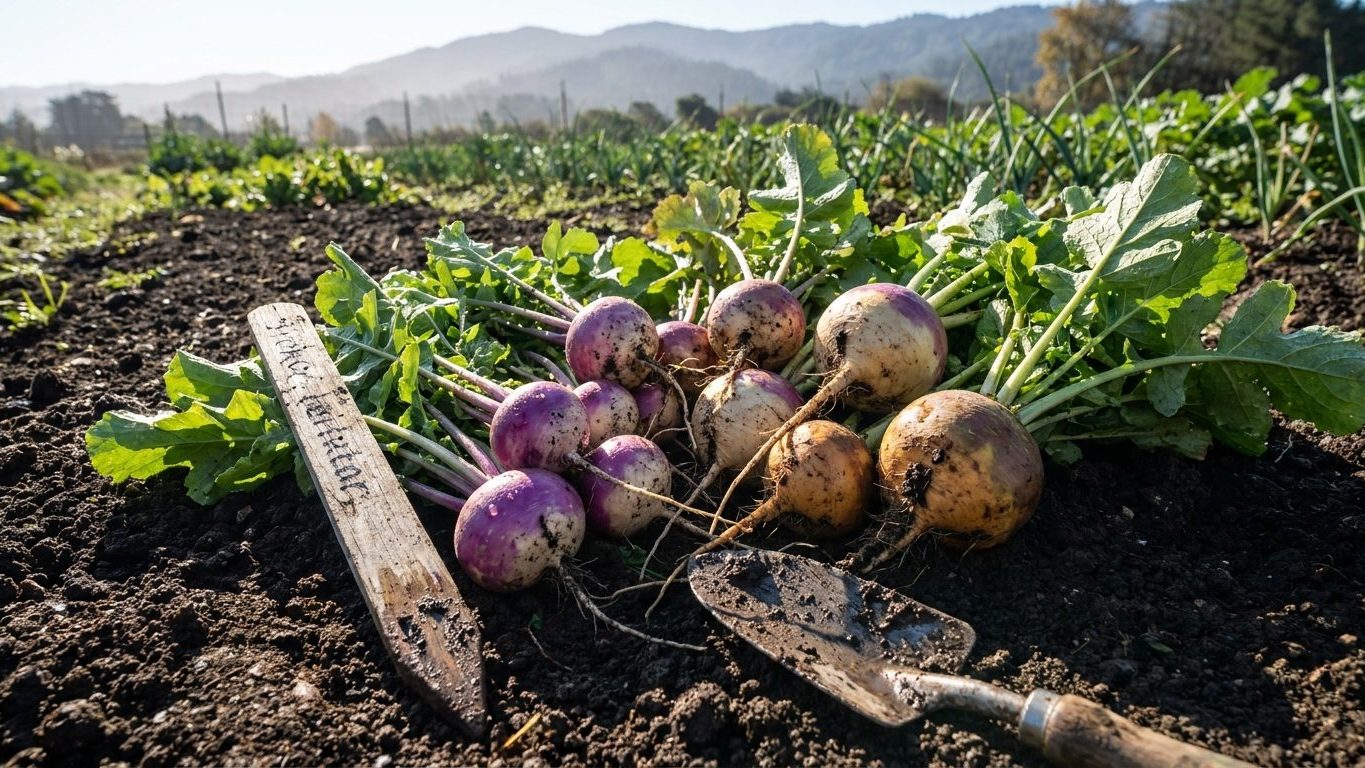

Turnips thrive across Michigan because they mature fast enough to dodge the state’s short growing window, while rutabaga demands a longer, cooler stretch that only a planned summer sowing can deliver. The right pick depends less on variety names and more on when you get seed in the ground relative to Michigan’s frost dates.
The short answer for Michigan
Michigan gardeners should treat Turnips and Rutabaga as two different crops with two different calendars, not interchangeable roots. Turnips run their full course in 40 to 60 days, which means the state’s frost-free stretch, roughly from late April or early May to early or mid October, gives room for a spring crop and a second fall crop in the same bed. Rutabaga is a different animal entirely. It needs 90 to 100 days to bulk up properly, and it actually improves in flavor after a light frost, so the smart move is a single planting timed to finish right around the first fall frost rather than a race against summer heat.
Work backward from Michigan’s fall frost window of October 6 to October 21 in zone 6a, and rutabaga needs to go into the ground by early to mid July at the latest to hit its 90 to 100 day mark before the ground turns hostile. Plant rutabaga seed by early July if you want roots with any size on them before frost forces harvest. Miss that window and you’re left with pencil-thin roots that never caught up.
Turnips give you more flexibility because their season is so much shorter. A spring sowing as soon as soil can be worked in April gets you a crop before the worst summer heat stresses the plants into bolting. A second sowing in late July or August catches the cooling fall temperatures and often produces the sweetest roots of the year, since turnips (like their rutabaga cousins) convert starches to sugars once nights turn cold.
The practical takeaway is simple. If you want a quick, forgiving crop that fits twice into a Michigan season, turnips are the safer bet. If you’re after the dense, storage-friendly roots that rutabaga produces, you get exactly one shot per year, and that shot has to be timed off the fall frost date, not the spring one. Growers who plant rutabaga in spring alongside their turnips, expecting an early harvest, usually end up disappointed by small roots and a plant that bolts to seed once the summer heat arrives.
What will not work here

Michigan’s growing season is not generous enough to forgive a late rutabaga planting. Sow it in mid or late July instead of early July, and the math stops working. A root that needs 90 to 100 frost-free days simply cannot finish if it starts counting down after the calendar has already eaten a third of the available time before the first fall frost arrives on October 6 in the cooler parts of zone 6a. The result is a rutabaga the size of a golf ball, harvested in a panic before a hard freeze locks the soil.
Spring-planted rutabaga fails for the opposite reason. Put it in the ground in April alongside your turnips, expecting a June harvest, and the lengthening days combined with rising early-summer heat push the plant to bolt, sending energy into a flower stalk instead of the root. This is a cool-weather crop on both ends of its cycle, and Michigan’s summer, while not brutally hot compared to states further south, still runs warm enough by July to trigger that response in a plant that prefers to finish its growth in falling temperatures.
Overwintering rutabaga in the ground without protection does not work in most of Michigan either. The coldest month here averages a nightly minimum of 19.2 degrees Fahrenheit at the Detroit reference station, and soil left unmulched will freeze solid well before spring. Rutabaga can handle a light frost sitting in the garden, which is part of why the fall harvest timing matters so much, but it cannot survive a Michigan winter unprotected in open ground the way it might in a milder coastal climate.
Tight spacing is another quiet failure point, especially in years with a wet, humid August. Both Turnips and Rutabaga planted closer than the seed packet recommends trap moisture around the foliage, inviting the fungal leaf spots and clubroot pressure that show up more often in Michigan’s humid summers than in drier climates. Thinning seedlings aggressively, even when it feels wasteful, protects the whole bed. And watering on a fixed weekly schedule, regardless of actual rainfall, tends to under-water during Michigan’s occasional dry stretches in July and August, right when rutabaga roots are doing their most important bulking.
What changes across Michigan
Michigan is not one garden, and the state’s hardiness zone range makes that obvious on paper before you even walk outside. USDA hardiness zones here span from 4a up to 6b, based on the average annual extreme minimum temperature, which means a gardener in the far north or the Upper Peninsula is working with a genuinely different climate than one near Detroit, even though both are technically in Michigan.
That spread matters most for timing. A rutabaga planting date built around the Detroit-area frost calendar assumes a longer, milder fall than a grower in a colder pocket of the state actually gets. Someone gardening toward the northern end of that zone range should expect their growing season to close earlier, which means the same 90 to 100 day rutabaga crop needs to start earlier too. Shift rutabaga planting three to four weeks earlier than the Detroit-area date if you’re gardening in a noticeably colder part of the state, since a fall frost that arrives ahead of schedule will catch an under-sized root the same way a late July planting would.
Turnips have more slack built in because of their shorter cycle, but even a 40 to 60 day crop can get squeezed if the fall growing window closes early. A second, fall-planted turnip crop that works fine near the Detroit reference station might need to move up a couple of weeks further north to guarantee a harvest before the ground freezes.
None of this means there’s a single correct calendar for the whole state, and this page cannot hand a reader in a specific zone a specific date, since the range itself spans nearly three full hardiness zones. The honest answer is that Michigan’s turnip and rutabaga timing needs local adjustment, and the only reliable way to know which end of that range applies to a given garden is to check it directly rather than guess from a state average.
Where to check this for your own county
The Michigan State University Extension service is the right next stop, and it exists specifically to translate state-level growing information into something usable at the county level. Visit canr.msu.edu/outreach/ and look for the office serving your county rather than relying on a statewide frost date that may not match your actual conditions.
Once there, two things are worth hunting down specifically. The first is a local planting calendar, since county extension offices frequently publish frost dates and sowing windows that are tighter and more accurate than the broad zone 6a figures used on this page, which were built around the Detroit area and the Lower Peninsula generally. A county office further north or at higher elevation will often have adjusted dates reflecting a shorter, colder season than what’s described above.
The second thing to look for is any list of turnip and rutabaga varieties that have actually been trialled in your county’s soil and climate. State-level guidance can point you toward the right type of crop and the right general timing, but it cannot tell you which specific variety has performed best in your particular county’s soil texture, rainfall pattern, or pest pressure. County extension staff and master gardener programs often maintain exactly that kind of localized track record, built from actual trial plots rather than statewide averages.
A county recommendation will always beat a state one when the two disagree, simply because it accounts for local variables this page cannot see. This page describes Michigan broadly, using reference points from the Detroit area and statewide zone data. Your county extension office describes your specific patch of ground, and that specificity is worth the extra step of tracking it down before you commit seed to soil.
Checking this against your own garden
Every date on this page is a starting estimate, not a guarantee, and your own garden will tell you more than any calendar once you know what to look for. Soil temperature is the first and most reliable signal. Turnip and rutabaga seed germinates poorly in cold, wet soil, so before spring planting, push a finger a couple of inches into the bed. If it feels cool and damp rather than merely cold, the soil has likely warmed enough for seed to sprout without rotting, regardless of what the calendar says the date should be.
Watch for the first true leaves as your second checkpoint. The initial pair of leaves that emerges from a turnip or rutabaga seedling is round and generic looking, but the true leaves that follow show the jagged, characteristic shape of the mature plant. Seedlings usually show true leaves within 10 to 14 days of a healthy germination, and a longer delay than that often signals soil that’s still too cold or too wet for vigorous growth, which is worth noting for next year’s timing in that same bed.
The third thing to watch is early flowering, sometimes called bolting, which shows up as a stalk shooting up from the center of the plant well before the root has bulked up. This is the clearest sign that a rutabaga was planted too early or that a turnip is struggling under heat stress. If you see it happening consistently in the same bed year after year, that’s a strong hint your particular microclimate, whether from a south-facing slope, reflected heat off a fence, or unusually fast-draining soil, is running warmer than the general state timing assumes, and your own planting dates should shift earlier or later to match what the garden is actually telling you.