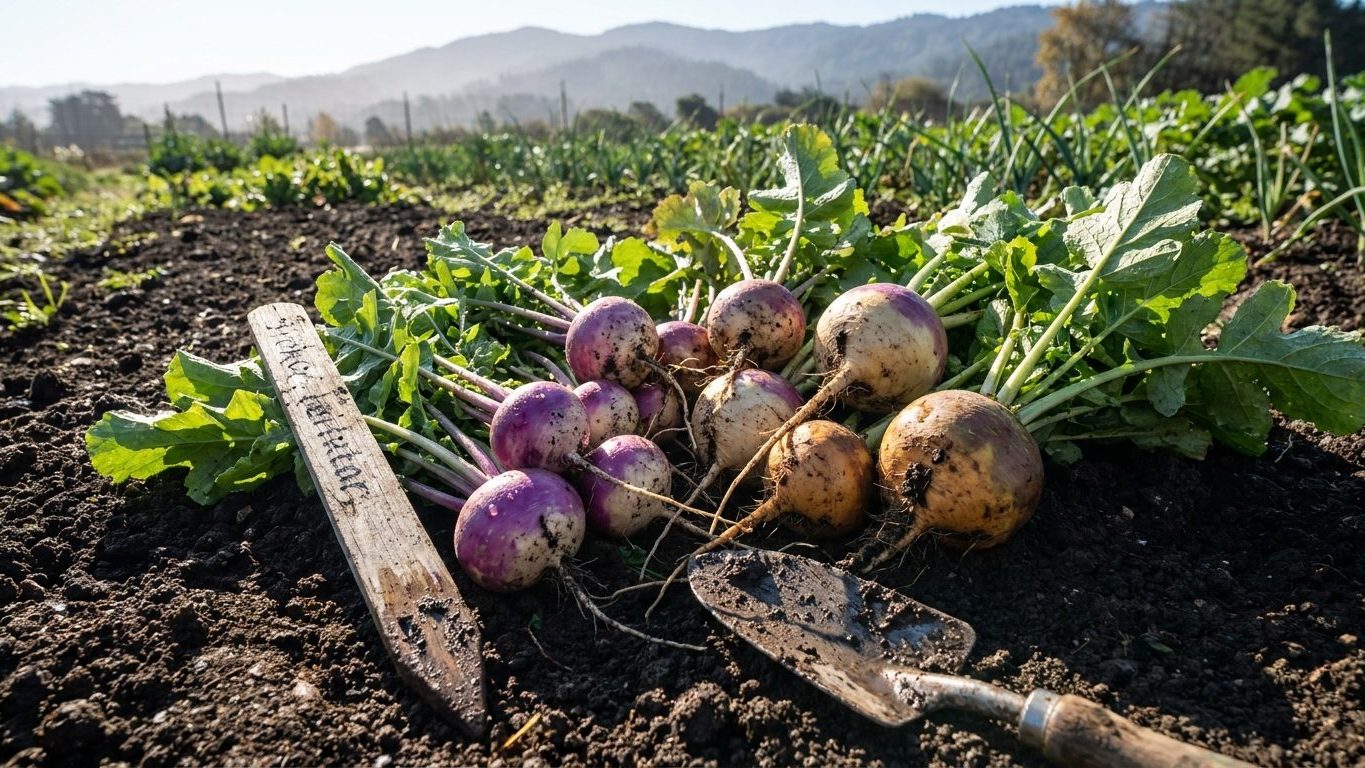

For most of Minnesota, the safest bet is a fast turnip like Purple Top White Globe or Hakurei, both ready in 45 to 55 days, planted as a fall crop. Rutabaga works too, but only if you get Laurentian or American Purple Top into the ground early enough to hit its full 90-to-100-day cycle before the first hard frost.
The short answer for Minnesota
Turnips and Rutabaga are cool-season roots, and in Minnesota that means the fall planting is almost always the better one. The state’s growing season runs from a last spring frost of April 17 to April 30 down to a first fall frost of October 11 to October 23 (NOAA NCEI 1991-2020 Climate Normals, reference station Minneapolis). That’s the window you’re working with, and it’s not generous once you subtract the days a fast-growing root needs to size up.
Run the math backward from the early end of that fall frost date, October 11, since that’s the one you should plan around rather than hope against. A 50-day turnip needs to go in the ground no later than roughly late August to mature before frost hits, with a little buffer for the slower growth of shortening fall days. A rutabaga needing 90 to 100 days has to be sown much earlier: by early July at the latest for gardeners near the Twin Cities, and that’s cutting it close.
Spring planting is possible for turnips, since they tolerate a light frost and germinate in cool soil, but it’s the riskier route in Minnesota. The gap between “safe to plant” (after April 30) and the arrival of real summer heat is short, and turnips sown too close to warm weather tend to bolt instead of bulking up their roots. Fall planting sidesteps that problem entirely: roots mature into cooling weather, which sweetens flavor instead of pushing the plant toward flowering.
Rutabaga doesn’t really have a spring option here at all. Its long season means a spring sowing would still be sizing up when Minnesota’s summer heat arrives, and rutabaga handles heat worse than turnips do. That leaves one shot: an early-summer sowing timed to finish in the cool, moist stretch before the first fall frost. Varieties bred for shorter maturity, some strains close to 80 days, buy a little insurance if your early-July window slips.
Winter storage in the ground isn’t part of the equation. The coldest month here averages a daily minimum of 8.8°F, cold enough to freeze unharvested roots solid without heavy mulch and often even with it. Plan to have everything out of the ground at or before the first fall frost date for your area, not after.
What will not work here

Long-season rutabaga varieties planted in mid-July or later are the most common failure. Do the arithmetic: a 100-day rutabaga sown July 15 is aiming for an October 23 finish, which is the late edge of the fall frost window, not the early edge, and any cool, wet stretch in September pushes that date further out. The result is a rutabaga still the size of a golf ball when the ground freezes.
Spring-sown turnips left in the ground into late June are the second big failure, and it’s a heat problem more than a cold one. Once daytime temperatures climb into the 80s, which happens with regularity across southern and central Minnesota by mid-June, turnip roots turn woody and the plant bolts toward seed. Harvest spring turnips before summer heat sets in, or skip the spring planting altogether and put your effort into the fall crop instead.
Tight spacing is a quieter failure, but a real one. Minnesota summers bring stretches of high humidity, especially in July and August, and rutabaga in particular is prone to clubroot and other soil-borne fungal issues when air can’t move between plants. Crowded rows that might get away with it in a drier climate will show disease pressure here that a wider spacing avoids.
Skipping mulch or floating row cover on a fall crop is another mistake, though a smaller one. Since the coldest month here bottoms out at an average minimum of 8.8°F, there’s no version of Minnesota where roots survive an unprotected winter in open ground. Growers who leave a late crop in place “just in case” usually lose it outright rather than gaining extra harvest time.
Finally, treating the whole state as one climate is its own kind of failure. A planting date that works in the Minneapolis area can be two to three weeks off for a garden in the northern part of the state, and a rutabaga timed to the Twin Cities’ October 11 frost date has no cushion left if the local frost actually lands in the last week of September instead.
What changes across Minnesota
Minnesota spans USDA Hardiness Zones 3a to 5a, a spread built entirely on the average annual extreme minimum winter temperature. That’s a wide range for one state, and it means there is no single planting date that fits everywhere. The frost dates and coldest-month figures above come from the Minneapolis reference station, which sits in the mildest, southernmost part of that range.
Northern Minnesota runs two to three weeks tighter at both ends of the season, according to the same NOAA Climate Normals used for the Twin Cities figures. That squeeze applies on both sides: spring frost lingers later, and fall frost arrives sooner. For a rutabaga grower, that turns an early-July sowing deadline into a mid-to-late-June one further north. For a fall turnip crop, it means the late-August planting window needs to shift toward early-to-mid August instead.
Elevation and local microclimate add another layer on top of latitude. Low-lying areas and river valleys collect cold air and tend to see frost before nearby higher ground, sometimes by a week or more, regardless of what the regional average says. Gardeners in those spots should treat the early end of any frost date range as the one to plan around, not the late end.
None of this is something to guess at from a state-level page. The USDA Plant Hardiness Zone Map lets you look up the zone for a specific location, and it’s the right tool for translating a statewide range into something usable for one garden. What matters here is simply knowing that “Minnesota” covers three-plus zones worth of difference, and that a date calculated for the Twin Cities is a starting point, not a guarantee, for anywhere else in the state.
Where to check this for your own county
Everything above is built from statewide and single-station data, which is useful for understanding the pattern but not a substitute for what your county extension office actually recommends. University of Minnesota Extension, at extension.umn.edu, is the land-grant extension service covering the whole state, and it’s the next stop after this page.
Two things are worth looking for specifically once you’re there. First, a local or regional planting calendar for root vegetables, which will reflect the actual frost pattern for your part of the state rather than the Minneapolis-centered figures used here. Second, any variety trial results or county-specific recommendations for Turnips and Rutabaga, since extension offices often track which cultivars have performed well in local trial plots, information that a statewide page simply can’t include.
A county-level recommendation will always beat a state-level one, for a straightforward reason: it accounts for the specific soil, frost behavior, and growing conditions of a smaller area, where this page is necessarily built from averages spanning hundreds of miles and three hardiness zones. Think of what’s written here as the frame, and the county extension office as the fine-tuning.
If your county doesn’t have a dedicated page, the statewide University of Minnesota Extension horticulture section still carries general vegetable planting guides, and the master gardener volunteer program in many counties fields specific questions by phone or email. That’s a faster path to a real answer than adjusting the dates on this page by guesswork.
Checking this against your own garden
Dates and averages get you close, but your own garden will tell you more than any calendar once the season is actually underway. Three things are worth watching, and none require anything more than your hands and your eyes.
Soil feel is the first check. Turnip and rutabaga seed germinates reliably once soil is workable and no longer cold and clammy to the touch, generally once it’s dried out enough to crumble rather than clump. If the soil still feels cold and wet at the date this page suggests for sowing, wait a few more days rather than planting on schedule; a cold, waterlogged seed bed will rot seed before it germinates regardless of the calendar.
The first true leaves are the second signal. Seedlings start with a pair of rounded seed leaves, then develop the jagged, more typical turnip-family leaf shape a week or two later. The appearance of that first true leaf pair is a rough marker of how quickly your particular garden’s conditions, sun exposure, soil warmth, drainage, are moving the crop along, and it lets you compare your own timeline against the maturity-day figure printed on the seed packet.
The third is watching for early bolting, a seedling sending up a thin flower stalk well before the root has sized up. That’s a heat or stress signal specific to your spot, often tied to a particularly warm microclimate, reflected heat off a nearby wall or driveway, or simply a hot stretch that arrived earlier than the regional average. A garden that bolts early two years running is telling you something the state page can’t: that your own fall planting window needs to start sooner than the general date suggests.