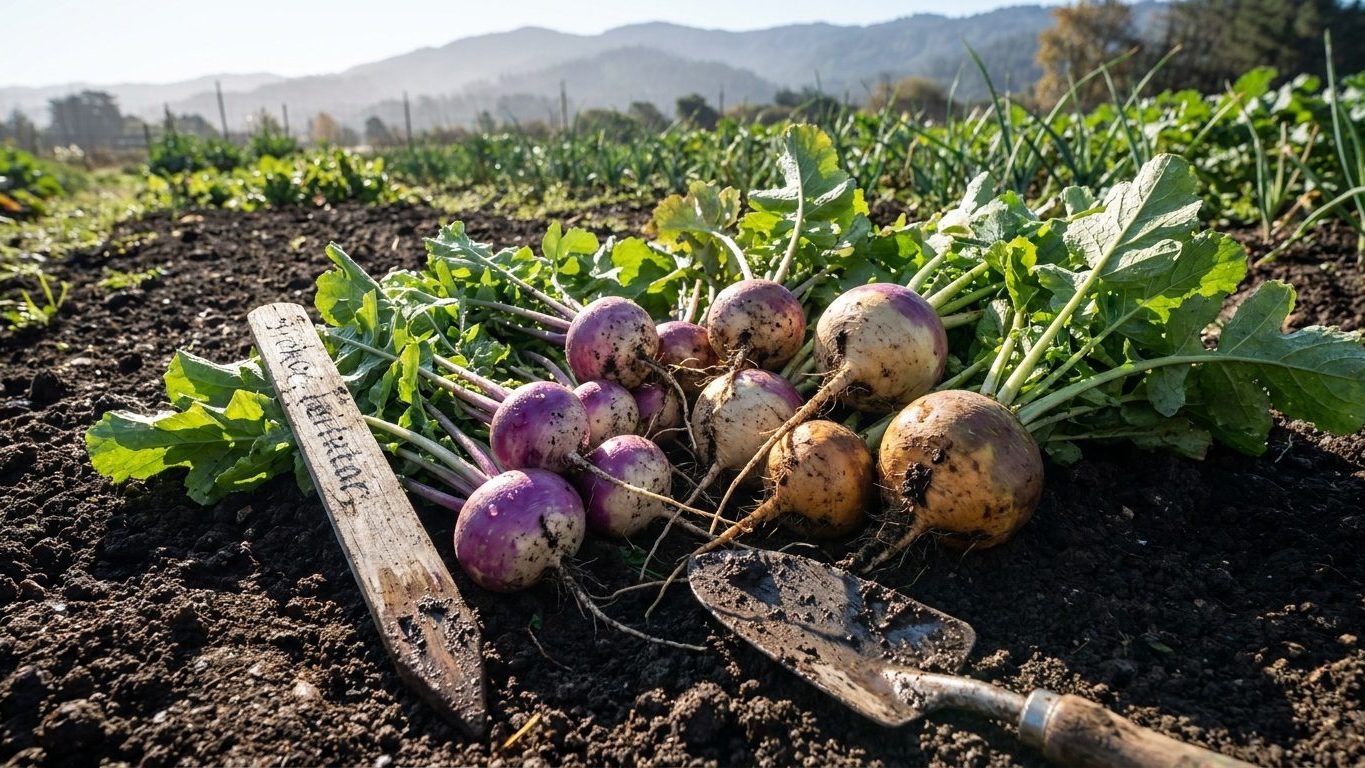

Newfoundland and Labrador’s cool, damp summers suit both crops, but the gap between frost dates decides which type actually finishes. Fast turnip varieties, done in under two months, fit almost any garden in the province. Rutabaga, needing three months or more, works too, but only if it goes in the ground within days of the last frost. Wait past early June, and the calendar starts working against you.
The short answer for Newfoundland and Labrador
Start with the numbers that actually govern this decision. At the St. John’s reference station, the mean last spring frost falls on May 30 and the mean first fall frost on October 17. That gives a frost-free window of roughly 140 days in an average year, generous by Canadian standards and a big part of why the province sits in hardiness zone 6a, a relatively mild rating on the Canadian scale thanks to the ocean’s moderating effect.
That window changes the calculation for each crop. Turnips built for speed, the kind that finish in 40 to 60 days, fit inside it with room to spare. A gardener can sow one batch in late spring and a second in midsummer for a fall harvest, something the short seasons in most of Canada simply do not allow. Rutabaga is the tighter fit. Most rutabaga varieties need 90 to 100 days from seed to a storable root, and against a 140-day window that leaves little slack for a late start or a cold, slow spring.
The practical decision by type looks like this: if the goal is a forgiving crop with room for mistakes, or a second sowing for fall eating, choose a fast turnip variety. If the goal is a storage rutabaga for winter, treat the mean last frost date as a starting gun rather than a safe date, and sow as close to May 30 as the soil allows. Rutabaga tolerates cool soil and light frost far better than heat, which plays directly into this province’s favor, but it cannot make up for three or four lost weeks at the start of the season.
Neither crop asks for much heat here, and that’s the real advantage of gardening in Newfoundland and Labrador. Rutabaga in particular turns woody and bitter in hot summers elsewhere in Canada. That failure mode barely exists on the Avalon Peninsula or along most of the coast, where summer heat rarely builds enough to stress the root. The trade-off is length of season, not warmth, and that trade-off is what every variety choice here should be built around.
What will not work here

The most common mistake is treating the mean last frost date as a guarantee rather than a midpoint. Environment and Climate Change Canada’s normal for St. John’s A station is a 30-year average, which means in roughly half of all years frost arrives after May 30, sometimes well after. A gardener who waits until mid-June to direct-sow rutabaga, assuming the frost risk is long past, has already burned two or three weeks off a season that only has 140 days to begin with. That variety may still be in the ground, unfinished, when the mean first fall frost of October 17 arrives.
Long-season storage turnips, the 100-day-plus types bred for prairie growing seasons, are a poor match for a single planting here. They leave no margin for a cool spring or a late start, and they eliminate the option of a second sowing that faster turnips allow. If a gardener wants one of these longer varieties, it needs to go in the ground at the very edge of the frost date, not weeks after.
Tight spacing is its own failure point in this climate. Newfoundland and Labrador’s coastal humidity, higher than most of inland Canada, favors clubroot and root rot in brassicas planted too close together. Turnips and Rutabaga crowded at standard prairie spacing often show stunted, misshapen roots and rot at the crown by late summer here, even when the same spacing works fine in a drier province.
Finally, don’t count on leaving roots in the ground past hard frost the way some warmer-zone gardeners do with a straw mulch trick. The mean daily minimum of the coldest month at the reference station is -8.7°C (about 16°F), cold enough that unprotected ground freezes solid well before winter’s coldest point. Roots left in the field past that point split, rot, or become impossible to dig. Lift the crop before the ground locks up, and store it indoors instead.
What changes across Newfoundland and Labrador
A single hardiness zone number cannot describe this province, and it isn’t meant to. The 6a rating comes from the reference city used by Natural Resources Canada’s Plant Hardiness mapping, which for this page is St. John’s, sitting on the mild, ocean-moderated tip of the Avalon Peninsula. That figure describes one location, not Labrador’s interior, not the west coast, and not the elevated inland districts of the island itself.
The spread inside this province’s own borders is enormous. Coastal areas warmed by the Atlantic hold onto zone ratings in the 5 to 6 range, while inland valleys and higher ground run measurably colder, and Labrador’s interior sits in a different climate category altogether, closer to the subarctic than to anything St. John’s experiences. Interior and northern gardens can run weeks behind the coast in both spring warm-up and fall cooling, which directly shrinks the frost-free window this whole page is built around.
That gap matters more for rutabaga than for turnips, simply because rutabaga has so little slack to begin with. A coastal garden working with something close to the 140-day window described above has room for a 95-day variety. A garden even one valley inland, with a shorter effective season, may not, and the only way to know is to check the zone map for your own location rather than borrow the reference city’s number. Natural Resources Canada’s Plant Hardiness site lets a reader look up conditions municipality by municipality, which is the only reliable way to translate this page’s numbers into a specific backyard.
This isn’t a case of splitting hairs over half a zone. The difference between a coastal Avalon garden and an inland or Labrador garden can be the difference between two turnip sowings a summer and one, or between a rutabaga crop that matures comfortably and one that gets caught by an early fall frost.
Where to check this for your own county
Newfoundland and Labrador’s Department of Fisheries, Forestry and Agriculture runs the provincial resource that replaces the county-level extension offices common in the United States, and it’s the right next stop after this page. This page has given the province-wide numbers, built from a single reference station and a single reference city’s hardiness zone. That’s useful as a starting point, but it is not a substitute for local, on-the-ground guidance.
What to look for once there: a regional or district planting calendar, if one is published, and any list of turnip or rutabaga varieties that have actually been trialled in local growing conditions rather than simply sold in a national seed catalog. Provincial agriculture offices often track which brassica varieties hold up against local pests, local humidity levels, and local frost timing, information no province-wide averages page can offer.
A district-specific recommendation beats a provincial one every time, for the same reason a provincial figure beats a national one. Climate data averaged across an entire province smooths over exactly the differences that matter most, coastal versus inland, island versus Labrador, low ground versus high. This page draws its numbers from one climate station and one reference city because that is what a province-wide resource can responsibly offer. A local office, by contrast, can often point to the actual varieties grown successfully nearby, which is a more direct answer than any frost-date average will ever give.
If the provincial site doesn’t have district-level detail for a specific area, a regional agricultural extension worker or a long-time local grower is often the next best source, particularly for confirming how far behind or ahead of the St. John’s dates a given inland or northern location tends to run.
Checking this against your own garden
Every date on this page is an average pulled from one weather station, and the garden in front of a reader will not always agree with it. Three direct observations settle the question faster than any calendar can.
First, soil texture by hand. Grab a handful from where the turnips or rutabaga will go. If it crumbles apart loosely rather than forming a wet, sticky clump, the soil has warmed and dried enough to work and sow, regardless of what the calendar says the date should be. Second, watch for volunteer weed germination in the same bed. Weeds sprouting on their own is a reliable, low-tech signal that soil temperature has crossed the threshold brassica seeds need to germinate reliably. Third, once seed is in the ground, track the arrival of the first true leaves, the second set to appear after the small rounded seed leaves. That timing shows how the season is actually running this year, not how it ran on average between 1981 and 2010.
None of these three checks needs a soil thermometer or any other instrument. They read the actual microclimate of one specific bed, in one specific year, which is exactly the information a province-wide average from a single coastal station cannot supply. If true leaves appear within a week of germination, the season is on pace with the region’s own conditions and a second sowing of a fast turnip variety is a reasonable bet for midsummer. If that stage is slow to arrive, the safer move is to let this crop finish rather than risk a second, later one against a fall frost that may not wait for it.