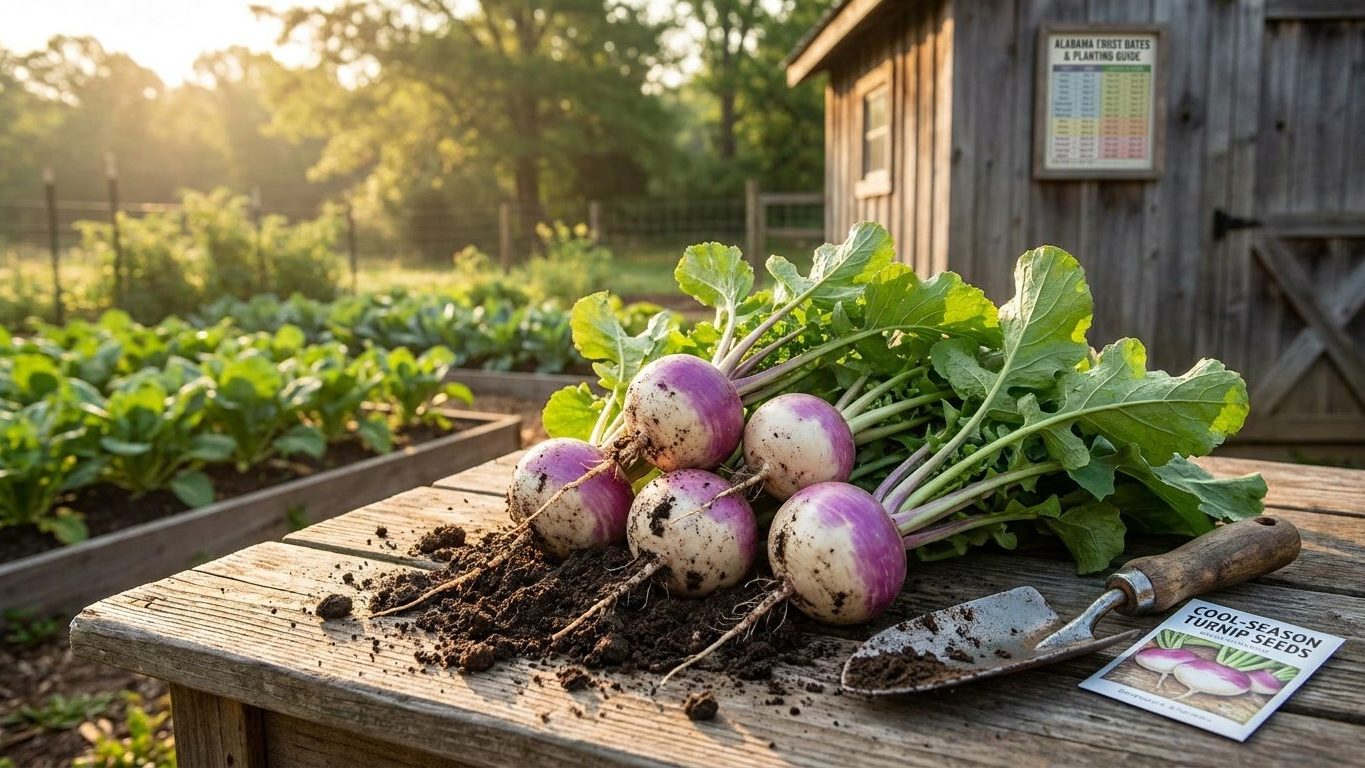

The safe window for direct-seeding turnips in the Northwest Territories runs from around the last spring frost, on average May 25, through mid-summer, with the crop timed to finish before the first fall frost, on average September 18. That’s a mean frost-free stretch of roughly 116 days on paper. In practice, both dates are averages, not promises, and the real planting math depends on which turnip you’re growing and where in the territory your garden sits.
The short answer for Northwest Territories
Turnips tolerate a light frost better than almost any root crop grown in the North, which is why they’re one of the few vegetables worth pushing right up against the shoulder seasons here. The safest approach is to seed the main crop once soil has thawed and warmed past the last spring frost date of May 25, then count backward from the first fall frost date of September 18 to make sure a given variety has time to size up. A fast turnip bred for greens and small roots needs about 45 to 55 days; that means the last realistic sowing date for a full crop sits around July 24, giving a 55-day turnip just enough runway before the mean frost arrives.
The catch is in the word “mean.” Environment and Climate Change Canada’s normals for the Yellowknife A station are calculated from 1981-2010 climate records, and a mean frost date is exactly what it sounds like: the midpoint. In roughly half the years on record, the first fall frost at that station actually arrived after September 18, and in the other half it arrived before. The same logic applies in reverse to the spring date. So neither May 25 nor September 18 is a line you can safely sow right up against; treat them as the center of a window that could shift two or three weeks in either direction in any given year.
That uncertainty is precisely why turnips make sense as a NWT crop and slow-maturing roots often don’t. A gardener who wants insurance against an early frost has two workable options: start turnips indoors a few weeks before the last frost date and transplant once the soil is workable, or stagger two outdoor sowings, one in late May for an early harvest and one in late June to hedge against a cold July. Either way, the target is a root or a bunch of greens that’s ready to pull well before the mean fall frost date, not exactly on it.
What will not work here

Rutabaga is the crop that exposes the real limits of the Northwest Territories growing season. Where turnips can finish in under two months, rutabaga typically needs closer to 90 to 100 days to bulk up properly, and that number alone eats almost the entire mean frost-free window before you’ve accounted for any variability at all. Sow rutabaga at the mean last frost date of May 25 and you’re aiming for a September finish that has, historically, coincided with frost in half the years on record. There’s effectively no margin left for a cold, late spring or an early fall snap, which is exactly the kind of year that shows up regularly at latitude 62.
Storage-type turnip varieties bred for long keeping quality run into the same wall, just less dramatically. Anything pushing past 60 or 65 days to maturity is gambling with a season that, on paper, gives you about 116 frost-free days but in practice can run considerably shorter. Add in the territory’s brutal winter baseline, a mean daily minimum of -29.5 °C in the coldest month, and it becomes clear why nothing here is designed around a leisurely fall finish: the ground doesn’t offer a slow, mild autumn to lean on the way a longer-season region might.
Treating the last spring frost date as a hard green light is another mistake specific to this climate. Because May 25 is a mean rather than a safe cutoff, sowing tender seedlings the moment that date arrives on the calendar leaves them exposed in roughly half of all years. Turnip greens shrug off light frost, but a young stand hit by a harder freeze in early June, which has happened before at this station, can be set back weeks or wiped out outright. Waiting a few extra days past the mean date costs little; sowing too early can cost the whole planting.
What changes across Northwest Territories
Every figure in this article comes from a single reference point, the Yellowknife A weather station, and a single hardiness zone rating tied to Yellowknife as a municipality. The Northwest Territories is not one climate. Natural Resources Canada rates the Yellowknife area at zone 1b under the Canadian plant hardiness system, which is built from seven climate variables rather than the single winter-minimum measure the USDA system uses south of the border. That zone number cannot be converted into a USDA equivalent, and it certainly can’t be assumed to apply territory-wide.
A territory that stretches from the Alberta and British Columbia borders up to the Arctic coast covers ground far colder and far shorter-seasoned than Yellowknife’s normals suggest. Communities farther north or at higher latitude routinely see a later spring thaw, a shorter run of frost-free days, and an earlier fall frost than the numbers in this article describe. Gardeners in those areas should expect the sowing window discussed here to compress from both ends, not just shift.
Rather than guess at a local zone from a territorial average, check the actual mapped rating for your community on Natural Resources Canada’s plant hardiness site, which lets you look up hardiness by municipality rather than relying on one reference city standing in for a territory the size of Western Europe.
Where to check this for your own county
A territory-wide sowing calendar, this one included, is a starting point, not a final answer. The Government of the Northwest Territories runs an agriculture program through the Department of Industry, Tourism and Investment, and it’s the resource built for local conditions rather than a single station’s climate normals. It’s worth visiting directly before locking in a planting date.
What to look for there is specific: a regional planting calendar built around growing conditions closer to your own community, and any list of turnip or rutabaga varieties that have actually been trialled in the North. Varieties bred for the Prairies or southern Canada don’t always perform the same way under near-continuous summer daylight and a compressed season, and a program working directly with northern growers is far more likely to flag which seed catalogs have proven themselves here.
A community-level recommendation will beat a territorial one every time, for the simple reason that it’s built from local data rather than a single climate station’s thirty-year average. This article works from the numbers available for Yellowknife because that’s the only complete, sourced dataset for the territory; a county or regional program can tell you how far your own conditions diverge from it, and by how much.
If you follow the almanac, here is when to plant turnips by the moon. It is a tradition, not a proven method.
Checking this against your own garden
Dates on a calendar are a guide, not a guarantee, and nothing beats what’s actually happening in the soil. Three signs are worth watching every spring, none of which require any equipment.
- Soil that crumbles rather than clumps when you squeeze a handful is soil that’s warmed and dried enough to work, regardless of what the calendar says about the mean frost date.
- The appearance of the first true leaves, the second set that emerges after the rounder seed leaves, confirms germination actually succeeded in that soil temperature, rather than seed sitting dormant in ground still too cold.
- An early flower stalk pushing up before the roots have sized up is a sign of bolting, often triggered by the long daylight hours typical of northern summers, and it tells you that variety or that sowing date ran into stress this particular year.
None of these signs override the general risk built into a mean frost date, but together they tell you more about your own yard’s microclimate in a single season than any territory-wide average can.