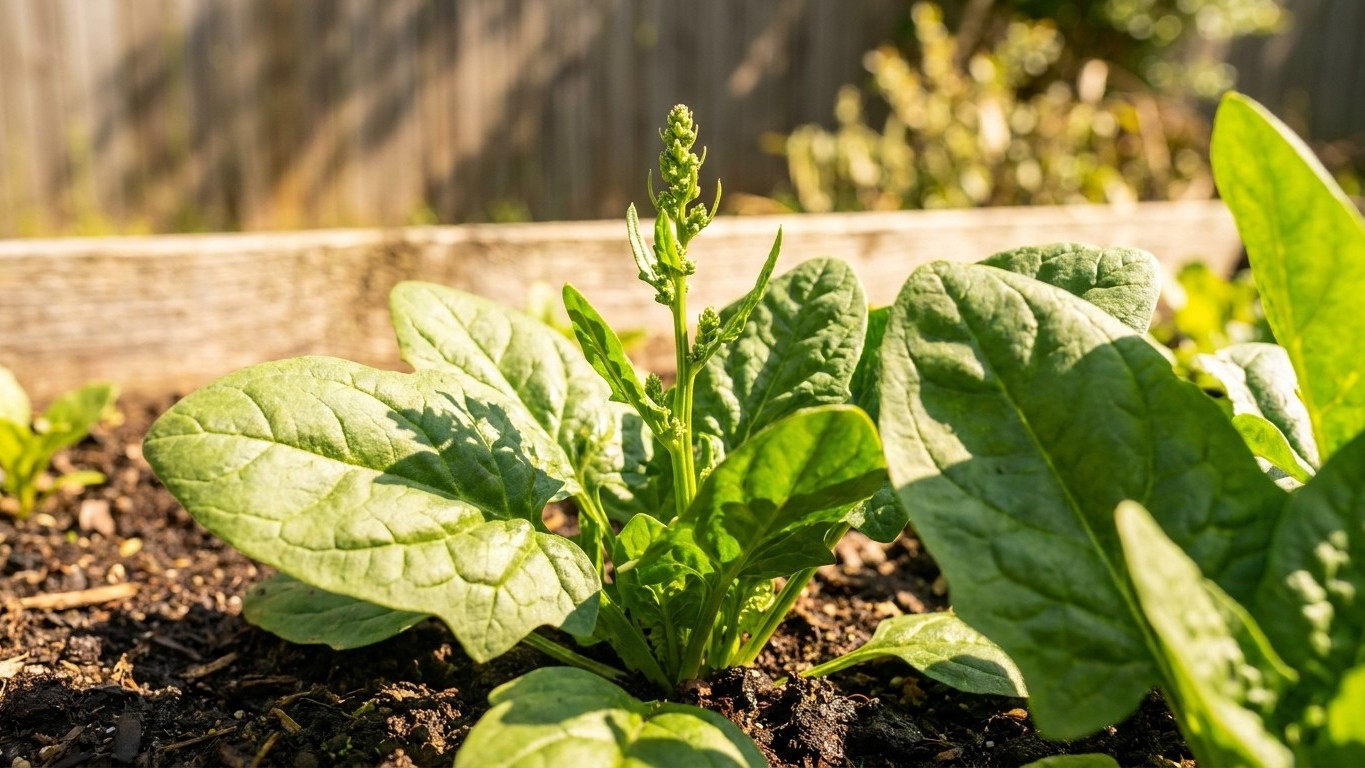

In Montana, spinach rarely loses to a single culprit. Four things on the calendar eat into the crop: long days that trigger flowering, air above 75 F, soil above 80 F that stalls germination, and the first frost of autumn. Each one shuts a different door at a different time, so the season comes in two short pieces instead of one long stretch. For the full crop guide, start with Growing Spinach in Montana.
The short answer
Billings gets 15 h 32 of daylight on the longest day of the year. That number matters more than any thermometer reading, because spinach bolts during long days as well as warm temperatures. Long days can set off flowering by themselves. A cool summer does not buy extra weeks, since the clock the plant is reading is the length of the day, not the weather.
So is the limit here the day length or the heat? Both. Day length closes the door from late spring through midsummer, when the days are longest. Heat closes it on its own schedule. Utah State University Extension says spinach grows best where temperatures do not exceed 75 F, and that figure is also the point where leaves turn bitter. Billings averages 28.3 days a year at 90 F or more, which is a measure of how much of the summer sits far above that ceiling. A crop that has already been pushed toward flowering by the long days gets no help from a mild afternoon.
One caution on the daylight figure. It is calculated from the station’s latitude with a geometric horizon, so real daylight runs about seven minutes longer. What the 15 h 32 tells you is that midsummer in Montana is deep in long-day territory, and spinach sown to mature then is working against the sky. The longer treatment of the mechanism is in Will Spinach Bolt Early in Montana?
Billings is one of the milder valleys in the state. Mountain valleys elsewhere in Montana can frost in any month, so a garden at higher elevation may lose its crop to cold well before the Billings numbers say it should. Daylight is nearly the same at a given latitude, but frost and heat are not.
The threats, in the order they show up in a typical year:
- Frost in spring, which can hit seedlings sown before the last frost date.
- Air above 75 F, which stops good growth and turns the leaves bitter.
- Long days, which push the plant to flower whatever the temperature.
- Soil above 80 F in late summer, which cuts germination of the autumn sowing.
- Frost in autumn, which ends the season.
How long the spring window really is
Spinach goes in the ground 2 to 3 weeks before the last spring frost. For Billings, NOAA NCEI 1991-2020 Climate Normals put that frost between April 29 and May 10, using the 30 to 70 percent probability band. Working it through gives a sowing window you can count on a calendar.
- Start with the frost range. April 29 is the early end and May 10 the late end. Because the range is a probability band, some years fall outside it.
- Count back three weeks from the early date. That lands on about April 8, the earliest sensible sowing in a normal year.
- Count back two weeks from the late date. That lands on about April 26, the last sowing that still follows the rule.
- Measure the window. From April 8 to April 26 is roughly two and a half weeks of eligible sowing days, and a cold snap can shrink it.
- Let temperature end the crop, not the calendar. Growth stops being good above 75 F. The end of the window is whatever week your own thermometer says so.
What does that mean in practice? The sowing window is short, and the growing stretch after it is measured in weeks, not months. Seeds that go in during the first half of April spend the cool spell building leaves, while seeds sown at the late edge have less time before the warmth and the lengthening days arrive. Early sowing is the only real lever you have.
Because the sowing happens before the last frost, a freeze after germination is normal, not a failure. Check the forecast the week your rows sprout, and keep a sheet of row cover handy.
Utah State University Extension names four varieties for home gardeners: Bloomsdale, Melody, Teton and Olympia. That is a question for your county Extension office.
The autumn crop, and when the soil lets you sow
The second season runs backward from the end. The source’s rule is to plant 50 to 75 days before the date you want to harvest. Billings sees its first fall frost between October 1 and October 14. Treating that range as the realistic last harvest date and counting back gives a sowing window from about July 18 to about August 25. The early end is October 1 minus 75 days (July 18), and the late end is October 14 minus 50 days (August 25).
That range covers more than five weeks, which looks generous until you check it against the soil. The full planting calendar is in When to Sow Autumn Spinach in Montana.
Warm soil is the first obstacle
The surprise for many gardeners is that autumn sowing is blocked by warmth, not cold. Seed germination is reduced when the soil is above 80 F. Late July and early August are exactly when Billings soil is hottest, given 28.3 days a year at 90 F or more. A seed that goes into the early part of that range may sit in the ground and come up thin or not at all.
The window opens when the soil falls, not on a date. If the soil is still above 80 F, wait. A soil thermometer pushed about an inch into the bed settles it in a minute. In practice, that pushes your real sowing toward the back half of the count-back range, closer to late August.
The first frost is the second
The other end of the window is fixed by the frost. Sow too late and the plants will be small when October 1 to 14 arrives. Sow at the late edge, around August 25, and a frost on October 1 leaves you only 37 days, which is short of the 50-day minimum. The count-back rule is the right one, but it works best with a margin, so treat the late-August date as an absolute outer limit and aim earlier once the soil allows.
The days are also shortening through this window, which works in the crop’s favor, because long days are what drive flowering. This is the logic behind an autumn crop being the more forgiving one in a place with a very long summer day. If you can manage only one planting a year in Montana, many gardeners would pick this one.
Common questions
Can I sow spinach in midsummer in Montana?
You can try, but the soil is working against you. Germination is reduced above 80 F, and midsummer is when Billings sees most of its 28.3 days at 90 F or more. Wait for the soil to cool, then count back from your frost date.
Which variety bolts least?
The source names Bloomsdale, Melody, Teton and Olympia.
How long will harvested spinach keep?
UC Davis Postharvest lists an optimum temperature of 32 F with 95 to 98 percent humidity, and says spinach will not keep good quality for more than 2 weeks. That is a ceiling, not a plan. A refrigerator door runs closer to the 41 to 50 F range, where leaves wilt and yellow in days, so use the back of the bottom shelf, where it is coldest.
Do insects or disease eat spinach in Montana?
Your county Extension office is the right place to ask about local pests.