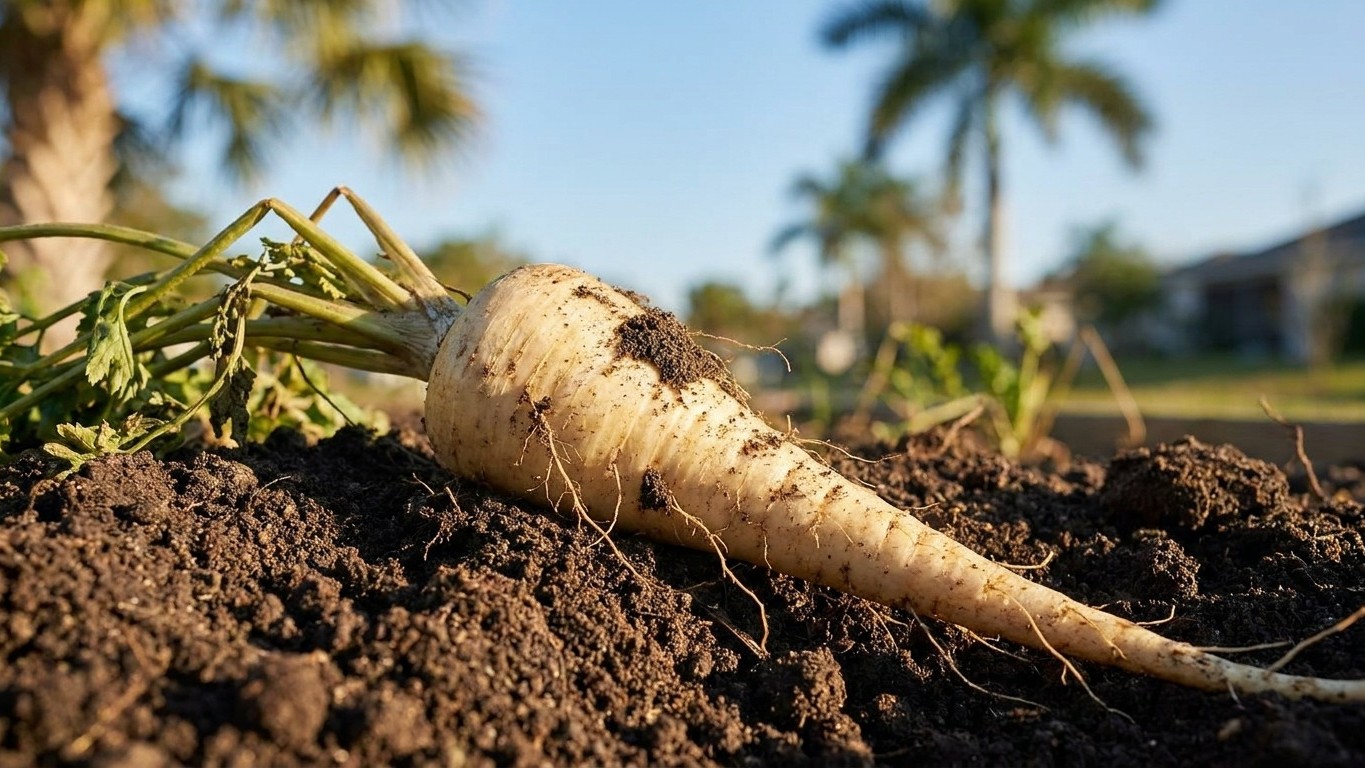

Texas A&M AgriLife Extension documents a working list of vegetable garden pests statewide, but only a handful of those actually touch parsnip. The rest are specialists that feed on squash, cabbage, or corn and never bother a root crop in the carrot family. Timing follows the frost-free window, not a fixed month, because parsnip’s whole life cycle here is built around cold exposure.
Which pests attack parsnip in Texas

Texas A&M AgriLife Extension documents thirteen garden pests for this territory. Sorting them against parsnip’s biology (a root crop in the carrot family, grown for its swollen taproot and feathery foliage) cuts that list down fast. Only seven of the thirteen have any real reason to be on a parsnip bed: fire ants, flea beetles, grasshoppers, melon aphid and other aphids, root-knot nematodes, spider mites, and whiteflies.
The other six belong to crops parsnip has nothing in common with. Cabbage looper and diamondback moth are brassica specialists, built to feed on cabbage, broccoli, and kale leaves, not on umbellifer foliage. Corn earworm targets corn ears and tomato fruit; parsnip has neither. Leaffooted bug pierces developing fruit on tomatoes, peppers, and pecans, a feeding style that doesn’t apply to a root vegetable with no fruit to speak of. Pickleworm, melonworm, and squash vine borer are cucurbit pests through and through, tied to squash and melon vines. Squash bug is the same story. Cucumber beetles ride along with flea beetles on AgriLife’s list, but where flea beetles will happily riddle young parsnip leaves with pinholes, cucumber beetles stay on cucurbits and skip the carrot family entirely.
That leaves a short, useful list. Flea beetles and aphids go after the tender top growth soon after germination. Spider mites and whiteflies show up once the canopy fills in and the weather turns hot and dry. Root-knot nematodes work underground on the taproot itself, invisible until the root is pulled. Grasshoppers and fire ants are opportunists, more about population pressure nearby than anything specific to parsnip. Seven pests, not thirteen, and that’s the number worth remembering when scanning a seed catalog’s pest warnings or a neighbor’s advice.
When each one shows up, and what it does first
Parsnip in Texas is sown directly in the ground, not transplanted, and the calendar for every pest on this list traces back to that seeding date rather than to a named month. Germination itself takes 14 to 21 days, according to Utah State University Extension, and nothing above ground exists for a pest to feed on before that window closes.
Once seedlings break the surface, flea beetles are usually first. They show up as a scatter of tiny, shot-hole punctures across the first true leaves, feeding that can stunt a stand of seedlings before the taproot has even started to size up. Aphids follow closely behind, clustering on the undersides of young leaves and along new growth, curling and yellowing the foliage as they draw sap. Both pests hit hardest in that early, tender-leaf stage, well before the crop has any size to it.
As the season runs on toward the 100 to 120 days from seeding that Utah State University Extension gives as parsnip’s maturity window, the pest pressure shifts. Spider mites become a summer problem, favoring hot, dry stretches, and their first sign is a fine stippling or bronzing across older leaves rather than a hole or a curl. Whiteflies build up around the same stretch, lifting off the plant in a small cloud when the foliage is disturbed. Grasshoppers tend to become a nuisance later in the season as populations swell nearby and migrate into garden beds, chewing ragged notches out of leaf margins. Root-knot nematodes give no visible sign above ground at all until the root is pulled and shows swelling, forking, or small galls. Fire ants are the wild card, showing up any time the soil is warm enough for their mounds, more a hazard to the gardener’s hands than a direct threat to the root itself.
Telling the damage apart from everything else
A parsnip bed can show a leaf problem, a root problem, or both, and not every one of them comes from an insect. A forked or split root has two separate possible causes here, and they are not the same thing: heavy or stony ground that physically deflects the taproot as it grows, and overwatering that encourages excess branching. Root-knot nematodes cause a different kind of root distortion, with small knotty galls rather than a simple fork, but the only way to tell them apart from a soil-texture problem is to look closely at the root once it’s out of the ground.
Leaf symptoms carry their own look-alikes. Yellowing, curled foliage can mean aphids feeding on the underside of the leaf, but it can also mean drought stress or a nitrogen shortfall, and only turning the leaf over settles it. Stippled or bronzed older leaves suggest spider mites, but similar bronzing shows up with plain heat stress on a crop that prefers cool growing conditions in the first place.
| Symptom | Possible pest cause | Non-pest look-alike | What tells them apart |
|---|---|---|---|
| Small holes in seedling leaves | Flea beetles | Hail or mechanical damage | Pest holes are rounded and scattered; mechanical damage is ragged and clustered |
| Curled, yellowing new leaves | Aphids | Drought stress, nitrogen deficiency | Check leaf undersides for clustered insects |
| Stippled, bronzed older leaves | Spider mites | Heat stress on a cool-season crop | Fine webbing on leaf undersides confirms mites |
| Forked or split taproot | Root-knot nematodes (knotty galls) | Heavy or stony soil, overwatering | Nematode damage shows small distinct galls, not a smooth fork |
None of this is a substitute for an actual look at the plant. When a symptom doesn’t clearly match one column or the other, that’s exactly the moment to bring a sample, not a description, to a local extension office.
What actually works here, and what is a waste of time
On a crop that stays in the ground through most of a year in this climate, timing beats any single treatment. A floating row cover set in place before germination finishes (that 14 to 21 day window) blocks flea beetles and winged aphids before they ever find the seedlings, and it costs nothing to remove once the plants are past the tender stage. Deep, loose, sandy soil, the same condition Utah State University Extension recommends for a straight, unforked root, also happens to make life harder for root-knot nematodes, which thrive in compacted, poorly rotated beds.
Crop rotation matters more here than any spray could, since nematodes are a soil-dwelling problem that a foliar treatment never reaches. Moving root crops to a different bed each season, and avoiding back-to-back plantings of carrot-family or nematode-prone crops in the same spot, does more long-term good than anything applied after the fact. Fire ant mounds near a bed are better relocated or treated as a mound problem on their own, since disturbing soil around a maturing taproot to chase ants risks damaging the root itself.
What tends to waste time: reaching for a broad treatment against nematodes, which live below the root zone and don’t respond to foliage-applied products, or overwatering a bed to “fix” what looks like drought stress when the real cause was a forked root all along. Texas A&M AgriLife Extension is the right place to confirm what’s actually labeled for use in home gardens in this state, since availability and rules shift and this page doesn’t prescribe products.
Where to check this for your own county
Texas A&M AgriLife Extension documents these pests at the state level, and that’s a starting point, not a diagnosis for any one backyard. Pest pressure inside Texas varies enormously between the Gulf Coast, the Hill Country, North Texas, and the Panhandle, four different USDA zones with different frost windows, different soil types, and different pest populations building at different speeds.
The frost dates used on this page (last spring frost February 4 to March 1, first fall frost December 1 to December 19) come from the NOAA NCEI 1991-2020 Climate Normals for the Houston area specifically, station IAH. A garden in Amarillo or Lubbock runs on a completely different calendar, with frost arriving weeks or months earlier and later than what’s listed here. Even inside the Houston area, Hobby airport tends to run about two weeks milder than IAH, which shows how much local variation exists even within a single metro region.
The county extension office is the resource built for that gap between a statewide pest list and what’s actually crawling on a specific bed. Bringing a physical sample, root and leaf both if possible, gets a far more useful answer than a description over the phone. That’s the next step when a symptom doesn’t clearly match anything on this page.
Common questions
Does frost kill a parsnip crop in Texas?
No. Parsnip actually needs exposure to frost for the flavor to develop; the roots convert stored starch to sugar during several weeks of cool, frosty weather. The plant itself tolerates cold well below freezing in the ground.
Can parsnip be grown in a mild winter without the crop tasting bland?
The sweetening comes from actual exposure to frost, not from being in a mild hardiness zone. A garden that stays comfortable all winter, with a coldest-month average minimum around 43.7°F as in the Houston area, may still see scattered freeze events within its frost window, but a winter with none at all won’t produce the same sugar conversion.
Why did my parsnip roots come out forked instead of straight?
Two separate causes are possible here: heavy or stony soil that physically deflects the growing root, or overwatering that encourages excess branching. Deep, loose, sandy soil (double-digging a heavy bed first) addresses the soil-texture cause.
How soon after sowing should pest problems be expected?
Not before germination finishes, which takes 14 to 21 days. Flea beetles and aphids are typically the earliest visitors once true leaves appear, well ahead of the 100 to 120 days the crop needs to reach maturity.