
In central and northern Illinois, collards go into the ground once the soil itself has warmed, not the moment the calendar clears the frost risk. Farther south and in mild winters, they can also be grown as a standing crop, picked leaf by leaf straight through the cold months. Which approach fits your garden depends less on frost dates than on how cold your coldest month actually gets.
When the soil is warm enough in Illinois

Gardeners tend to fixate on the frost date, but frost is a proxy, not the actual requirement. Collard roots and the soil microbes that feed them need warm ground, and ground warms slower than air. At the reference station in Chicago (USW00094846), NOAA’s 1991-2020 Climate Normals put the last spring freeze probability window between April 11 and April 22. That’s a probability band, not a guarantee: a 30 to 70 percent chance of a 32°F freeze occurring on either side of it, drawn from three decades of airport data. Suburban and rural gardens away from that paved, heat-retaining airport site typically see their own last frost run later, sometimes by one to two weeks, and even more if your property sits at higher elevation or in a low frost pocket.
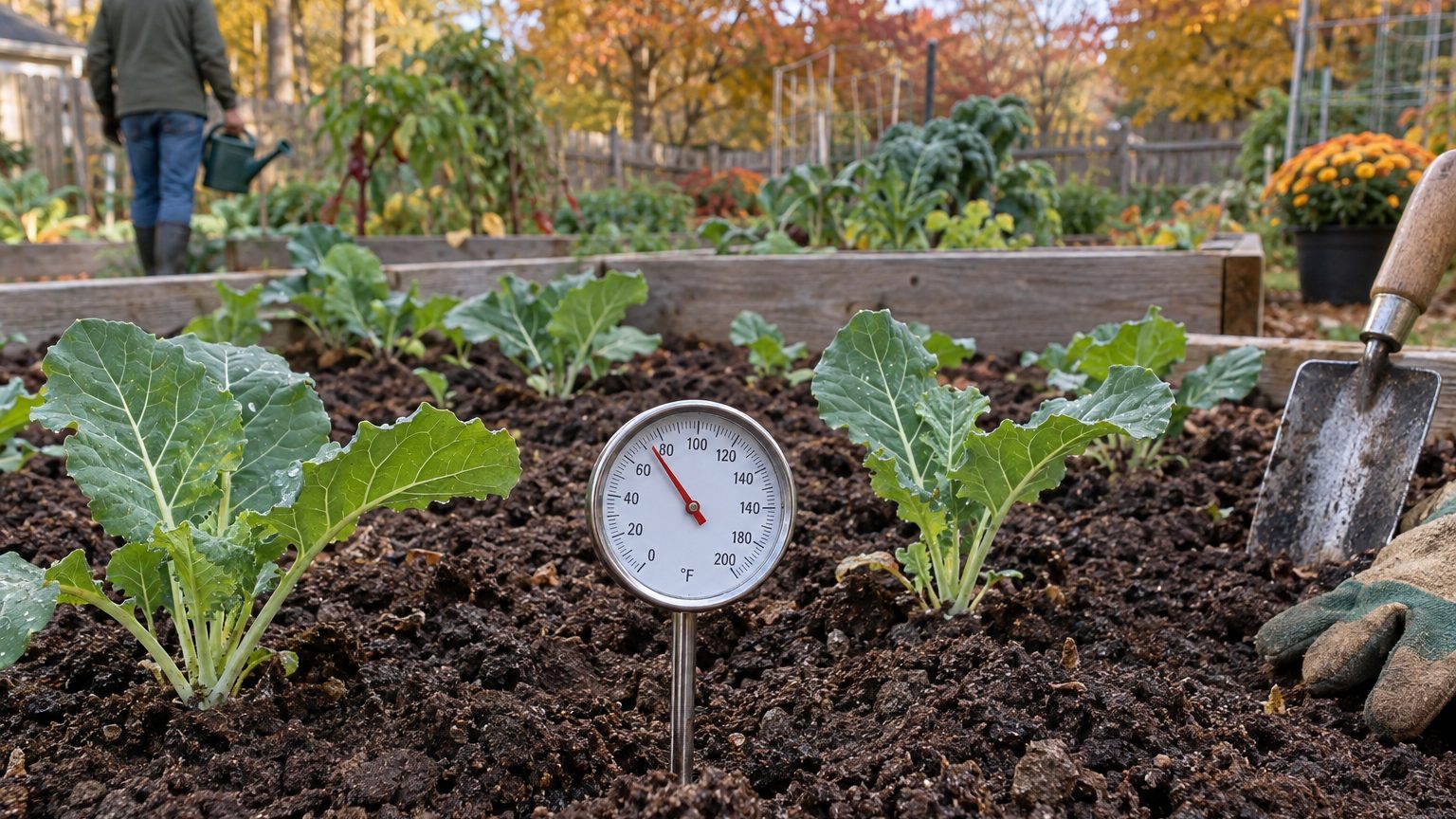
Soil temperature catches up to that window gradually. Even after the freeze risk from the chart has passed, cold, wet clay soil common across much of Illinois can sit in the low 40s for another week or two. Direct-seeding or transplanting collards into ground that hasn’t warmed leads to stalled growth and purpled, stressed leaves rather than outright death, since collards tolerate a light frost better than most vegetables. The practical move is to check soil temperature with a simple probe thermometer rather than trusting the frost date alone, and to wait for a stretch of settled weather rather than the first mild afternoon.
Bed prep matters as much as timing. Collards are brassicas, the same family as cabbage, kale, mustard, and turnips, and they carry the same soil-borne troubles: clubroot, black rot, cabbage maggot. Planting into a bed that grew any of those crops the previous year, or the year before that, isn’t really rotating anything. Check your county’s own frost record and, for a rotation plan that actually protects the bed over several seasons, work from the crop family groupings rather than guessing at how far back you need to go.
For variety selection at planting time, resist the urge to pick whatever seed packet looks familiar. This page doesn’t carry a list of cultivars trialled for Illinois conditions, and naming one here would be a guess dressed up as advice. The state’s Extension service tracks which types perform in local trials, and that’s the source worth checking before you buy seed.
How long the season lasts here
Stack the two frost windows from the Chicago normals against each other and you get a growing season that runs, depending on which end of each window your county lands on, somewhere around 195 to 196 days from last spring freeze risk to first fall freeze risk. That’s the span between April 11-22 on one end and October 24-November 3 on the other. Six and a half months is a genuinely long window for a leafy brassica that only needs 60 to 80 days to reach a pickable size.
What that length allows is a second planting. A window this generous means you aren’t limited to a single spring sowing that has to carry you through summer heat and into fall; you can seed again in mid to late summer for a crop that matures in the cooler, shorter days of September and October, when collards actually sweeten rather than turn bitter. That’s a meaningfully different growing strategy than a gardener in a shorter-season state gets to use, where the first sowing is often the only one that fits.
The length of the window also changes whether transplanting versus direct seeding is worth the trouble. With six-plus months to work with, starting seedlings indoors for an early spring crop and direct-seeding the summer succession is a reasonable split: it gets you an earlier harvest without tying up indoor space twice. In a shorter window, the math tips harder toward transplants for every planting, since every week of head start counts more when there isn’t a lot of season to spare.
If you’re planning exactly when to make that second sowing, the succession sowing guide on this site walks through timing it against your own first-fall-frost estimate rather than the Chicago average, which matters more the further your garden sits from that reference station.
Heat and water in Illinois

Collards live two different lives in Illinois, and the split isn’t about how hot the summer gets. It’s about how cold the winter gets. At the Chicago reference station, the coldest month’s average daily minimum temperature runs 18.8°F, and the state as a whole spans USDA Hardiness Zones 5a to 7b. That range matters because it separates two genuinely different ways of growing this crop.
Where winter lows stay closer to the milder end of that zone range, mainly in the state’s southern counties, collards can be grown as a standing crop: left in the bed and harvested leaf by leaf from November clear into March, with cold actually improving their flavor. Where winters run colder, closer to the Chicago normal of 18.8°F or below, that approach doesn’t hold up. Repeated hard freezes through a long winter eventually damage the crown, and the practical plan is to treat collards as an autumn crop that finishes at the first hard freeze rather than banking on it surviving the whole season outdoors.
Summer is a secondary factor here, and it cuts both ways rather than pointing in one clear direction. Illinois summers are humid and can turn muggy for stretches, and that humidity is friendlier to fungal leaf diseases like downy mildew than dry heat is. A stretch of hot, sticky weather slows collards down and can push them toward bitterness faster than a milder summer would, which is part of why the second, cooler-season sowing tends to produce the better-tasting harvest. Good airflow between plants and mulch to keep soil moisture even do more for a collard bed here than any amount of extra watering during a heat spell.
None of that changes the core planning question, though. Whatever the summer does, it’s the winter low in your specific county, not the July heat, that decides whether this bed is a one-season autumn planting or a standing crop you’re still picking from in February.
Which collards suit Illinois
Sort the choice by type rather than by brand name on a seed rack, and the state’s own facts point the way. A season that runs close to 195 to 196 days from frost to frost is long enough to favor the faster-maturing types for a spring planting, freeing up time for that second summer sowing discussed above. For gardeners in the state’s colder zones, where the coldest month’s minimum sits near 18.8°F, an autumn-focused type bred to finish before hard freeze makes more sense than one bred for extended standing harvest.
In the milder southern counties within Zone 7, where a standing-crop approach is realistic, disease resistance moves up the priority list. A plant that’s going to sit in the garden through a humid autumn and into a damp winter needs some built-in resistance to the leaf diseases that thrive in that kind of weather, more than it needs sheer speed to maturity. Airflow planning, wider spacing, and orienting rows to catch prevailing wind, does as much work here as the variety itself.
This page won’t name a specific cultivar, and that’s a deliberate choice rather than an oversight. Seed catalogs list dozens of collard types bred for different combinations of speed, cold tolerance, and disease resistance, and which ones actually perform well changes from one part of Illinois to another. The University of Illinois Extension runs and publishes variety trials specific to the state’s growing conditions, and that’s the source that carries real weight, because it reflects what’s actually been grown and measured in Illinois soil rather than a general description of a “type.”
Whatever type you land on, the same brassica-family caution applies at planting time as it does everywhere else on this crop: don’t tuck collards into a bed that grew cabbage, kale, mustard, or turnips within the past couple of seasons. They’ll carry forward the same soil-borne problems, and a rotation that ignores the family relationship isn’t really a rotation at all.