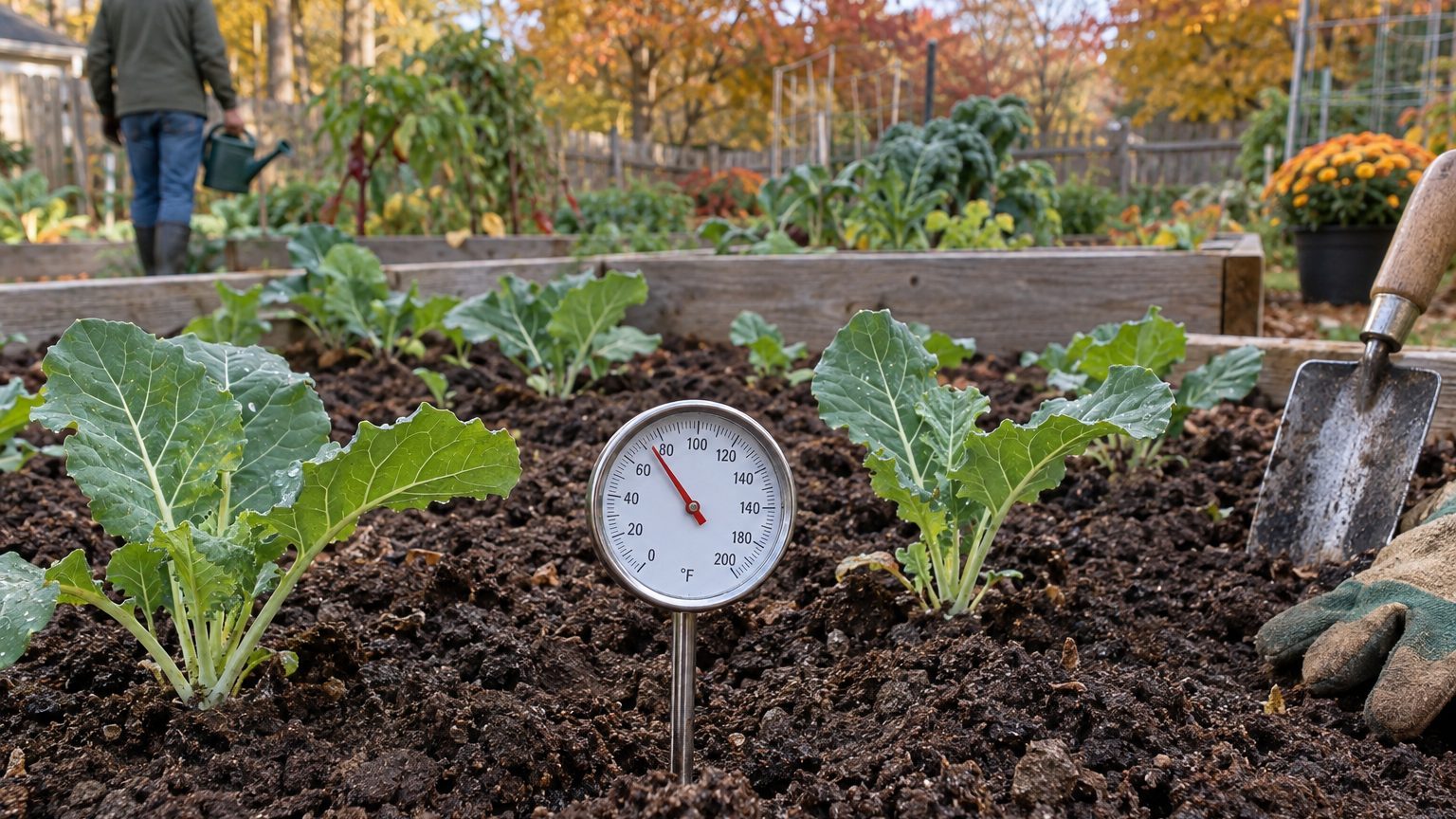

Collards go in the ground once the soil itself has warmed, not simply once the frost calendar clears. In Rhode Island that generally means late April through mid-May for transplants, with direct seeding pushed a bit later, and it means the crop can often keep producing leaves well past the first fall frost if the winter stays mild enough.
When the soil is warm enough in Rhode Island

Gardeners reach for the frost date first because it’s the number everyone repeats, but it’s a stand-in for something else: soil temperature. Collards germinate and transplant well once the ground itself has shed its winter chill, and that lag behind the air is real, sometimes a full week or two behind the date on the calendar. For Rhode Island, the reference figure comes from NOAA’s Climate Normals for 1991-2020, calculated from freeze-probability data at station USW00014765: the last spring frost typically falls somewhere between April 7 and April 17. That’s a 30 to 70 percent probability band, not a guarantee, and it’s measured at an airport weather station, so a low-lying garden a few miles inland or up in elevation should expect frost risk to linger later into spring than that window suggests.
What that means practically: treat the back half of that window, closer to mid-April, as the earliest sensible target for direct seeding, and hold transplants until the soil has had a week or so of settled warmth afterward. Pulling soil from four inches down and feeling whether it’s still cold and damp, rather than just checking whether the thermometer cleared 32°F overnight, tells you more about whether collard roots will actually get moving.
Why frost dates undersell the real risk
A frost date is a probability, not a promise. Even inside the stated window, a late cold snap can still catch an early planting, and gardeners who push transplants out in the first week of April in a typical Rhode Island yard are gambling against odds that haven’t favored them yet that season. Collards tolerate a light frost far better than tomatoes or peppers do, which is part of why they’re forgiving to grow here, but seedlings set out into still-cold ground simply sit and sulk rather than dying outright.
Collards belong to the brassica family alongside cabbage, kale, mustard, turnip, and rutabaga, and that matters even at planting time: if the bed hosted any of those crops last season, the same soil-borne pests and diseases are waiting in it. Check the crop rotation guide for brassicas before deciding where this year’s collards go, rather than assuming a bed is clean just because it looks that way.
How long the season lasts here
Rhode Island’s frost-free window runs from that April 7-17 spring date to a first fall frost that NOAA’s 1991-2020 normals place between October 24 and November 3, again from station USW00014765. Because both edges of that window shift together (each about ten days later at the late end of their range), the length works out consistently: roughly 200 frost-free days, however you combine the early or late version of each date.
Two hundred days is a genuinely long growing season by New England standards, and it changes how a collard patch gets planned. It’s long enough to support a spring sowing that matures through early summer and a second sowing in mid-to-late summer that comes on through fall, rather than treating collards as a one-shot crop. Gardeners who only ever plant once in April are leaving a second harvest window unused.
What the window changes for transplants
A season this long also makes transplanting more forgiving. If an early batch gets checked for root health, a soft or discolored root system, and needs to be replaced, there’s still enough calendar left to start over without losing the year. In a shorter window that decision would be nearly a season-ending one; here it’s a setback, not a disaster. For the mechanics of staggering plantings so the harvest doesn’t all land the same week, the site’s succession sowing guide walks through timing a second round once the first is in the ground.
Heat and water in Rhode Island

The number that actually decides how a collard bed gets planned in Rhode Island isn’t a summer figure at all. It’s the winter one: the mean daily minimum of the coldest month, which NOAA’s Climate Normals put at 22.1°F for the Providence reference station. That figure, not the record low and not a seasonal average, is what determines whether collard plants can be left in the ground through winter as a standing crop or whether the season simply ends at the first hard freeze.
Rhode Island sits in USDA Hardiness Zone 6a to 7b, a range built entirely around the average annual extreme minimum temperature, and it spans real variation across the state, coastal areas running milder than inland valleys. Where winter lows stay on the gentler end of that range, collards can be picked leaf by leaf from November into March, since a light frost sweetens their flavor rather than damaging them. Where the cold cuts harder, as it can well inland, the crop is better treated as an autumn planting that finishes at the first hard freeze rather than one gardeners try to nurse through January.
Summer conditions matter here too, though in a quieter way than in warmer states. Coastal New England summers tend to run humid rather than scorchingly hot for long stretches, and that combination, moisture without the driest heat, is exactly the setup that favors fungal problems: downy mildew, leaf spot, slower ripening in a wet stretch. Spacing plants for airflow and watering at the soil line rather than overhead does more good here than anything aimed at heat stress. It’s also worth remembering the brassica connection again: mildew and leaf spot don’t stay confined to collards. A bed shared with cabbage or kale one year and collards the next hasn’t broken the disease cycle, it’s carried it forward.
Which collards suit Rhode Island
The honest answer to which variety to plant is that this page can’t responsibly name one. Collard trials run by state extension services test named cultivars against local disease pressure, local season length, and local heat and cold, and those results change from one state to the next. A variety bred to shrug off Southern humidity isn’t automatically the right pick for a Rhode Island garden with a 200-day season and a milder, wetter summer. Naming a cultivar here without that local trial data behind it would be a guess dressed up as advice.
What this page can do is point toward the reasoning that should guide the choice. A season of roughly 200 frost-free days favors types bred for a shorter, cooler run rather than ones that need a long hot stretch to size up. The humid coastal summer makes disease resistance, particularly against downy mildew and leaf spot, the first thing to check on a seed packet or plant tag, ahead of leaf size or color. And where the coldest-month minimum stays gentler, a cold-hardy type suited to standing through winter picking is worth seeking out specifically, rather than assuming any collard will hold up the same way once frost sets in.
For the actual names trialled and recommended for Rhode Island conditions, the University of Rhode Island Cooperative Extension is the source that carries real weight, since its recommendations come from plantings tested in this state’s soil and weather rather than a national average. That’s also the place to check current guidance on rotation timing for brassica beds, since collards, cabbage, kale, mustard, turnip, and rutabaga all share the same soil-borne risks and none of them count as a rotation partner for the others.