
Two sowing windows work in Colorado: a spring transplant window timed off the last spring frost, and a summer direct-sow window timed off the first fall frost. Both dates come straight from Colorado’s freeze data, not from a generic garden calendar. Collards tolerate cold better than most greens, which is exactly why the state’s short, dry, high-elevation growing season still leaves room for two solid harvests if you hit these windows.
The short answer for Colorado
Set transplants outside from mid-April through the first days of May, aiming to land two to three weeks ahead of your area’s last spring freeze. Then direct-sow a second round from late June through mid-July for a fall crop that keeps producing after frost sweetens the leaves. Both dates hang on the same number: Colorado’s last spring frost falls between May 1 and May 11, and the first fall frost lands between September 30 and October 12, both figures pulled from the 30-70% probability band in NOAA’s 1991-2020 Climate Normals for the Denver station (USW00003017).
That probability band matters more than the calendar date itself. A 30-70% band means the freeze risk on any given day inside that window is neither rare nor certain, it is genuinely up for grabs. Planting on May 1 is not “safe,” it’s a coin flip weighted slightly in your favor by the end of the window. Collards handle that gamble better than beans or squash because a light frost on young transplants rarely kills them outright, it just stalls growth for a few days.
Direct seeding in early spring is a different story. Collard seed germinates poorly below 45°F and barely moves until soil hits the mid-50s, and Colorado’s plains soil at 5,280 feet warms slowly under a thin, dry snowpack. That’s why the spring window favors transplants started indoors six to eight weeks earlier, not seed sown straight into cold ground. For general timing on soil prep and spacing once transplants go in, see Growing Collards in Colorado.
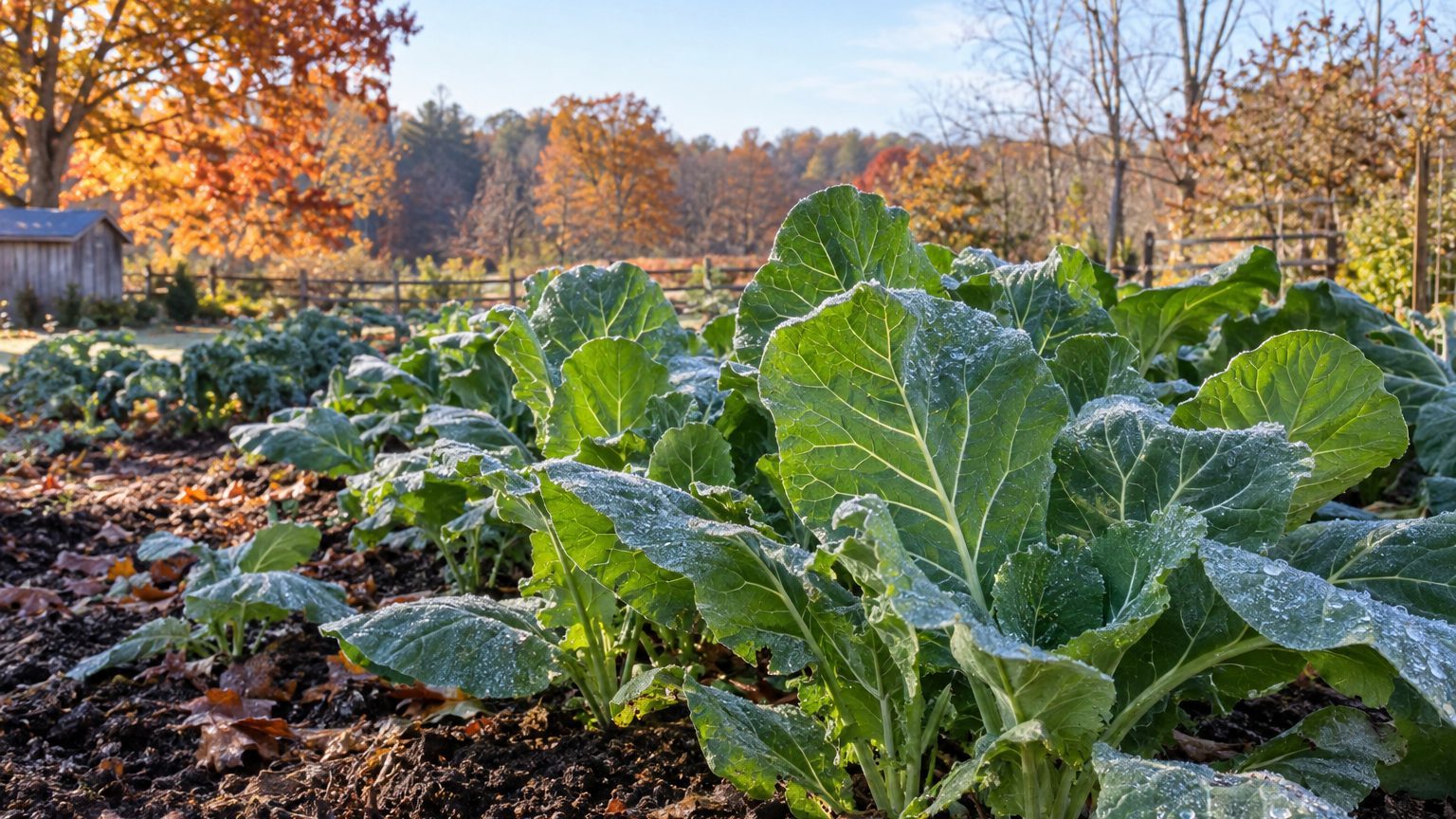
The fall window works on the opposite logic. Counting back from the September 30 to October 12 frost range, a 60 to 85 day collard variety sown in late June or the first half of July has enough runway to size up before cold arrives, and then it keeps going. Frost doesn’t end a collard planting, it improves it, converting starches to sugars in the leaves. That’s the real payoff of gardening collards in a state with an early fall freeze: the crop is built for it.
What will not work here

Slow varieties miss the window entirely. A 90-day collard direct-sown after the Fourth of July is racing a frost date that can arrive as early as September 30, and it will likely lose that race most years. Colorado’s growing season between the two frost bands runs roughly 140 to 160 days at the Denver reference point, and that’s a generous estimate for the plains. Push a long-season variety past mid-July and you’re gambling with a plant that needs every one of those days just to reach a harvestable size, leaving zero margin for a cold snap or a slow, cloudy stretch.
Weekly watering fails just as often, for a completely different reason. Denver’s climate is dry and sits at altitude, which means faster evaporation and lower humidity than a collard grower in the Southeast ever has to plan for. A once-a-week soak might carry a plant through a Georgia summer, but on Colorado’s Front Range that same schedule leaves collard roots gasping between waterings, and the leaves respond by turning bitter and tough. Two to three waterings a week, deep enough to reach past the first few inches of soil, is closer to what the climate actually demands.
Unprotected overwintering is another trap. Collards can survive into the mid-20s without much trouble, but Colorado’s coldest month brings a mean daily minimum of 18.4°F, and that’s an average, not the floor. A plant left uncovered through a hard January cold snap is not surviving on hope. If you’re trying to stretch a fall crop deep into winter, that’s a row-cover-and-mulch project, not a “leave it and see” project.
Variety choice compounds all of this. Picking a collard bred for a long, humid Southern season and expecting it to behave the same way on the high plains ignores exactly the kind of local trial data covered in The Best Collards and Greens for Colorado, which is worth checking before you buy seed.
What changes across Colorado
Colorado is not one growing season, it’s several stacked on top of each other by elevation. The state’s USDA hardiness zones span 3b to 7b, a five-and-a-half zone spread inside a single state’s borders, and that range alone tells you the Denver-area dates above are a starting point, not a rule for the whole map.
A gardener on the eastern plains near the Denver reference station is working with the frost dates cited here fairly directly. A gardener in a mountain valley is working with something else entirely. High-elevation towns can see a freeze in July, which means the entire two-crop spring-and-fall system described above collapses into a single, compressed summer window, or shifts almost entirely to season-extension tools like cold frames and row covers just to get one harvest in. The western slope runs on its own pattern too, shaped by different air drainage and different summer heat than the Front Range.
The practical shift for anyone outside the Denver corridor is straightforward: push the spring transplant date later and the fall sowing date earlier, in proportion to how much colder and shorter the local season runs compared to the plains. A county at higher elevation isn’t a slightly colder version of Denver, it can be a genuinely different growing zone with a season measured in weeks rather than months.
None of this is something to guess at from a state-level article. The zone spread here is the reason to check the actual USDA Plant Hardiness Zone Map for your specific location rather than assume the Denver dates apply, because a five-zone range packed into one state means the answer really does change depending on where you’re standing.
Where to check this for your own county
Colorado State University Extension is the source that overrides everything on this page. Its statewide site sits at https://extension.colostate.edu/, and from there the county offices publish planting calendars built on local frost data rather than the single Denver reference station used above.
Two things are worth hunting down once you’re there. First, the county-level planting calendar, which will show a sowing window adjusted for that county’s actual elevation and frost pattern, not the statewide average. Second, any variety trial results or extension bulletins naming collard cultivars that have performed well in that specific county’s soil and heat pattern. A county office in a mountain valley and one on the eastern plains are not going to recommend the same varieties or the same dates, and that’s the whole point of checking locally.
This page works at the state level because it has to say something true for both a Denver-area garden and a mountain-valley garden at once, which means it can only get so specific. A county extension recommendation doesn’t have that problem. It’s built from local data for local conditions, and it beats a state-level calendar every time there’s a conflict between the two. Treat what’s written here as the floor, not the ceiling, of how precise your planting decision can get.
The Moon calendar is a separate, older custom: see when to plant collard greens by the moon, written as tradition rather than fact.
Checking this against your own garden
Every date on this page is a probability, and your own garden is the tiebreaker. Three things to watch, none of which need a thermometer or any other tool.
Soil that crumbles easily in your hand, rather than clumping cold and wet, is telling you the ground has actually warmed enough for collard roots to get moving, regardless of what the calendar says. Squeeze a handful from the planting bed; if it falls apart loosely, that’s workable soil, and if it packs into a cold, dense ball, wait.
First true leaves showing up roughly 10 to 14 days after direct sowing confirm the seed actually germinated in that soil temperature, rather than sitting dormant. If nothing’s shown after three weeks, the ground was likely still too cold when you sowed, and that’s useful information for next spring’s timing, not just this year’s.
A seed stalk shooting up unexpectedly in a spring planting is a bolting signal, usually triggered by a hot stretch arriving earlier than the calendar suggests. That’s your garden telling you the local microclimate runs warmer or faster than the state averages, and it’s the cue to pull that planting and shift straight into fall-sowing mode rather than waiting out a crop that’s already decided its season is over.