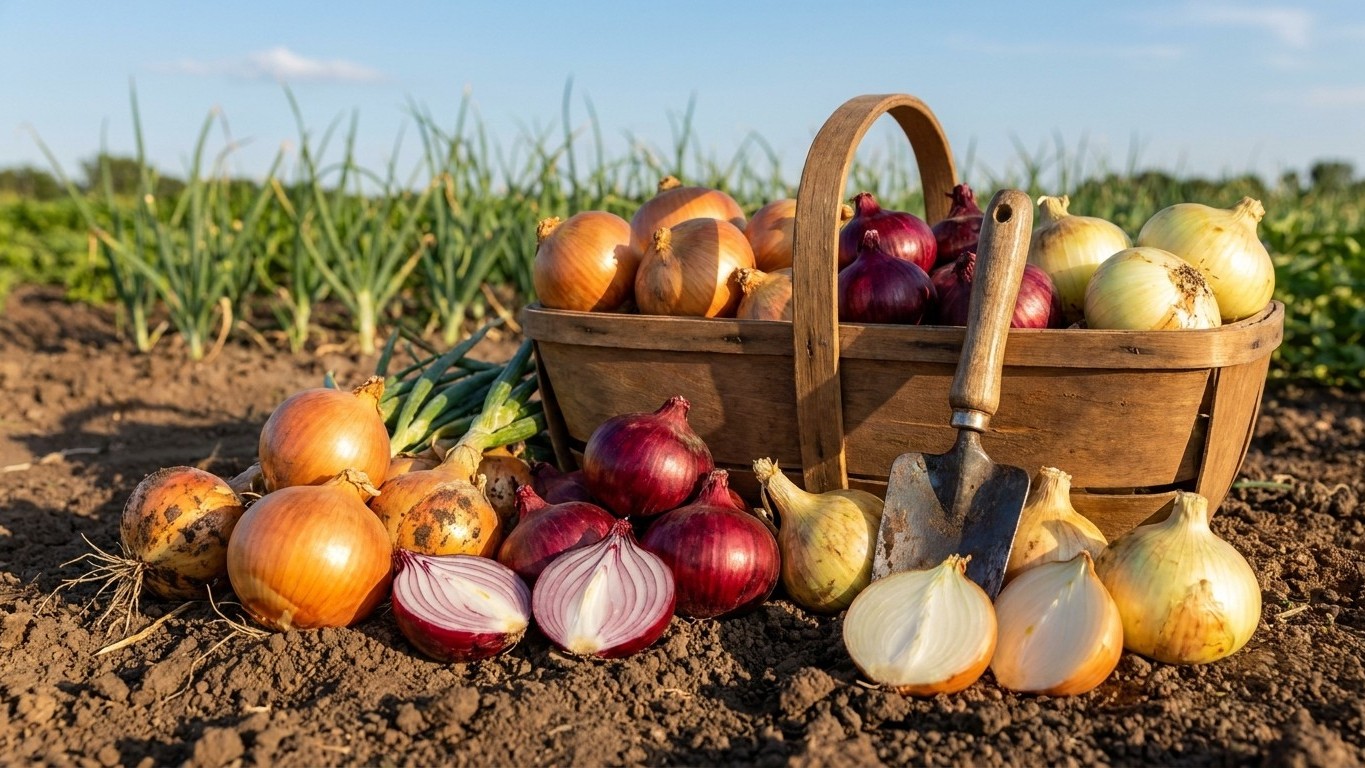

Lift Montana onions when the tops flop over and turn yellow, then cure them somewhere warm, dry and airy until the necks are tight and the skins papery. Bulbs go into storage only after that, never straight from the ground. Day length sets the schedule. At Billings, 45.81 degrees north, the longest day runs 15 h 32, enough to push long-day onions into bulbing. The harvest follows from that, and so does how long the crop will keep.
The short answer for Montana
An onion does not bulb because the weather warms up. It bulbs when the day gets long enough. Short-day varieties start at about 12 hours of daylight, a threshold published by Clemson Cooperative Extension. Long-day varieties wait for 14 to 16 hours. Billings, the city these figures come from, gets 15 h 32 on the longest day (calculated from its latitude, with the real figure about seven minutes higher once atmospheric refraction is counted). That clears the long-day requirement with room to spare, which is why long-day onions are the natural fit across Montana. The full planting picture is in Onions in Montana.
Reading the tops
Once bulbing starts, the plant stops making new leaves and pours its reserves downward. When the bulb is full, the neck softens, the tops yellow and fall over. That is the signal to lift, not a date on the calendar. This page does not publish a harvest date or frost date for Montana, because those vary by garden. Pull on a dry day, shake off the soil, and do not wash the bulbs.
Curing until the necks are tight
Curing is a drying step. Spread the bulbs in a single layer in a warm, shaded, well-ventilated place, with the tops still attached and the bulbs sheltered from rain. You are finished when the neck is tight and dry and the outer skins rustle like paper. Then trim the dried tops to a short stub and store.
The target for storage, per Clemson Extension: “Ideal conditions are between 45 °F and 55 °F, and 50 to 60 percent humidity.” (Clemson Cooperative Extension, Home & Garden Information Center.) Onions want it dry, which is the opposite of what carrots and beets want.
What will not work here
Several common habits fail in Montana, and they fail in predictable ways. Short-day onions are the clearest case. They begin bulbing at about 12 hours, long before Montana’s days peak, so they bulb early on a small plant and finish with small bulbs. Late planting has a similar effect, though many gardeners expect the opposite. Planting late does not delay the harvest, it shrinks it. Whatever size the plant has reached when day length triggers bulbing is the size of the bulb you get. A seedling that is still tiny in late June will make a tiny bulb in August.
The failures at harvest and storage are just as firm:
- Short-day varieties: they trigger at about 12 hours of daylight, so they bulb early and stay small at Montana’s latitude.
- Late-planted onions: the plant is too small when bulbing starts, and the bulb is capped at that size.
- Lifting with green, upright tops: the neck is still thick and wet, and wet necks let rot in during storage.
- Washing before curing: the moisture sits in the outer layers and invites mold.
- Storing sweet types for winter: they hold fewer protective sulfur compounds and soften well before spring.
- Sharing a cellar with carrots: root crops want damp air, onions want 50 to 60 percent humidity, and one space cannot do both well.
- Binning damaged bulbs: a bulb with a nick or pest damage rots first and spreads it, so use those first.
The opposite mistake, planting a long-day onion where days never reach 14 hours, does not apply in Montana. Here the day is long enough. The risk lies in picking the wrong group, or in rushing the finish. For what feeds on bulbs through the season, see What Eats Onion in Montana, and When.
What changes across Montana
Montana is a large state, and 45.81 degrees north is the latitude of Billings only. The state stretches a good distance north to the Canadian border and a little south of Billings along its southern edge. Gardeners at either end should look up their own latitude instead of borrowing Billings’ number. The figures come from NOAA NCEI, the station that also supplies the climate normals for Billings.
| Location | Latitude | Longest day | What it changes |
|---|---|---|---|
| Billings (reference city) | 45.81 degrees north | 15 h 32 | Clears the 14 to 16 hour long-day requirement |
| Far north, toward Canada | Higher than Billings (check yours) | Longer than 15 h 32; exact figure not published here | Bulbing triggers a little earlier in the season, tops fall a bit sooner |
| Southern edge | Lower than Billings (check yours) | Shorter than 15 h 32; exact figure not published here | Still long-day territory, but frost dates and elevation matter more than latitude |
Nowhere in the state does the day drop to the 12-hour mark that triggers short-day types, so the group does not change from one end to the other. What shifts is timing: the date the tops fall and the date frost arrives. Elevation can matter as much as latitude, since a mountain valley and the eastern plains can differ by weeks in frost dates. That is the reason to treat a harvest window as a local number, not a state one.
Sweet now, or onions that last
Every garden makes a trade here, and chemistry sets its terms. The sharp bite of an onion comes from volatile sulfur compounds, and those same compounds protect the bulb in storage. A sweet onion has fewer of them. It tastes better raw and will not last the winter. University of Missouri Extension puts it plainly: “As a rule, ‘sweet’ onions do not store as well as the more pungent types.”
Day length lines up with this. Short-day types run sweeter, long-day types keep longer. A southern garden gives onions to eat soon, and a northern one gives onions that feed you into March. Montana sits on the northern side, so the best-keeping crop here is a pungent long-day onion. It will taste sharp the day you cure it and mellow once it is cooked.
By March, a properly cured, properly stored crop of pungent long-day onions is the pantry you want: firm bulbs, dry skins, a few sprouting at the neck that you use first. A sweet batch from the same garden would by then be soft, translucent or gone. If you want some of both, plant the sweet ones for August and September eating, and keep the pungent ones for winter. Each variety’s keeping character is covered in The Best Onion Varieties for Montana.
Checking this against your own garden
The Billings figures are a starting point, not a verdict for every garden in the state. Your county extension office knows the local frost dates, the elevation effects and which varieties have worked nearby. A few checks you can finish this week:
- Look up your own latitude, especially if you are far north or south of Billings, and compare the day length to the 14 to 16 hour long-day requirement.
- Ask your county extension office for the local first-frost and last-frost dates, since this page does not publish them.
- Check the label or catalog notes on every variety you grow to confirm it is a long-day type.
- Take a thermometer and a hygrometer to the spot you plan to store onions, and see whether it holds 45 to 55 °F and 50 to 60 percent humidity.
- Pick your curing spot now: warm, dry, shaded, ventilated and out of the rain.
- Decide which bulbs you will eat first (sweet types, thick necks, any damaged ones) and which are for winter.
Common questions
How do I know my onions are ready to lift?
Watch the tops. When most have yellowed and fallen over and the necks have gone soft, the bulbs are done growing. Lift on a dry day and shake off the soil. There is no single Montana date, since frost dates and planting dates vary by garden.
How long does curing take?
No fixed number is published here, because it depends on weather and the thickness of the necks. The test is the finish: necks tight and dry, outer skins papery. If a neck is still thick or moist, keep curing.
Where should I store cured onions?
Choose somewhere that holds 45 °F to 55 °F and 50 to 60 percent humidity, per Clemson Extension. Keep them in a single layer or in a well-ventilated container. Do not store them next to carrots or other root crops that need damp air.
Can I store sweet onions through winter?
Not reliably. Sweet onions hold fewer of the sulfur compounds that protect a bulb, so they soften early. Eat them first, and save pungent long-day onions for the months ahead.