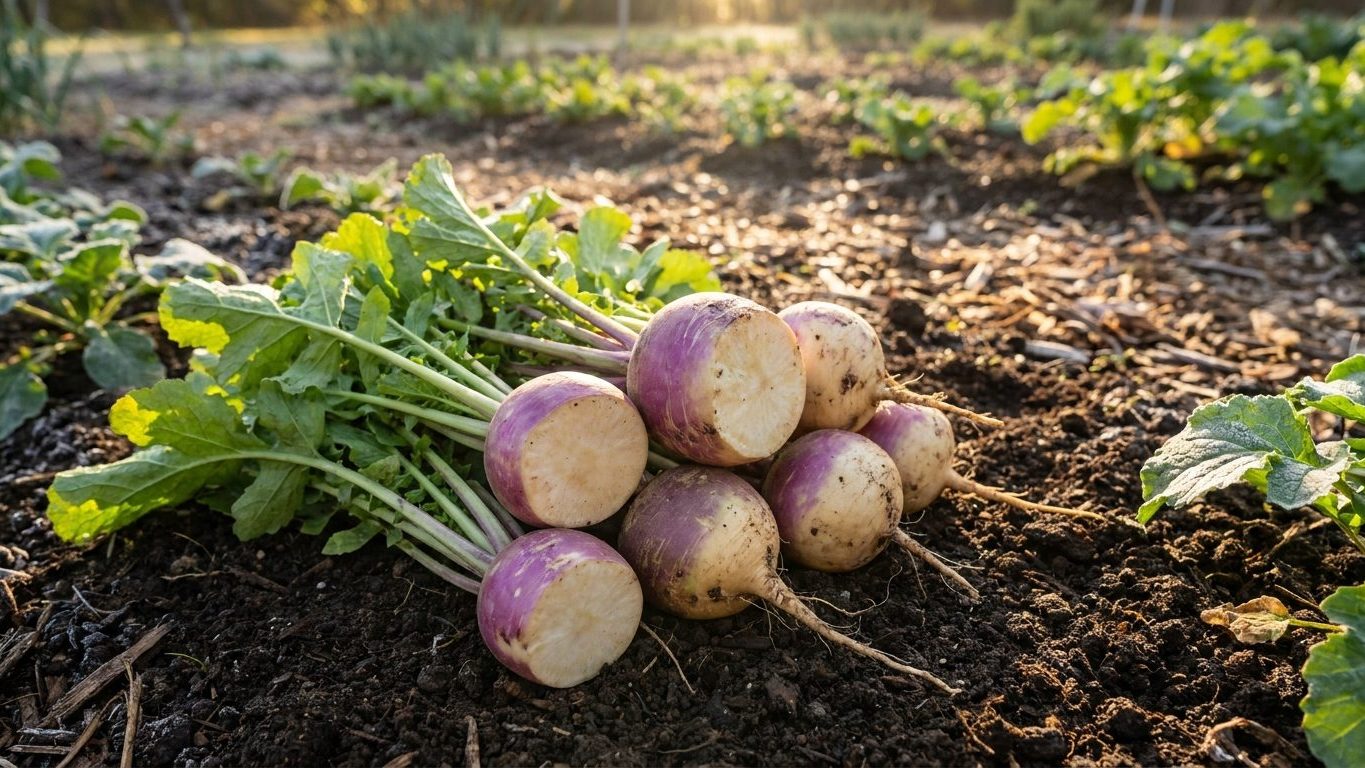

Growing turnips in Florida works, but the calendar runs opposite to what northern gardeners expect. In north Florida, around Jacksonville, the crop belongs to the cool months, with a fall sowing doing most of the work. Farther south, frost is effectively absent, winter becomes the whole season, and summer is the hard part. Which Florida you garden in decides nearly everything.
When the soil is warm enough in Florida
The date most north Florida gardeners ask about is the last spring frost. The NOAA NCEI 1991-2020 Climate Normals place it between February 16 and March 7, using 32F freeze probabilities (the 30-70% band) at station USW00013889, the Jacksonville airport. That is a probability, not a promise, so a late freeze after March 7 is possible in any given year.
Frost is only a proxy, though. Turnips and rutabaga do not care about the calendar. They care about the soil. Soil warms after the frost risk ends, not along with it, because the ground holds winter’s chill longer than the air does. A seedbed that is still cold and soggy leaves seed sitting and rotting. A seedbed that has warmed gives steady germination. In north Florida that warm-up comes quickly, and the heat that follows closes the spring window almost as fast.
Spring sowing in north Florida is therefore a short, early bet. The fall sowing is the main event, timed by when summer’s heat finally breaks and the soil cools. This page does not carry a sourced sowing date for fall, and a made-up one would be worse than none. Your county office publishes the local planting calendar, which you can find through University of Florida IFAS Extension.
North Florida is not the whole state
The Jacksonville numbers describe north Florida only. The airport sits at an inland site, and even there three of thirty falls saw no freeze at all. Central and south Florida are effectively frost-free, so the frost-date logic above does not apply to Orlando or Miami. There the calendar inverts: the main season runs through the cool winter months, and summer is what you plan around.
If you garden in central or south Florida, treat the February and March dates above as irrelevant to you. Start from the cool months and ask your county extension agent which sowing weeks have worked locally.
How long the season lasts here
Both frost dates come from the same NOAA station, so the subtraction is honest. Counting from the latest edge of the spring band (March 7) to the earliest edge of the fall band (November 26) gives 264 days. Counting from the earliest spring edge (February 16) to the latest fall edge (December 13) gives 300. The frost-free stretch in Jacksonville is therefore roughly 264 to 300 days, depending on which end of each band a given year lands on.
That is a long window, and a long window is useful mostly for what it allows. It allows a second sowing. A gardener in Jacksonville is not limited to one shot at the crop the way a gardener in a short-season climate is. You can sow a modest spring planting, accept that summer will end it, and sow again for fall. You can also stagger the fall planting over several weeks so the harvest does not arrive all at once. The succession sowing guide on this site walks through how to space those plantings.
One caution. The frost-free count is not a turnip count. The middle of that 264-to-300-day window is summer, and summer is not turnip weather. The usable part is the cool shoulder on either side. What the long window really buys you is permission to miss a sowing and try again.
It also changes the transplanting question. Turnip and rutabaga roots resent disturbance, and a transplant needs a root check before it goes in, since a bent or damaged taproot leads to a misshapen crop. With a long window you can simply resow a failed row, so transplanting rarely earns its trouble. Compare that with a territory where the first sowing is the only sowing. In Growing Turnips and Rutabaga in Nunavut, a failed start can cost the whole year, and the arithmetic of transplanting looks very different.
Heat and water in Florida
This page was supposed to quote the count of days above 90 F and the summer rainfall. Neither figure is in the verified data behind it, so neither appears here. Both are available from NOAA station normals and from your county extension office. Florida summers are long, hot and wet, which is why nobody sows turnips into them, and why the two facts that govern this crop are the cold ones.
The first is the coldest month. At the Jacksonville reference station, the mean daily minimum of the coldest month is 42.9 F (NOAA NCEI Climate Normals 1991-2020). That is the average of the coldest nights, not the record low. On a typical winter night the ground does not freeze hard, so roots can usually stay where they grew, under a layer of mulch, instead of being lifted for the winter. Mulch here is about holding moisture and steadying the soil, not insulating against a deep freeze.
Leaving roots in warm, wet winter soil has its own risk, which is rot and coarse, woody growth. Harvest when roots reach a good size rather than treating the ground as storage. For anything you do bring in, inspect each root. A soft patch, a weeping spot or a moldy crown ends the question, and a root that looks sound from the outside is not proven safe. This page promises no keeping time.
The second fact is the winter low, and it decides how much frost sweetening the crop actually gets. Cold nights push turnips and rutabaga to convert starch to sugar. The first fall frost falls between November 26 and December 13 (same station, same 30-70% band), and in three of thirty falls it never came at all. With nights averaging 42.9 F in the coldest month, Florida sweetening is modest and unreliable. Do not plan a recipe around it. For a fuller account of the mechanism where it works dependably, see Growing Turnips and Rutabaga: An Autumn Crop, Sweetened by Frost.
The USDA Plant Hardiness Zone Map (2023, built on 1991-2020 normals) lists the state as 8b to 11b. That system rests on one variable, the average annual extreme minimum temperature, so it says whether perennials survive and almost nothing about when to sow turnips. The range is territory-wide, and parts of the state differ sharply from the Jacksonville station used here.
Humidity is the other half of the story. Turnips and rutabaga are brassicas, so they share their pests and diseases with cabbage, kale and mustard. Damp air and warm days favor fungal leaf spots and rots. Spacing for airflow, draining the bed and watering at the base of the plant help. So does rotation, but only if the next crop is not another brassica. Rotating turnips into a cabbage bed rotates nothing. The rotation page on this site explains the plant families to keep apart.
Which turnips and rutabaga suit Florida
Choose by type, and let your county extension agent supply the names. Florida’s growing conditions point to a few criteria that matter more than any catalog description:
- Quick-maturing turnips for the short spring window, so the roots finish before heat arrives.
- Types with strong disease resistance, since humidity makes this the first filter in Florida, ahead of flavor or color.
- Upright, open-topped plants that allow airflow, and a planting layout that shades the soil around the roots.
Rutabaga deserves a separate word. It generally needs a longer stretch of cool weather than a turnip does. In north Florida the fall-to-winter window can accommodate it with an early fall sowing, but it is the less forgiving of the two, and it is far harder in the warmer parts of the state. Treat it as the crop to try after turnips have worked for you.
This page names no cultivars, and that is deliberate. The varieties that perform in Florida are the ones trialled in Florida soil, heat and disease pressure, and this page does not have those trial results. A variety name pulled from a national catalog or a neighboring state’s list may behave very differently in a humid, sandy-soil garden. Your local trial data lives with University of Florida IFAS Extension, and your county office can say what has actually grown well nearby.
For a neighboring Southern climate with its own disease pressure and sowing rhythm, Growing Turnips and Rutabaga in Louisiana makes a useful comparison, though its recommendations should not be transplanted wholesale onto a Florida bed.
Common questions
Can I use these dates in Orlando or Miami?
No. The February 16 to March 7 and November 26 to December 13 bands come from the Jacksonville station. Central and south Florida are effectively frost-free, and the main turnip season runs through winter there, so frost dates do not apply.
Can I sow turnips in spring in Florida?
In north Florida, yes, after the last spring frost band (February 16 to March 7) has passed and the soil has warmed. Expect a short window before heat arrives, and treat the fall sowing as the main crop.
Do turnips need frost to taste good?
Frost sweetens them, but they do not require it. In Jacksonville, three of thirty falls saw no freeze at all, so sweetening there is a bonus, not a given. Harvest when roots reach a good size.
Is a turnip with one soft spot still safe to eat?
No. A soft patch, a weeping spot or a moldy crown ends the question, even if the rest of the root looks firm. Inspect every root before storing it, and discard any that fail.