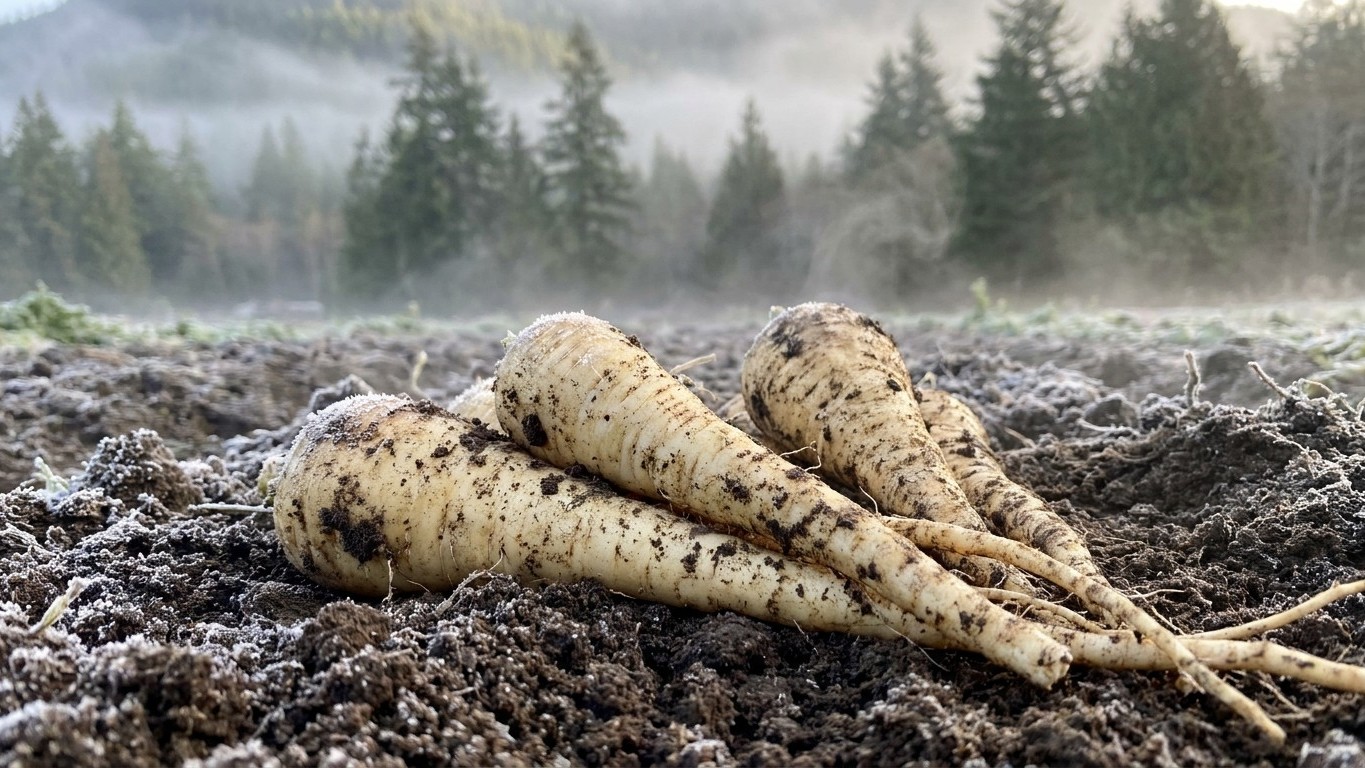

Lift parsnips in Idaho after several weeks of frosty weather, which in a low valley like Boise means November at the earliest. The first fall frost there lands between October 7 and October 21. Roots pulled sooner are edible but starchy. Once they’re out, they keep four to six months only if storage holds 32 to 34°F at 98% humidity. Beside apples, they turn bitter.
The short answer
Does Idaho deliver several frosty weeks? In the Boise valley, yes, with room to spare. NOAA NCEI Climate Normals put the mean daily minimum of the coldest month at 25.4°F. That is an average of the nightly lows, so a typical night in midwinter sits well under freezing, and the cold keeps coming week after week. A parsnip grown here will sweeten, not merely grow. The reference station is in a low valley, and most of Idaho is higher and colder than Boise. A garden at higher elevation gets more frost, not less. Its season is shorter, though, which becomes the problem in the next section.
Frost exposure, not the hardiness zone
The sweetening is a chemical change. Cool, frosty weather makes the root convert stored starch to sugar, according to Utah State University Extension. What matters is how many frosty weeks the root actually sits through, and a hardiness zone number can’t tell you that. A comfortable zone is not the same as several weeks of frost. A mild-winter garden grows a perfectly good parsnip that never becomes sweet. Boise’s 25.4°F figure answers the real question, and the details of the process are in Will Parsnips Sweeten in Idaho?.
Count forward from the first frost. If it arrives between October 7 and October 21, several weeks of frost carries you into November. That is the earliest sensible lifting date in a valley garden. A garden that frosts sooner can lift sooner. The full growing picture, from sowing to the table, is in Growing Parsnips in Idaho.
How long they keep, and what ruins them
Four to six months. That is the storage life the USDA gives for parsnip roots in Agricultural Handbook 66, and by any standard it is a long keeper. The figure assumes 32 to 34°F at 98% relative humidity, held steady. Almost no house does that. A refrigerator is cold enough but dry, and a garage swings with the weather.
Cold itself is not the danger. The handbook says parsnips are not chilling sensitive. The danger is ethylene, the ripening gas that apples and other fruit give off. Parsnips make almost none themselves, but even low levels in cold storage turn the root bitter. Keep them away from apples, pears and anything ripening, even when the temperature is perfect. One more rule from the same source: top the roots after harvest, but do not trim into the crown.
Does the season fit?
A parsnip needs 100 to 120 days from seeding, and the sowing goes in place, 2 to 3 weeks before the last spring frost. Here is the arithmetic for the Boise valley, using NOAA NCEI Climate Normals frost dates, in words.
- The last spring frost falls between April 23 and May 7. That is the 30-70% probability band for a 32°F freeze, not a guarantee.
- Sowing 2 to 3 weeks ahead of those dates puts seed in the ground from about April 2 at the earliest to about April 23 at the latest.
- Germination takes 14 to 21 days. For most of April’s sowings, the row looks like bare soil well into May. Leave it alone. Digging it up to re-sow is the classic mistake.
- Add 100 days to the earliest sowing and you reach about July 11. Add 120 days to the latest sowing and you reach about August 21. Mature roots are possible anywhere in that window.
- The first fall frost arrives between October 7 and October 21. Even the slowest sowing finishes its 120 days roughly seven weeks before that.
- That gap matters because the sweetening starts only when frost does. The roots simply sit in cool soil and wait, which is exactly what they should do.
- Verdict for the valley: the season fits comfortably. It also fits with margin for a late sowing, which is useful because parsnip seed is slow and the spring can run cold.
Higher and colder Idaho is another story. The last frost comes later and the first fall frost comes sooner, so the 100 to 120 days get squeezed from both ends. A frost-date pair for each of those places is not published here, so check your own location’s normals before you count days. If the arithmetic comes out tight, sow at the early edge of the window. If it comes out negative, the season will not finish a parsnip, whatever the soil is like.
What goes wrong here
Idaho’s frost is rarely the failure. Soil, water and timing are.
- Forked roots in heavy or stony ground. A root that hits clay or stone splits around it. Utah State University Extension calls for deep sandy soil and says heavy soil must be double dug. Any state soil map is only a starting point, so dig a test hole and look. Loosen the full depth of the root, and pick out stones before you sow.
- Forked roots from overwatering. This is a separate cause, and the soil can be perfect. Too much water can fork the roots, so a loose bed won’t save a row that is soaked daily. Water deeply but less often, and let the top inch dry between sessions.
- A season that runs out. This hits higher-elevation gardens, where a short frost-free window cuts into the 100 to 120 days. The remedy is to sow at the earliest workable date, 2 to 3 weeks before the last frost. If even that fails the arithmetic, grow something with a shorter clock.
- A winter too mild to sweeten. Parsnips grow fine without frost, but they stay starchy. The valley’s 25.4°F coldest-month minimum is plenty. In a spot where nights rarely fall below freezing, no technique fixes the flavor. Judge by frost exposure, never by the hardiness zone.
- Lifting too early. Roots pulled in October, before several frosty weeks, taste of starch. Wait until November, and wait longer if the weather has been mild.
- Bitterness in storage. The cause is ethylene from nearby apples or ripening fruit. Store roots well away from it, and keep the crowns intact when you top them.
- Losses in the ground. Voles, rodents and other pests will take roots while they wait for frost. What Eats Parsnip in Idaho, and When covers who shows up and the weeks they do.
Common questions
When is the earliest I can dig parsnips in Idaho?
Not before several weeks of frost have passed. In the Boise valley the first fall frost comes October 7 to October 21, so early to mid November is the realistic start. A colder, higher garden gets its frost sooner and can start sooner. Roots dug before the frost are edible, just starchy.
How long do lifted parsnips really keep?
Four to six months in ideal storage, which means 32 to 34°F at 98% humidity held steady. A home refrigerator or garage will usually fall short of that, so expect less. The cold does no harm, because parsnips are not chilling sensitive. A dry or swinging environment is what shortens their life.
Can I store parsnips near apples?
No. Apples and other ripening fruit give off ethylene, and even low levels in cold storage make parsnips bitter. Parsnips produce very little of the gas themselves, so the problem always comes from the neighbors. Give them their own shelf, drawer or bin.
I sowed three weeks ago and see nothing. Should I re-sow?
Not yet. Germination takes 14 to 21 days, and cold spring soil can push it to the far end of that range. Check again before you dig. Parsnips are sown in place, and the 100 to 120 days run from seeding, so a re-sow also resets the clock on the whole season.