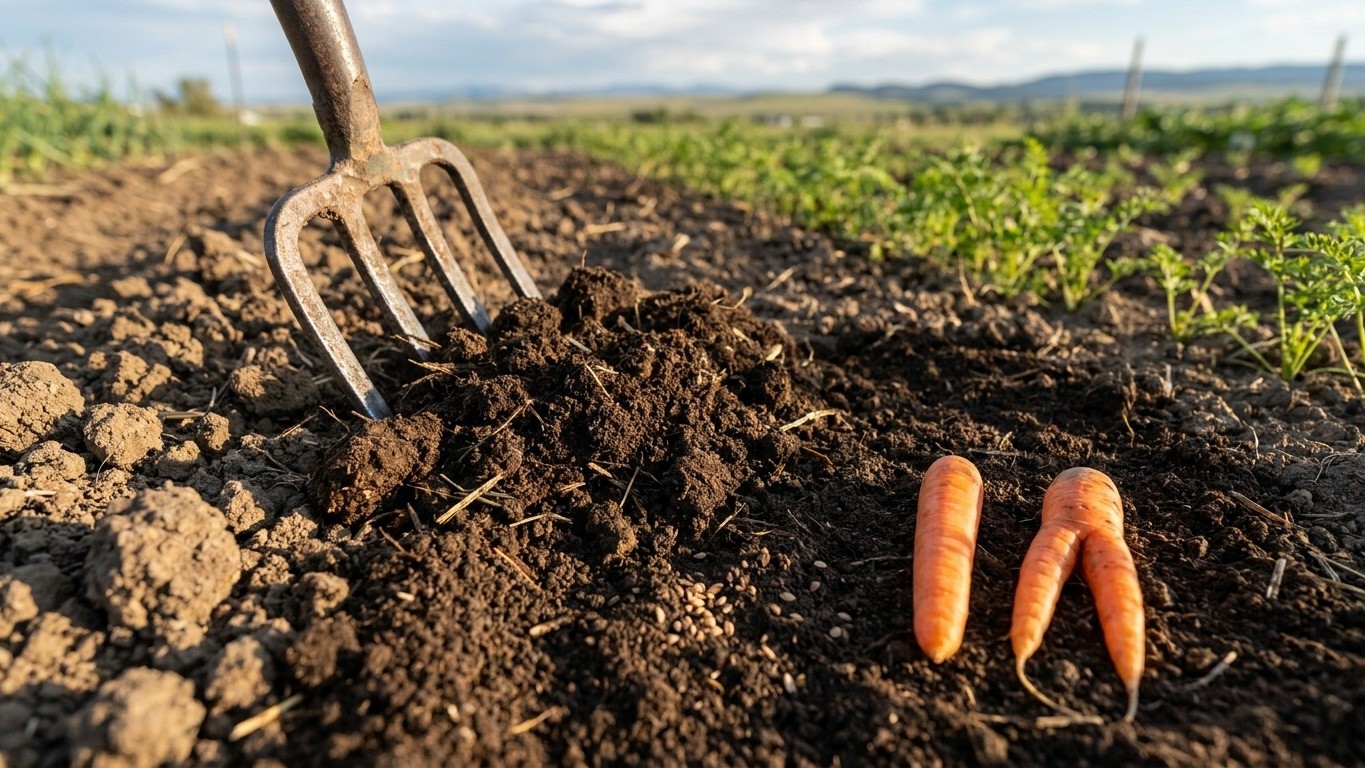

Pull carrots when the shoulders push up out of the soil line looking full and orange, not when a date on the calendar says so. In Idaho gardens that usually lines up with 65 to 75 days after seeding, going by Clemson Cooperative Extension’s guidance on timing. Once they’re out, get them straight to 33°F and high humidity. Skip that step and the clock on freshness starts running fast.
When carrots are ready in Idaho
The plant tells you before the calendar does. Look at where the root meets the soil: once that shoulder has filled out to a solid, rounded width and the color has gone fully orange rather than pale, the root underneath has caught up. The foliage gives a second clue, tips that start yellowing slightly at the base of the plant usually mean the root has stopped putting energy into new growth and started storing sugar instead. That’s the signal worth trusting over any date circled on a fridge calendar, because a cool wet spring or a hot dry stretch can push the same seed packet a week or two off its usual pace.
The rough window still matters for planning, though. Clemson Cooperative Extension puts carrot harvest at 65 to 75 days after planting, and because carrots are sown directly in the ground rather than transplanted, that count starts the day the seed goes in, not some later date. There’s no transplant shock to factor in and no second clock to track, just the one count from seed to shoulder check.
What shifts the window here
Soil is the biggest variable most Idaho gardeners don’t think to check until something goes wrong. The soil USDA lists as representative for the state, the Threebear series, is a volcanic-ash Andisol: light and porous, unusually good at holding both water and phosphorus, running about 35 percent sand, 15 percent clay and 50 percent silt at the surface, with a strongly acid pH near 5.0. That’s a useful starting picture, not a verdict on any one yard. A state runs across hundreds of soil series, and a garden bed that’s been amended, tilled, or built on fill dirt for years can look nothing like the mapped surface horizon those numbers describe. A home soil test is the only way to know what’s actually under your row.
Utah State University Extension is blunt about what happens when that soil runs heavy or rocky instead of loose and deep: carrots want sandy, well-drained ground rich in organic matter, and anything denser makes the root fork rather than grow straight down. If your ground leans toward the clay end of Idaho’s typical range, compost and double digging do more for harvest timing and root shape than any seed choice. The full breakdown of how forking happens and what it looks like at pull time is worth a look before you plant the next row, see Will Carrots Fork in Idaho Soil?. And if the tops look chewed rather than just yellowing, that’s a separate signal worth checking before you assume the root underneath is fine, covered in What Eats Carrot in Idaho, and When, sourced to University of Idaho Extension.
Keeping them, and for how long
Clemson Cooperative Extension’s Home & Garden Information Center lays out the numbers plainly: harvest carrots about 65 to 75 days after planting, store them at 33°F and high humidity to prevent wilting, and bunched carrots, meaning roots still wearing their tops, hold for about 10 to 14 days. That figure is a ceiling under conditions most home kitchens don’t actually offer, not a guarantee stamped on every bag of carrots pulled from a garden row.
The tops are the catch, and it’s worth understanding why before you decide whether to leave them on. Leaves keep drawing moisture out of the root even after the carrot is out of the ground, which is exactly why the bunched, leafy version fades inside two weeks while a trimmed root, cut clean at the shoulder right after harvest, holds up far longer under the same cold and humid conditions. Cutting the tops the day you pull the carrots is the single step that separates a fast fridge-drawer wilt from weeks of usable storage.
None of this works if the temperature drifts. 33°F sits just a couple degrees above freezing, which means there’s very little room for error before carrots either freeze at the surface or, more commonly in a home kitchen, sit warm enough that they soften and start sprouting well ahead of that 10 to 14 day mark. A carrot held at 45°F or 50°F, which describes a lot of ordinary refrigerator shelves and most root cellars on a mild day, is not living by the same clock Clemson’s figures describe. The number only holds if the storage spot actually holds the number.
Where in the house that actually is
Most kitchens don’t have a spot built to hit 33°F with reliable humidity, which is exactly why so many home-stored carrots underperform the numbers on paper. A standard refrigerator runs colder in the back near the cooling element and noticeably warmer near the door, so a bag of carrots pushed to the front every time someone reaches for milk isn’t sitting at a steady number at all. An unheated basement or an old-style root cellar, where Idaho farmhouses often still have one, tends to land closer to that 33°F target through fall and winter, especially with a lid of damp sand or sawdust added for humidity. A garage is the least reliable of the three here, since Idaho’s swing between a mild afternoon and an overnight cold snap can carry an uninsulated garage well past freezing and back within the same 24 hours.
| Storage spot | Typical temperature behavior | Humidity |
|---|---|---|
| Refrigerator crisper | Steady but variable by shelf position, often colder than 33°F at the back | Low unless bagged with perforations or a damp towel |
| Basement or root cellar | Closest to Clemson’s 33°F target in cold months | Can be raised with damp sand |
| Unheated garage | Swings with outdoor weather, can freeze in cold snaps | Uncontrolled |
A crisper drawer set to its coldest setting, with the carrots in a perforated bag and a slightly damp paper towel tucked in, comes reasonably close to the mark for smaller harvests. For anything larger than a kitchen drawer will hold, the basement or root cellar route is worth the extra step. Either way, don’t take the storage spot’s word for it. Check the actual temperature with a thermometer left in the container for a day or two before trusting a full harvest to it, because a dial on a fridge door and the real number a few inches deep in a drawer can differ by several degrees.
What goes wrong here
Three failures show up more than others once carrots are out of the ground in Idaho. The first traces back to the soil rather than the harvest: a clay-heavy pocket in an otherwise light garden bed splits the taproot into two or three forks as it grows around the obstruction, which Utah State University Extension attributes directly to heavy or rocky ground. It shows up at pull time as a root that looks fine at the shoulder and forked below it, and the fix is upstream of harvest entirely, worked compost and a properly loosened bed, detailed in Will Carrots Fork in Idaho Soil?.
The second is a storage spot that freezes rather than chills. An unheated garage or an uninsulated cellar corner can drop well below Clemson’s 33°F line during one of Idaho’s cold snaps, and a frozen carrot turns soft and watery the moment it thaws, with no way back. Insulating the storage container, packing roots in a box of damp sand set away from an exterior wall rather than against it, is what keeps a hard freeze outside from becoming a ruined harvest inside.
The third is a wet pull. Carrots dug during or right after a rain carry surface moisture into storage, and that dampness is what starts rot at the shoulder within days rather than weeks. Waiting for the soil to dry out somewhat before pulling, and letting roots air-dry briefly before boxing them up, cuts that risk substantially. Staggering a planting over a few weeks rather than sowing a full row on one day, a point covered in Growing Carrots in Idaho, also spreads harvest and storage load out instead of dumping the whole job into one damp afternoon.
Common questions
Can I leave carrots in the ground instead of storing them indoors?
Clemson’s figures describe indoor storage at 33°F, not ground storage, and that’s the only tested guidance covered here. Whether a mulched row survives an Idaho winter in place isn’t a number this page can back up.
Should I wash carrots before storing them?
Clemson’s guidance centers on temperature and humidity, not washing. What’s clear is that surface moisture from a wet harvest promotes rot, so drying roots before boxing matters more than whether they’re washed.
Do bunched carrots really only last 10 to 14 days?
That’s the figure Clemson gives for carrots stored with their tops still on, under 33°F and high humidity. It’s a ceiling, not an average, and a warmer or drier spot will shorten it further.
Does the acidic Idaho soil affect how long carrots keep?
No storage figure here ties to soil pH. The state’s representative soil runs strongly acid at the surface, which matters more for how the root grows than for how it holds up once it’s out of the ground.