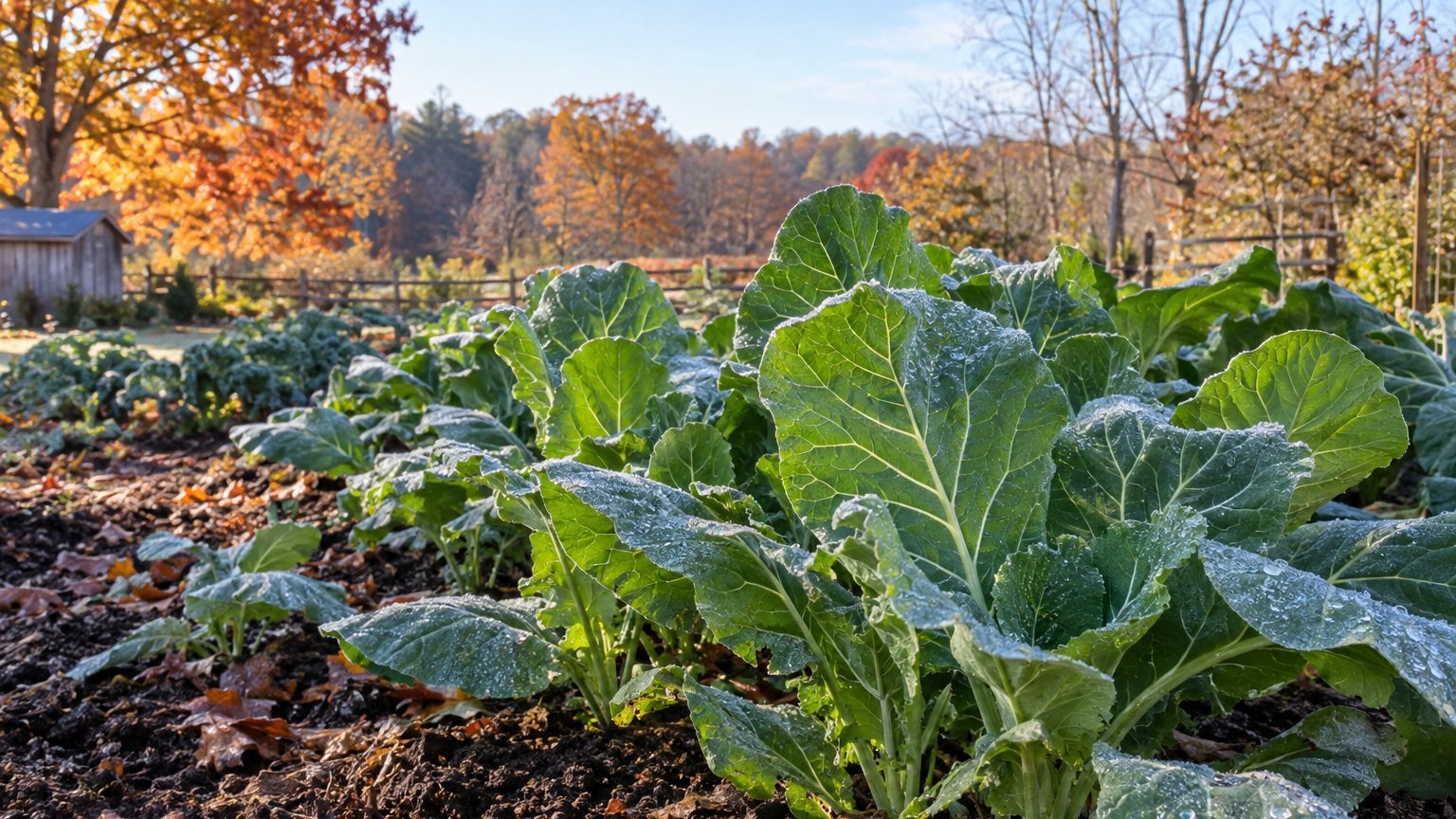

Collards grow year-round in lowland Hawaii because there is no frost season to schedule around. The real calendar question here isn’t when the cold breaks, it’s which weeks of rain, wind, and elevation give your plants the best shot. That answer changes by island side, not by month.
The short answer for Hawaii
In most of Hawaii, you can direct-seed or transplant collards in any month of the year. That’s not a hedge, it’s what the data says: NOAA’s 1991-2020 Climate Normals for Honolulu can’t even calculate a frost-percentile date, because the flag for freeze occurrence at 32°F comes back “not computable.” Zero days per year reach freezing at the reference station. There is no last-frost date and no first-frost date to build a calendar around, because there’s no frost at all where people garden.
What decides whether collards thrive isn’t cold, it’s whether the plant ever gets cold enough to slow down and sweeten, and whether it gets too wet or too dry in the meantime. The mean daily minimum for the coldest month in Honolulu sits at 66.8°F, which tells you plenty. That’s warmer than many mainland gardens ever get in July. Collards can survive that easily, but they also never experience the chill that some growers count on for flavor, and pest cycles never get reset by a hard freeze.
The practical planting advice for most of the state: pick a window with steady moisture and moderate temperatures rather than a specific date on a calendar. On windward coasts, that often means avoiding the heaviest rain months when seedlings rot before they establish. On leeward and dry sides, it means avoiding the driest stretch when young plants can’t get consistent water without heavy irrigation. This page doesn’t have island-by-island rainfall data to pin down exact months for every county, and it won’t invent numbers to fill that gap. What it can say, backed by the frost data above, is that timing here is governed by rainfall, elevation, and which side of an island you’re on, not by a frost line that simply doesn’t exist in inhabited Hawaii.
For step-by-step guidance on getting collards established once you’ve picked your window, see Growing Collards in Hawaii.
What will not work here

A frost-based planting calendar is the first thing that fails in Hawaii, because it assumes a killing cold that this state’s inhabited elevations never receive. Any advice built around “two weeks after last frost” or “before first frost in fall” simply doesn’t translate here. If you’ve gardened somewhere with real winters and you try to import that calendar wholesale, you’ll either plant too cautiously or miss the actual risks, which are heat stress, waterlogging, and pest pressure that never lets up.
Watering on a once-a-week schedule is the second common failure, particularly on leeward slopes where dry air and strong sun pull moisture out of shallow-rooted seedlings fast. Collards need consistent soil moisture to germinate and to avoid bolting prematurely in warm soil, and a weekly watering habit built for a cooler climate leaves gaps that stress the plant during the exact stretch when roots are trying to establish. On the flip side, tight spacing that might be fine in a drier mainland garden invites fungal problems on windward sides, where humidity stays high for long stretches and airflow between plants matters more than it would in a drier climate.
The absence of a cold season also means pest populations never get knocked back the way they would somewhere with a real winter. Aphids, cabbage worms, and other collard pests can persist year-round instead of dying off, so a planting strategy that assumes “pests show up in spring, then fade by fall” won’t hold here. Continuous scouting matters more than calendar timing when it comes to pest control.
Choosing a slow-maturing variety bred for a long, mild mainland season can also underperform in Hawaii’s warmth, where plants move through their life cycle faster and can bolt to seed before a slow variety would even be at harvest size elsewhere. Matching the variety to Hawaii’s heat, not to a Southern frost calendar, is the fix, and it’s covered in The Best Collards and Greens for Hawaii.
What changes across Hawaii
Hawaii is not one growing climate, and the USDA Plant Hardiness Zone Map makes that obvious. The state spans zones 9a to 13a, a spread so wide it covers everything from near-tropical lowland warmth to cooler upland conditions found nowhere else in the islands’ inhabited zones. That range is built on the USDA system’s single variable, average annual extreme minimum temperature, and it means there is no one planting window that applies to a gardener on a warm coastal flat and a gardener several thousand feet up a volcanic slope in the same state.
The reference figures in this article, including the 66.8°F coldest-month minimum, come from Honolulu. That number describes conditions at sea level on Oahu’s leeward side. A garden at higher elevation on Hawaii Island or in an upland Maui community will run measurably cooler, sometimes enough to sit in a different hardiness zone entirely, even though neither location sees frost. A garden that gets the full force of the northeast trade winds on a windward coast will see far more rainfall and higher humidity than one tucked into a dry leeward rain shadow just a few miles away, sometimes on the same island.
That’s the nature of a hardiness zone range this wide inside one state’s borders: there is no single sowing window that fits Hilo and fits Kona and fits an upland garden on the same schedule, because the underlying conditions genuinely differ that much. Rather than guess where you fall on that range, check the USDA Plant Hardiness Zone Map for your specific location, and treat this page’s figures as describing lowland, leeward baseline conditions rather than a universal Hawaii number.
Where to check this for your own county
This page describes statewide patterns, and Hawaii’s counties differ enough that a state-level answer will always be a rough guide rather than a precise one. The University of Hawaii’s College of Tropical Agriculture and Human Resources runs the state’s official Cooperative Extension Service, and it’s the source built to fill in the gaps this page can’t close. You’ll find it at https://www.ctahr.hawaii.edu/site/extension.aspx.
Once there, look specifically for two things. First, any planting or seasonal calendar published for vegetable growing in your county, whether that’s Honolulu, Hawaii, Maui, or Kauai County, since extension offices tailor timing advice to local rainfall patterns and elevation bands that a statewide page can’t capture. Second, look for variety trial results or recommended cultivar lists for greens grown in your specific area. Extension programs often test which varieties actually perform well against local pest pressure, rainfall, and heat, and that trial data is more useful than any general variety description, because it reflects what actually grew well in conditions like yours.
A county-level extension recommendation will always outrank a state-level page like this one, simply because it’s built from local trial plots and local weather records instead of statewide averages. This page exists to give you the mechanism, the frost data, the hardiness zone spread, and the reasoning behind Hawaii’s rainfall-driven planting logic. Your county extension office exists to give you the specific dates and specific varieties that have already been tested where you actually garden. Use this page to understand why Hawaii doesn’t run on a frost calendar, then use CTAHR’s local resources to get the specific numbers for your address.
Checking this against your own garden
No calendar, county-level or otherwise, beats what your own garden tells you directly. Three signs are worth learning to read, and none of them require any equipment you don’t already have.
First, soil warmth by feel. Push a finger a couple inches into the bed before sowing. If it feels cool and damp even in afternoon sun, that patch may be shaded, waterlogged, or sitting in a cooler microclimate than the rest of your yard, which matters more on this state’s varied terrain than a printed date ever will. Second, watch for the first flush of male flowers on any collards already in the ground. Early flowering is a heat-and-stress signal, telling you that spot runs hotter or drier than expected and that a new planting there might bolt before it’s worth harvesting. Third, track how fast seedlings put out their first true leaves after the initial seed leaves. A quick, even push to true leaves within about a week to ten days tells you conditions in that bed are close to ideal; a slow, uneven emergence points to soil that’s too wet, too cool, or too compacted for that particular spot.
Each of these signs is really telling you about your own microclimate, not about Hawaii as a whole. Between windward humidity, leeward dryness, and elevation swings big enough to span multiple hardiness zones in a single state, your garden’s own feedback will always be more precise than any calendar built to cover the whole archipelago at once.