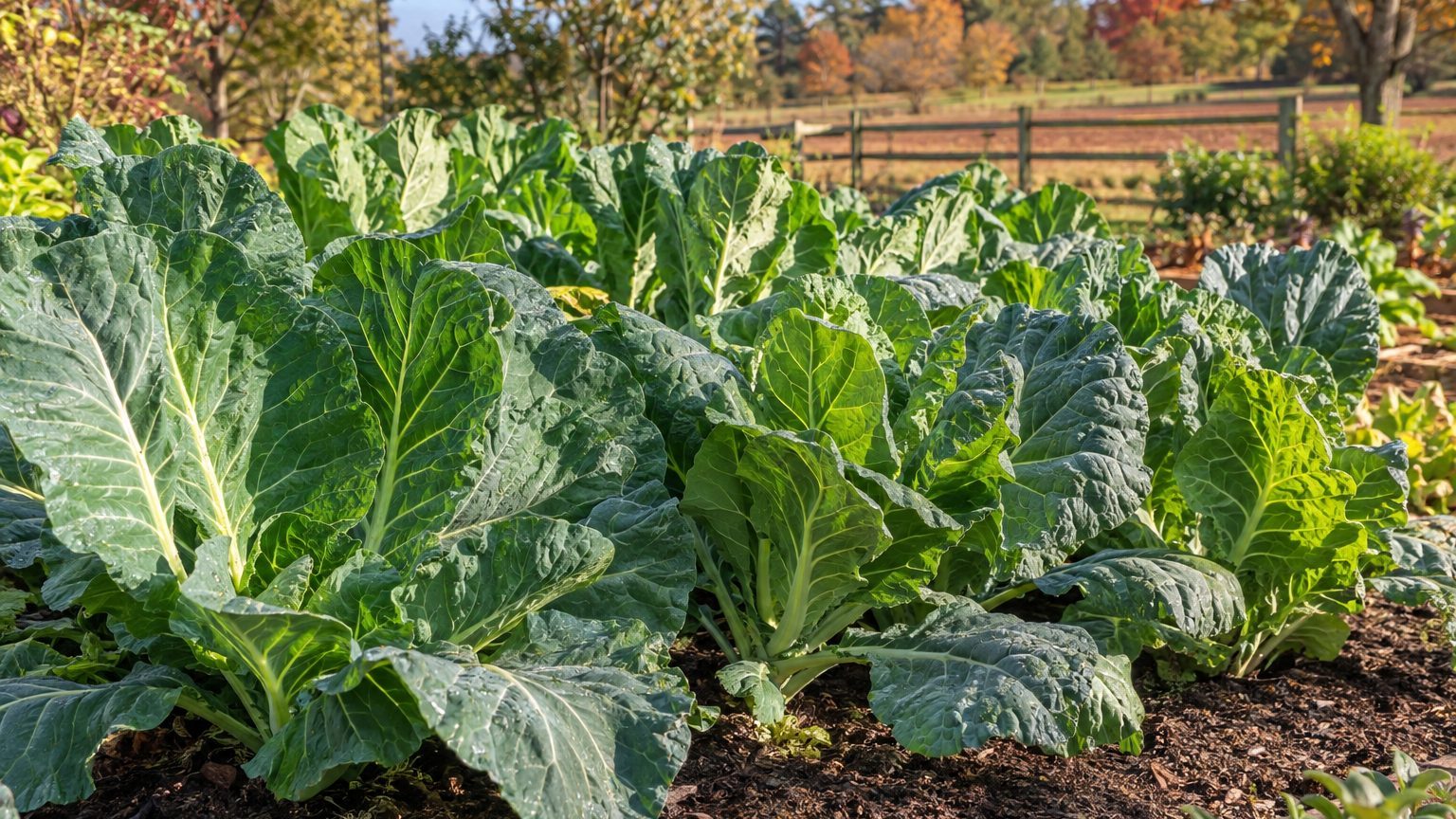

The Best Collards for Hawaii are heat-tolerant, slow-bolt strains such as Georgia Southern and Vates-type seed, grown alongside heat-tough mustard and kale relatives at higher elevations. Cold hardiness never enters the decision here. What matters is how a plant handles constant warmth, humidity swings, and whichever side of an island it’s planted on.
The short answer for Hawaii
Start with the number that changes everything: the coldest month in Honolulu averages a daily minimum of 66.8°F. That’s warmer than most mainland gardens ever get in June. It means collards here never experience the chill that triggers dormancy, slows growth, or sweetens leaves after a frost. Every variety decision in Hawaii is really a heat-and-moisture decision dressed up as a “greens” decision.
That reframes which types earn a spot in the garden. Slow-bolt collard strains, the ones bred to resist flowering under long, warm days, do the heavy lifting. Georgia Southern and its close relatives were selected in the Deep South for exactly this kind of heat load, and Vates-type collards carry similar bolt resistance while staying compact enough for smaller lots common on Oahu and Maui. Both types tolerate the wet-then-dry rhythm of tropical rainfall better than delicate specialty greens.
Mustard greens and a handful of loose-leaf kales fill the gap at higher elevations, where nights cool down enough to slow bolting further and where fog or mist keeps humidity high without soaking the soil. These aren’t cold-hardy varieties in the mainland sense. They’re simply varieties that keep producing tender leaves without shooting up a flower stalk the moment daytime heat stacks up for a few weeks running.
Fast-maturing greens like tatsoi or baby mustard mixes make sense for gardeners who want a quick harvest between rain events, especially on the drier leeward sides of the islands where soil moisture swings hard. Collards, by contrast, reward patience: a full-size Georgia Southern plant can keep producing outer leaves for months once established, since there’s no frost to cut the season short. For a deeper look at which specific collard types perform best plot by plot, Growing Collards in Hawaii breaks down growth habits side by side.
What will not work here

Winter-hardy specialty collards bred for northern gardens are the first thing to skip. Varieties selected to survive a hard freeze, or prized because their flavor improves after one, simply don’t get the chance to prove it. NOAA’s 1991-2020 climate data for the reference station puts the number at zero days per year at or below 32°F in inhabited parts of Hawaii. Frost shows up only on the summits of Mauna Kea, Mauna Loa, and Haleakala, nowhere near a vegetable bed. A collard variety’s frost tolerance is a feature nobody in a Hawaii garden will ever use.
Slow-bolt resistance failures are the opposite problem, and they’re common with greens bred for cooler climates. A mustard or collard type selected for a short, mild spring in Ohio or Oregon can bolt within weeks once it hits sustained Hawaii warmth, especially at lowland elevations near sea level. The plant reads long, hot days as a signal to flower and set seed, cutting the harvest window short just as it should be hitting stride.
Weekly watering schedules copied from mainland gardening guides also tend to fail, particularly on leeward coasts where rain shadow effects from the volcanic ridgelines leave soil drying out fast between showers. Collards and mustard greens both wilt hard under moisture stress, and a wilted plant under tropical sun bolts even faster than one that’s simply hot. Gardeners moving to a Hawaii property from a temperate state often bring a watering habit built for cooler air, and it doesn’t transfer.
Tight spacing borrowed from drier mainland climates causes trouble on the windward side, where humidity sits high for days at a stretch. Crowded collard rows trap moisture around lower leaves, and that’s exactly the setup fungal leaf spot and downy mildew need to spread. Wider spacing than a seed packet recommends for a dry state is often the fix, giving air room to move through the canopy before disease gets a foothold.
What changes across Hawaii
Hawaii isn’t one growing climate, it’s several stacked on top of each other by elevation and wind exposure. The USDA Plant Hardiness Zone Map puts the entire state at zone 9a to 13a, a spread wide enough to cover everything from near-frost mountain slopes to steamy lowland coastlines, all within the same island chain and sometimes the same county.
That range means there’s no single collard variety, or single planting rule, that applies evenly from Hilo to upcountry Maui. A garden near sea level on the leeward side of an island sits at the warm end of that zone spread, where heat and bolt resistance matter most and where fast-cycling greens can be worth planting in succession rather than betting on one long-season collard bed. A garden a few thousand feet up a volcanic slope sits much closer to the cooler end, where nights drop enough that bolt-prone varieties finally behave, and where the mustard-kale hybrids common in upcountry gardens really earn their keep.
Windward versus leeward matters as much as elevation, sometimes more. Two gardens at the same elevation on opposite sides of the same island can differ enormously in rainfall, one getting soaked most afternoons, the other staying dry enough to need irrigation through much of the year. Variety choice should follow that split: moisture-loving loose-leaf greens do better windward, while collards with tougher, more upright leaves handle the drier leeward stretches with less fuss.
None of this can be resolved from a state-level page. A reader in a cool upcountry pocket and a reader on a hot coastal flat are gardening in different worlds, even though both fall inside Hawaii’s official zone range. Checking a hardiness zone map for the specific property, rather than assuming the state average applies, is the step that actually narrows the variety list down to something useful.
Where to check this for your own county
The University of Hawaii’s College of Tropical Agriculture and Human Resources runs the state’s official extension service, and it’s the source built for exactly this gap. The address is https://www.ctahr.hawaii.edu/site/extension.aspx, and it connects to county-level offices covering Oahu, Hawaii Island, Maui, and Kauai separately, each with its own growing conditions and its own trial results.
What’s worth looking for once there isn’t a generic greens list. County extension agents run variety trials specific to their own soil, rainfall, and elevation bands, and that data outranks anything a state-wide page can offer, including this one. A recommendation tested on a county’s actual volcanic soil and actual rainfall pattern beats a recommendation built from statewide averages every time, because the averages smooth over exactly the windward-leeward and elevation differences that decide whether a collard variety bolts in six weeks or six months.
Two things to ask a county office directly: which collard and mustard varieties showed up in their most recent trial results, and what planting window they recommend locally given that county’s rainfall pattern rather than a frost date that doesn’t apply here. Since Hawaii’s growing calendar runs on rain and elevation instead of frost, the timing question is where a county office earns its keep. For a full breakdown of how that timing works statewide, When to Plant Collards in Hawaii covers the rainfall-based windows in more detail, but a county agent can narrow that further to a specific valley or ridge.
This page can point toward the right varieties by type and explain why frost hardiness doesn’t matter here. It can’t replace a conversation with someone who has watched collards grow in that exact county for years. That’s the gap a county extension visit closes.
Checking this against your own garden
No calendar or variety list beats what’s actually happening in a specific bed, and three signs matter more than any planting date.
Soil warmth by feel is the first, even though Hawaii’s soil rarely runs cold. Pressing a hand into the top few inches after a dry stretch reveals whether the bed is holding moisture or has dried past the point where seedlings germinate evenly. Cool, slightly damp soil that crumbles easily is the target; soil that’s dusty and warm to the touch on top usually means a watering pass is overdue before sowing anything new.
The first true leaves on a young collard or mustard seedling tell the second story. These appear after the initial rounded seed leaves, and their shape and vigor say a lot about whether the spot gets enough light and even moisture. Slow, pale true leaves usually point to a shadier microclimate than the variety wants, common under taller windward-side plantings where afternoon shade lingers longer than expected.
The third sign is the one that matters most in a place with no frost to set a rhythm: watching for the first male flower stalk pushing up from the center of a collard or mustard plant. That’s the bolting signal, and it shows up faster in a hot, dry microclimate than a shaded or windward one, even within the same yard. A gardener who notices that stalk appearing weeks earlier on one side of a property than another has just found, without needing a soil thermometer or a calendar, exactly where the hot spot in their own garden sits.