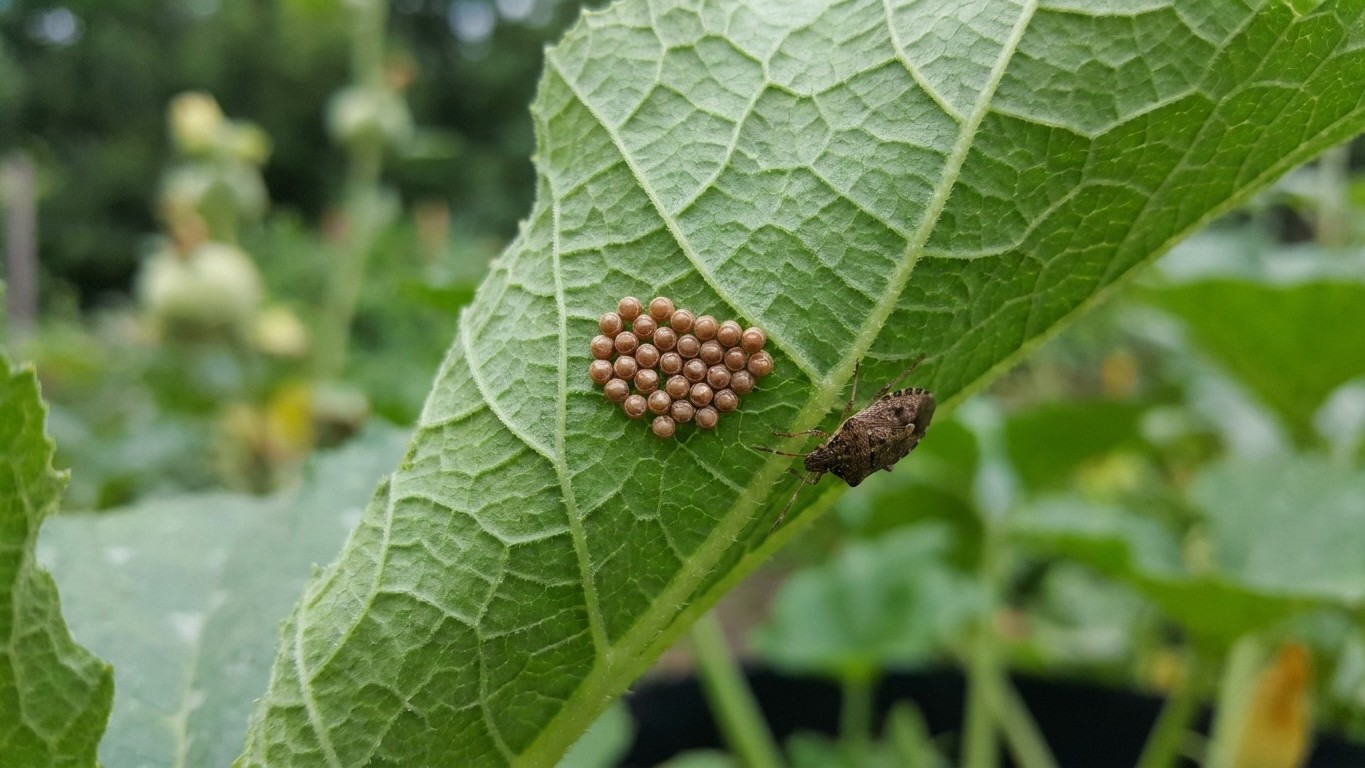

Squash bugs show up in Missouri gardens right around the time your squash and pumpkin vines start putting out their first true leaves, usually mid-to-late May in the southern part of the state and into early June farther north. The real damage window opens a few weeks later, once adults mate and lay their copper-colored egg clusters on the underside of leaves. Stopping them means acting before that egg-laying starts, not after you spot the first wilted leaf.
Anasa tristis, the squash bug’s scientific name, is a member of the Coreidae family, the “leaf-footed bugs.” Missouri gardeners tend to lump it in with stink bugs because of the shield-shaped body and the smell it releases when crushed, but it’s a distinct pest with its own timeline and its own weak points.
When squash bugs actually show up in Missouri
Adults overwinter as far north as the Iowa border and as far south as the Bootheel, tucked under garden debris, mulch, wood piles, and even the loose bark of nearby trees. They don’t migrate in from somewhere warmer each spring. The bugs that damage your zucchini in July are often the same individuals that survived winter thirty feet from where they’ll feed.
Those overwintered adults emerge once daytime temperatures hold steady in the 70s, which in a typical Missouri spring lines up with late April in the Bootheel and early-to-mid May around Columbia, Kansas City, and St. Louis. They head straight for the nearest cucurbit planting, whether that’s a backyard raised bed or a commercial pumpkin field.
Egg laying is the milestone that matters most for control. Females start depositing eggs once vines begin to run and put out flowers, typically two to three weeks after transplanting or direct-seeding. In central Missouri that usually falls in the first half of June. Each female can lay several hundred eggs over her lifetime, arranged in tidy clusters of a dozen or more on the underside of leaves, close to the veins where they’re easy to miss if you’re not looking.
Missouri’s growing season is long enough for two generations most years, sometimes a partial third in the warmer southern counties. That second generation is the one that catches people off guard in August, right when the first wave of damage seemed to be tapering off.
Regional timing differences worth knowing
The Bootheel and southwest Missouri warm up faster and stay warm longer, so squash bugs get moving ten days to two weeks ahead of the northern counties along the Iowa line. If you garden near Kirksville or Hannibal, you generally get a slightly shorter window of vulnerability each generation, but you’re also more likely to see damage concentrated in a single hard push during peak summer heat rather than spread across a longer season.
How to identify squash bugs at each stage
Adults measure about five-eighths of an inch, brownish-gray with orange or copper-colored stripes along the edge of the abdomen visible when the wings are folded. They move fast when disturbed and tend to scatter toward the base of the plant or under nearby leaves rather than fly off immediately.
Nymphs are the stage most gardeners misidentify. Freshly hatched nymphs are gray with black legs and antennae, clustering tightly near the empty egg shells. As they molt through five instars over roughly four to six weeks, they gradually take on a grayish-white, almost dusty appearance before darkening toward the adult color. Because they cluster in groups and don’t scatter as fast as adults, this is actually the easiest stage to catch and remove by hand.
The eggs themselves are the earliest warning sign and the most reliable one. Look for tight clusters of shiny, bronze-to-copper oval eggs on the underside of leaves, usually in the angle between veins. A single check of your plants twice a week during the first three weeks of June catches most egg-laying before it turns into a nymph infestation.
What actually stops squash bugs in a Missouri garden
Nothing single-handedly wipes out a squash bug population, but a few tactics consistently outperform the rest, and timing matters more than product choice.
Sanitation breaks the overwintering cycle
Since adults spend winter in garden debris, the single most effective long-term move is clearing vine remains, mulch, and boards from the cucurbit bed at the end of the season rather than leaving them until spring cleanup. Missouri State University and University of Missouri Extension research on cucurbit pests consistently points to fall sanitation as the step that reduces the following year’s overwintering population the most, because it removes the shelter before the first hard frost, not after.
Rotating squash, pumpkins, and cucumbers to a different part of the yard each year adds another layer, since overwintered adults emerge close to where they spent the winter and have to travel farther to find a new host plant.
Trap cropping and resistant varieties
Blue hubbard squash is famously attractive to squash bugs compared to zucchini, yellow summer squash, and pumpkins. Planting a small border of it around the main crop draws adults away from the plants you actually want to harvest, and that border can then be treated or removed once it’s covered in bugs. Butternut squash also tends to show less damage than other varieties, likely due to its tougher stem tissue, making it a reasonable substitute for gardeners who’ve had repeated trouble with zucchini.
Three practical additions worth pairing with sanitation and trap cropping:
- Floating row covers left on until flowers open, then removed to allow pollination
- A wooden board or shingle laid near the base of plants overnight, then checked each morning since adults hide underneath it and can be collected and destroyed
- Hand-removal of egg clusters using tape, which lifts the eggs cleanly off the leaf without damaging the plant
Why sprays work better on nymphs than adults
Adult squash bugs have a hardened outer shell that sheds most contact insecticides, which is part of why spraying an established adult population rarely delivers the results gardeners expect. Insecticidal soap and neem-based products work far better against the soft-bodied early nymph stages, which is another reason that twice-weekly scouting in early June pays off. Catching nymphs within the first one to two weeks after hatching, before they harden, is the narrow window where a spray actually earns its cost.
For anyone leaning on broader-spectrum products, timing the application for early morning or evening protects pollinators visiting open squash blossoms during the day, a detail that matters given how dependent cucurbits are on bee visits for fruit set.
Recognizing the damage before it’s too late
Squash bugs feed by piercing plant tissue and sucking out sap, injecting a toxin as they go that causes wilting even before the plant has lost significant fluid. The telltale sign is a single leaf or runner wilting and turning black while the rest of the plant still looks fine, distinct from squash vine borer damage, which usually starts with the entire main stem collapsing.
Left unchecked across two generations, a heavy squash bug population can take down an entire zucchini or yellow squash planting by late July, right as the first big harvest should be coming in. Pumpkins planted for fall harvest are particularly vulnerable to the second generation, since that wave peaks in August, just as the pumpkins are sizing up for October.
One detail that surprises a lot of Missouri gardeners: a mixed planting of squash alongside nasturtium or dill doesn’t reliably repel squash bugs on its own, despite what companion-planting guides often claim. The tactics with actual research behind them, fall sanitation, trap cropping, early scouting, and targeting nymphs, do the heavy lifting. Everything else is a nice-to-have at best.