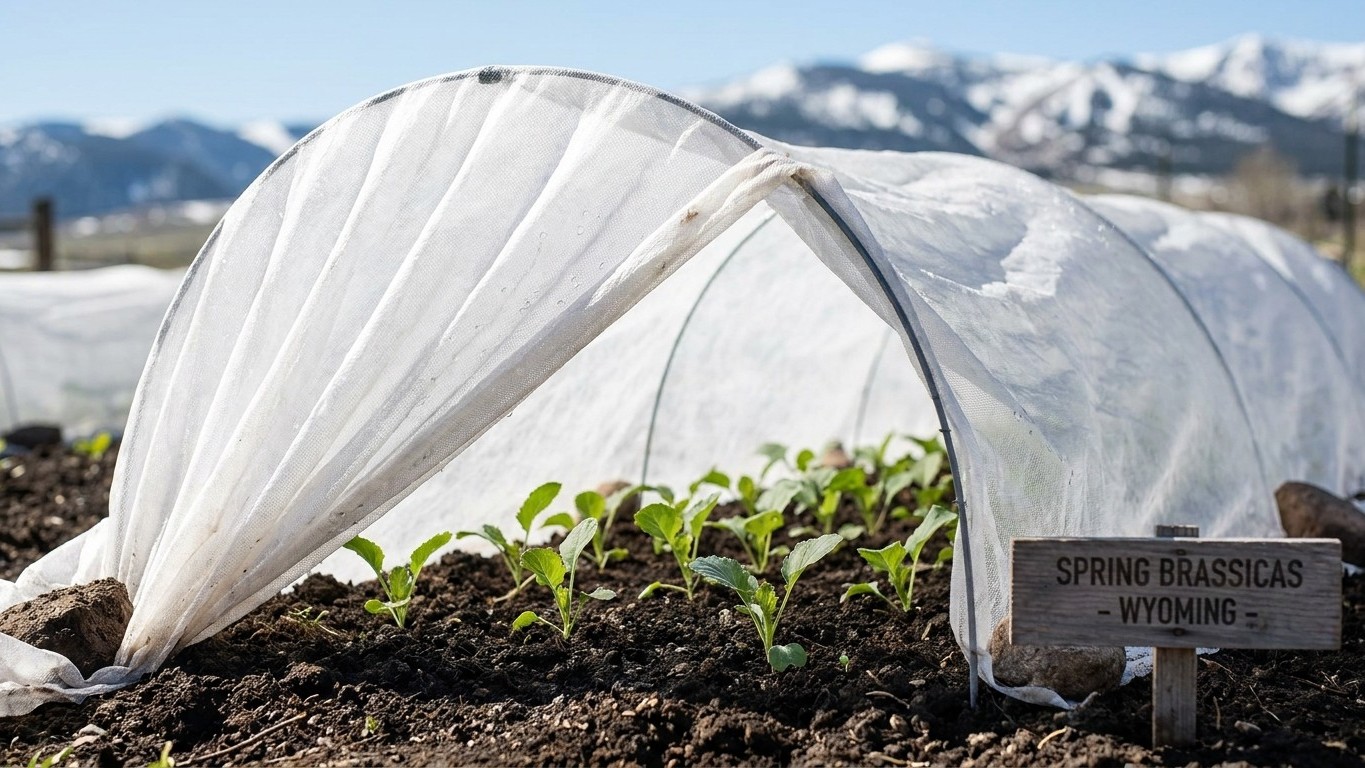

Cabbage worms show up in Wyoming gardens once transplants have had two to three weeks in warm soil, not on a fixed calendar day. The University of Wyoming Extension tracks this pest through the state’s short, cool growing season, and the fix is cheap: row covers timed to your last frost, hand-picking, and a rotation plan that starves next year’s moths of an easy target.
Reading the calendar from your last frost

The last spring frost across Wyoming falls somewhere between May 7 and May 18, based on NOAA’s 1991-2020 Climate Normals for station USW00024018. That’s a normal, not a guarantee. At elevation, frost can still show up in June, and at 6,000 feet the state gets roughly 130 frost-free days in a good year. Any date you calculate by counting backward from that range is still a range, never a single day you can circle on the wall calendar.
Cabbage worms don’t read that calendar anyway. The adult butterfly answers to soil and air warmth, not to a fixed week, so an early, mild spring pulls the first moths out sooner, and a cold, wet one pushes them back. Once transplants go into the ground, the first chewed leaves typically appear two to three weeks later, which is roughly when the earliest eggs have hatched into feeding larvae.
That window is what matters for a cover. A floating row cover needs to go on at transplant time, before the first moths find the bed, and it has to stay sealed at the edges through that two-to-three-week stretch. Pulling it too early defeats the purpose. Leaving it on past flowering, on crops that need pollination, causes its own problems. Because the frost date itself is a spread of eleven days, plan the cover around the later end of that spread if your garden sits at higher elevation or in a low spot that holds cold air.
What it attacks, and what the damage looks like
The symptom shows up before the culprit does. A gardener usually notices ragged, irregular holes chewed through cabbage, broccoli, kale, or collard leaves, sometimes with a light green caterpillar sitting in plain sight along the leaf vein, sometimes with nothing visible but small, dark pellets of frass scattered on the foliage below. On young transplants, damage can concentrate at the growing point, stunting the whole plant before it has a chance to head up.
Cabbage worms target the brassica family specifically: cabbage, broccoli, cauliflower, kale, collards, Brussels sprouts, and to a lesser degree radish and turnip greens. Cucumbers, tomatoes, and beans are not on the menu, so if you see similar chewing there, it’s a different insect entirely.
The larval stage does essentially all the damage. Adult butterflies, small and white with faint dark wing spots, do nothing but lay eggs and sip nectar. It’s the caterpillar that emerges from those eggs and feeds continuously for several weeks, molting as it grows, that strips leaves and bores into developing heads. This matters for timing any response: once the caterpillar has tunneled into a tight cabbage head or down into a broccoli crown, a surface treatment or a hand-picking pass can no longer reach it. Anything you do has to happen while the larva is still exposed on an outer leaf, which is also the stage most gardeners spot first, since the holes appear before the worm bores in deep enough to hide.
Telling it apart from other leaf feeders
Slug damage tends to leave smoother, more rounded holes and a slime trail, usually worse after rain. Flea beetle damage looks like a fine scatter of tiny shot holes rather than the larger, irregular chewing cabbage worms leave behind. If you find a caterpillar and it’s smooth-skinned and green, blending in with the leaf color, that lines up with a cabbage worm rather than a hairier or differently colored species.
How Wyoming sits in this pest’s range

On this site, cabbage worms are documented in two territories so far. That’s a narrow footprint, and it puts Wyoming closer to an edge of the coverage this project has built out rather than in the middle of a well-mapped, wall-to-wall range. It doesn’t mean the pest is rare here, only that the published, territory-by-territory picture is still thin compared to pests tracked in a dozen states or more.
What that narrow footprint does tell you is to lean on the source that actually covers this ground. The University of Wyoming Extension is the local reference for identification and timing in this state, and its guidance should carry more weight for a Wyoming garden than any general national write-up on cabbage worms that doesn’t account for the state’s elevation, short season, or late frost window. If you garden near the border with a state this site does cover, it’s worth checking that state’s page separately rather than assuming the numbers transfer.
What actually works against it
Timing the planting comes first, and it costs nothing. Getting brassica transplants in early, right around the region’s frost window rather than weeks after it, gives plants a head start before moth populations build up through the season. A bigger, tougher plant tolerates some leaf loss far better than a fresh transplant does.
Row covers are the next cheapest layer, and the mechanism is simple: a floating cover creates a physical barrier the adult butterfly can’t cross to lay eggs. It works only while it’s sealed at the soil line and only until the crop needs pollinators or outgrows the fabric’s slack. Once a moth gets under a gap, or once the cover comes off for weeding and isn’t resealed, the barrier is gone.
Hand-picking works directly on the larval stage, while caterpillars sit exposed on outer leaves. A regular check, every few days through the peak feeding weeks, catches most of them before they do serious damage or bore into a head. This is also the point where the method stops working: once a larva has tunneled into a tight cabbage head or a broccoli crown, it’s physically out of reach, and no amount of hand-picking on the outer leaves will remove it.
Crop rotation and clearing garden debris both interrupt the pest’s life cycle rather than killing an individual worm. Overwintering pupae shelter in old plant debris and soil near where brassicas grew, so moving next year’s cabbage family crops to a different bed, and clearing spent plants at season’s end, denies the next generation an easy, nearby target. None of these steps reverses damage already done to a plant. They lower the odds for the next planting, which in a short Wyoming season is often the more useful goal.
Common questions
Do cabbage worms survive a Wyoming winter?
The pest overwinters as pupae sheltered in plant debris and soil, which is why clearing old brassica stalks and leaves at the end of the season reduces the population that emerges the following spring.
Can I still plant brassicas if I missed the early frost window?
Yes, but expect the moths to already be active, so pair a late planting with a row cover from day one rather than waiting to see if damage shows up first.
Is a single caterpillar sighting worth treating?
Check a few more plants before deciding. One larva on an outer leaf, caught early, is usually a hand-picking job; if several plants show chewed leaves and frass, it’s a sign the window for hand-picking is closing and a broader check across the whole bed is worth the time.