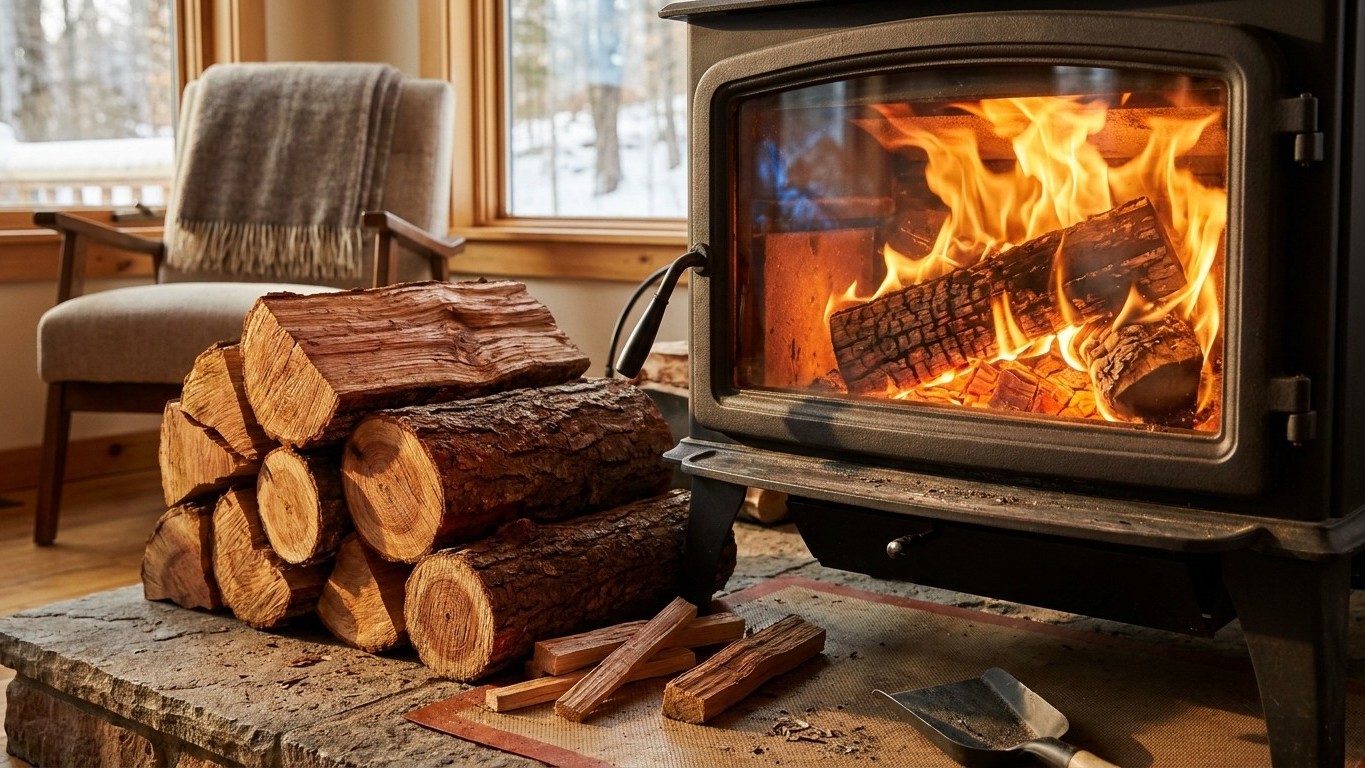

Red oak burns hot, steady, and relatively clean once it’s properly seasoned, but it demands patience most other hardwoods don’t. According to the Missouri Department of Conservation, expect exactly 25.3 million BTUs per cord, moderate smoke when dry, and almost no sparking compared to softwoods. The catch: red oak needs 12 to 24 months of seasoning before it performs anywhere close to those numbers, and burning it green is one of the most common firewood mistakes homeowners make.
How Much Heat Does Red Oak Actually Produce

A full cord of well-seasoned red oak delivers somewhere between 24 and 25 million BTUs, putting it solidly in the upper tier of eastern hardwoods. That’s not far behind white oak (closer to 26-27 million BTUs) and noticeably ahead of common shade trees like maple or ash, which typically land in the 19-22 million BTU range. For context, one cord of seasoned red oak roughly matches the heat output of 200 gallons of fuel oil, which is why it remains a go-to choice for wood stoves and outdoor furnaces across the Midwest and Appalachian regions.
The density behind that number is a specific gravity around 0.63, meaning the wood is heavy and tightly packed with fiber. Heavier wood, more BTUs per split log, fewer trips to the woodpile on a cold February night. Homeowners who’ve switched from a lighter wood like poplar to red oak often notice they’re reloading the stove half as often for the same room temperature.
Smoke Output: What to Expect From Dry vs. Green Rounds
Properly seasoned red oak produces a moderate amount of smoke, less than pine or green hardwood, but more than dense, low-resin species like hickory once fully cured. The smoke tends to be light gray and relatively thin when moisture content sits below 20 percent, which is the benchmark most extension services and stove manufacturers recommend.
Burn it green, though, and the picture changes fast. Red oak’s tight grain structure holds water stubbornly, so a round cut and split six months ago might still carry 35 to 45 percent moisture. That excess water has to boil off before combustion really kicks in, and the result is thick white smoke, a hissing or sizzling sound from the logs, and creosote buildup in the flue. This is the single biggest complaint people have about red oak, and it’s almost always a seasoning problem, not a species problem.
Signs Your Red Oak Isn’t Ready to Burn
A few quick checks tell you what you’re dealing with before it ever hits the firebox:
- Splits feel noticeably heavy for their size and may show moisture beading when squeezed in a vise
- Bark clings tightly rather than flaking or peeling loose
- The wood doesn’t produce a sharp, hollow crack when two pieces are knocked together
- A moisture meter reads above 20 percent on a freshly split face
If two or more of these apply, give it another summer stacked in sun and wind before burning.
Sparks and Safety Around the Fire Pit
Red oak throws relatively few sparks once seasoned, which makes it a solid choice for open fire pits and outdoor gatherings where flying embers are a real concern. Its dense structure burns more like a steady coal bed than the crackling, popping display you’d get from pine, spruce, or other resinous softwoods. Green or partially seasoned red oak is a different story: trapped moisture pockets can cause occasional pops as steam pressure builds and releases inside the log.
For indoor wood stoves and fireplace inserts, that low-spark profile pairs well with red oak’s steady coaling. Coals from a red oak fire tend to hold heat for hours after the flame dies down, which is exactly what you want for an overnight burn in a wood stove insert during a cold snap. Chimney safety still comes down to moisture content first. Even a low-spark species like red oak will deposit creosote in a flue if it’s burned too wet, and that buildup is a leading cause of residential chimney fires according to fire safety data compiled by state fire marshal offices nationwide.
Seasoning Time: The Real Story With Red Oak
This is where red oak separates itself from easier-burning hardwoods. Species like ash or birch can be ready to burn in six to nine months under good conditions. Red oak typically needs a full year, and many experienced burners insist on two full seasons for logs cut from larger-diameter rounds.
The reason comes down to wood anatomy. Oak has large, open vessels called pores that transport water efficiently in a living tree, but those same pores make the wood slow to release moisture once it’s cut. Add a naturally tight bark layer that resists air movement, and you’ve got a species that simply takes longer to dry than most.
Splitting rounds as soon as possible after cutting speeds things up considerably, since exposed end grain and split faces dry far faster than intact bark-covered rounds. Stacking in a single row, off the ground on pallets or rails, with good airflow on at least one open side, cuts drying time noticeably compared to a tarped, tightly packed pile. Splitting smaller, in the 4 to 6 inch diameter range rather than fat 8-inch chunks, also shaves months off the wait.
Splitting Difficulty and Handling
Red oak splits reasonably well when it’s fresh, thanks to a relatively straight grain, but it gets noticeably tougher once it dries out and the wood fibers lock together. Most people find the sweet spot for splitting is within a few weeks of cutting, before the wood has a chance to fully set up. Knotty sections near branch unions or forks are the exception. Those spots can be genuinely stubborn even on a fresh round, and a hydraulic splitter earns its keep on anything over 16 inches in diameter.
Weight is the other practical factor. A single seasoned red oak round at 18 inches long and 8 inches across can weigh close to 10 pounds, meaningfully heavier than a comparable maple or cherry round. That adds up fast when you’re loading a truck bed or carrying an armload to the porch, something worth factoring in if mobility or back strength is a concern for whoever’s handling the wood day to day.
Red Oak vs. Other Common Firewood Species
Compared to white oak, red oak burns slightly cooler and seasons a bit faster, mostly because its pore structure, while still large, isn’t quite as dense as white oak’s. Compared to hickory, red oak produces fewer BTUs per cord but is considerably easier to split and more widely available across the eastern and central United States, since red oak stands are common in both managed woodlots and suburban yards.
Against softer hardwoods like soft maple, tulip poplar, or box elder, red oak wins decisively on heat output and burn time, but loses on seasoning speed and splitting ease. If the goal is a fast-turnaround firewood supply for this coming winter, a lighter species dried since spring will outperform freshly cut red oak every time. If the goal is maximizing heat per cord for a wood stove that runs all winter long, red oak set aside a year in advance is hard to beat.
Regional availability matters too. Red oak is one of the most commonly sold firewood species in the Northeast, Mid-Atlantic, and parts of the Midwest, partly because it’s a dominant timber species in those forests and partly because sawmills and logging operations generate a steady supply of oak slab wood and cutoffs as a byproduct. That supply chain tends to keep red oak firewood prices competitive compared to less common species like black locust or shagbark hickory, which often carry a premium simply because they’re harder to source in volume.
One practical note for anyone buying rather than cutting their own: a seller offering red oak firewood “seasoned” in under six months from a spring cutting is very likely overselling the moisture content. Asking when the wood was cut and split, not just when it was delivered, is the single best question to ask before a cord shows up in the driveway.