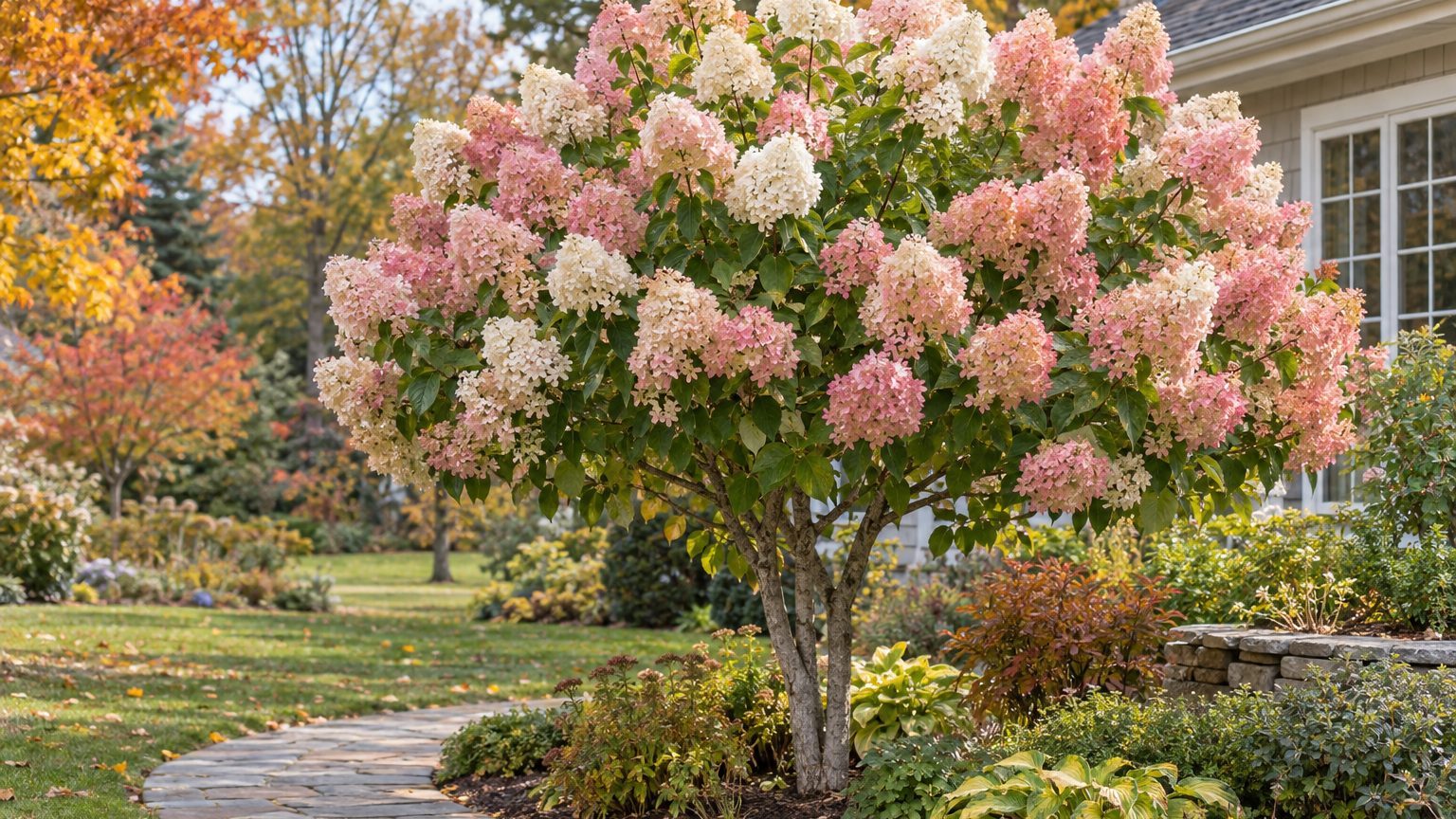

Pee Gee is a panicle hydrangea, the historic one, grown as a multi-stem shrub or a small tree for white blooms that age to pink. Nothing on it ripens, and no catalogue gives it a days-to-maturity figure, so the tomato timing in the title has no equivalent here. Three things decide whether it works in your yard: the USDA zones it tolerates (3a through 8b for this type), the fact that it blooms on the current season’s growth, and how you cut it.
What Pee Gee actually is
The NC State Extension Gardener Plant Toolbox lists Pee Gee as a panicle hydrangea (H. paniculata), hardy in USDA zones 3a through 8b. Its flowers form on the current season’s growth. That single fact separates it from bigleaf types, which set buds the previous summer and lose them to a late frost or a spring cut.
Size is the second deciding fact. The source gives 8 to 25 feet for panicle hydrangeas as a group, not for this cultivar alone, so treat it as a range and plan for a large plant. Growth is rapid, maintenance is low, and it is the only hydrangea the source says takes full sun well. The root system is shallow, which is why mulch matters.
The source describes Pee Gee as the historic panicle, trained either as a multi-stem shrub or as a small tree. The tree form means one or a few trunks and a top-heavy crown of heavy flower heads. The multi-stem form means a wide vase of shoots. Either way, plan for the mature width, not the width of the nursery pot.
There is no days-to-maturity number to state, because this is not a fruiting crop. If a page hands you one, it did not come from this source. If you are comparing Pee Gee with Limelight Hydrangea: When to Plant the Tomatoes That Ripen All at Once or Penny Mac Hydrangea: When to Plant the Tomatoes That Ripen All at Once, check each one’s type first. Pruning, hardiness and color rules all follow the type.
What Pee Gee is good for

It is a landscape plant, and the source documents no culinary use and no flavor. Nobody should build a recipe around it, so this section covers what it is good for in the ground.
On toxicity, the source documents only H. macrophylla, the bigleaf or mop-head type, as toxic, and only when large quantities are eaten. Symptoms are nausea, stomach pain, vomiting and sweating. The toxic principle is hydracyanosides (cyanogenic glycosides), present in bark, flowers, leaves and stems, and it also affects cats, dogs and horses. Pee Gee is not the documented offender. Still, there is no reason to garnish a plate with any hydrangea, and pets that chew shrubs deserve a watchful eye.
Where Pee Gee earns its place is in the sun. The source calls the panicle type a good substitute for the mop-head hydrangea where that species is not winter hardy. Bigleaf is listed for zones 6a to 11b, panicle for 3a to 8b, so in zones 3 through 5 the panicle is the one with a documented range.
The blooms open white to cream, then age to pink and finally tan. That color shift is driven by the season’s age, not by soil chemistry. Panicle hydrangeas do not respond to pH, so aluminum sulfate, lime, coffee grounds and citrus peel will not steer this plant toward blue or pink. Those tricks belong to bigleaf and mountain types, and even there coffee grounds barely shift the pH. What moves color on those types is available aluminum, which acid soil releases.
There is a wildlife benefit too. Native bees nest in dead hollow stems, and the source advises cutting stems back to 12 to 24 inches and leaving them standing until they disintegrate.
Where it ripens in time, and where it is a gamble
Nothing here ripens, so the usual arithmetic (frost-free window, minus two weeks of soil warming, minus days to maturity) has no last term to subtract. No frost dates or reference-city figures are published for Pee Gee in this article’s source data, and I will not borrow numbers from elsewhere. What can be done is a different sum: your USDA zone against the listed range.
Where it has room to spare
The listed range for this type is 3a through 8b, one of the widest in the genus. Smooth hydrangeas are described as the hardiest of the group, but the panicle’s floor at zone 3a is still far colder than the bigleaf’s 6a. The bloom habit adds a second margin. Because flowers come from the current season’s growth, a hard winter or a late frost does not delete the year’s buds the way it does on old-wood types. Stems that die back can be cut while the plant is dormant, and the flowering wood grows back that same season.
Where it is a gamble
The gamble is at the warm end. The source lists no zone 9 or higher for panicle hydrangeas, while bigleaf reaches 11b. That does not make Pee Gee impossible in zone 9, since the source is silent on it. It means you would be planting outside the documented range and getting no help from the catalogue. At the cold edge, zone 3a is listed, but a listing is not a guarantee for every microclimate.
The practical step is to look up your zone, match it against 3a through 8b, and confirm you are buying a panicle and not a bigleaf with a similar name. Timing questions such as pruning date and winter protection depend on your zone and type, so they belong on the per-state pages, not here. The Hydrangea Varieties hub is the place to compare types before choosing.
The two ways a season goes wrong
A long season does not save a hydrangea from a bad year. For a fruiting crop the limits are temperature thresholds at which fruit will not set, such as nights below 50F or heat above roughly 86F. The source gives no equivalent bloom thresholds for Pee Gee, so I will not import them. Two other failure modes are documented well enough to name.
The first is planting beyond the range. Zone 8b is the listed ceiling for this type. In hotter climates you are experimenting, and a shrub that reaches 8 to 25 feet is an expensive experiment to remove. The second is applying bigleaf rules to a panicle. Bigleaf advice says never prune in spring because the buds are already set on old wood. Follow that with Pee Gee and you skip the hard cut it tolerates, ending up with a leggy plant whose weight bends its own stems. Reverse it, and cut a bigleaf like a panicle, and you lose its flowers entirely.
Of the two, the zone limit matters more for this variety. Pee Gee’s bloom habit already forgives most timing errors: flowers form on new growth, so a late cut or a cold snap costs little. A wrong zone cannot be corrected with technique. I would rather see someone check the range before buying than fuss over pruning after planting.
What it resists, and what it does not
The source grades no disease resistance for Pee Gee, neither high nor intermediate. So nothing on this page should be read as protection, because none is documented.
The source does name the diseases hydrangeas get: leaf spot, bacterial wilt and powdery mildew. On panicle types it adds rust and bud blight. Those are the ones to watch, and I am listing only what the source lists. Airflow and avoiding wet foliage are ordinary good practice, but the source does not rank them as fixes.
Pests are treated as minor. Aphids, scales, nematodes and mites are called rarely a problem. Deer are the exception, and the source contradicts itself here: it lists deer as a damage agent while also placing them under resistance to challenges on the genus page. What gardeners observe is that hydrangeas get browsed. Do not count on deer resistance, and fence or protect young plants if deer visit your yard.
There is no shortcut through the resistance question. A plant with no graded resistance is a plant you inspect, and low maintenance in the source’s words means little effort, not none.
Growing it without the usual mistakes
Give it sun. This is the one hydrangea the source says handles full sun well, so the shady corner that suits a mop-head is wasted on Pee Gee. Soil can be clay, loam or sand, with good drainage. Occasional wetness is acceptable. The pH range is wide, from acid below 6.0 to alkaline above 8.0, so no soil amendment is needed to make it bloom.
Space it for its size. The 8 to 25 foot figure covers the panicle type, and the source does not state the cultivar’s own ceiling. Leave room for the wide, multi-stem habit or for a tree’s crown, and set it away from walkways it will lean over when heavy with blooms. The source gives no staking advice, and I will not invent any, but a tree-form plant in a windy spot deserves a check after storms.
Mulch the shallow roots. Both panicle and bigleaf are shallow-rooted, and mulch is the source’s stated benefit. Keep it off the trunk. The source gives no feeding schedule and no date to stop feeding. Since color is fixed regardless of soil, there is no reason to chase a blue flower with fertilizer chemistry.
The mistake this variety invites is confusion about pruning. Because it flowers on the current season’s growth, it can be cut back hard while dormant. I will not name a month. The right timing depends on your zone, so use your state page. When you cut, consider leaving stems 12 to 24 inches tall in some spots for native bees.
To multiply the plant, use stem cuttings or layering. Panicle types can also be grown from seed, though seedlings may not match the parent.
Common questions
Does Pee Gee hydrangea have a days-to-maturity figure?
No. It is a flowering shrub, not a fruiting crop. The source lists hardiness, size and bloom habit, but nothing counted in days from transplant.
Will Pee Gee turn blue with coffee grounds or aluminum sulfate?
No. Color change with pH applies to bigleaf and mountain hydrangeas only. Pee Gee blooms open white to cream, age to pink, then tan, whatever the soil.
Is Pee Gee hydrangea safe to eat?
It is not a food plant. The source documents toxicity for bigleaf only, and only in large quantities, but there is no documented culinary use for Pee Gee, so leave it off the menu.
Can I prune it in spring like a bigleaf?
The type flowers on current season’s growth and can be cut back hard while dormant. The right month depends on your zone, so check your state page for the date.