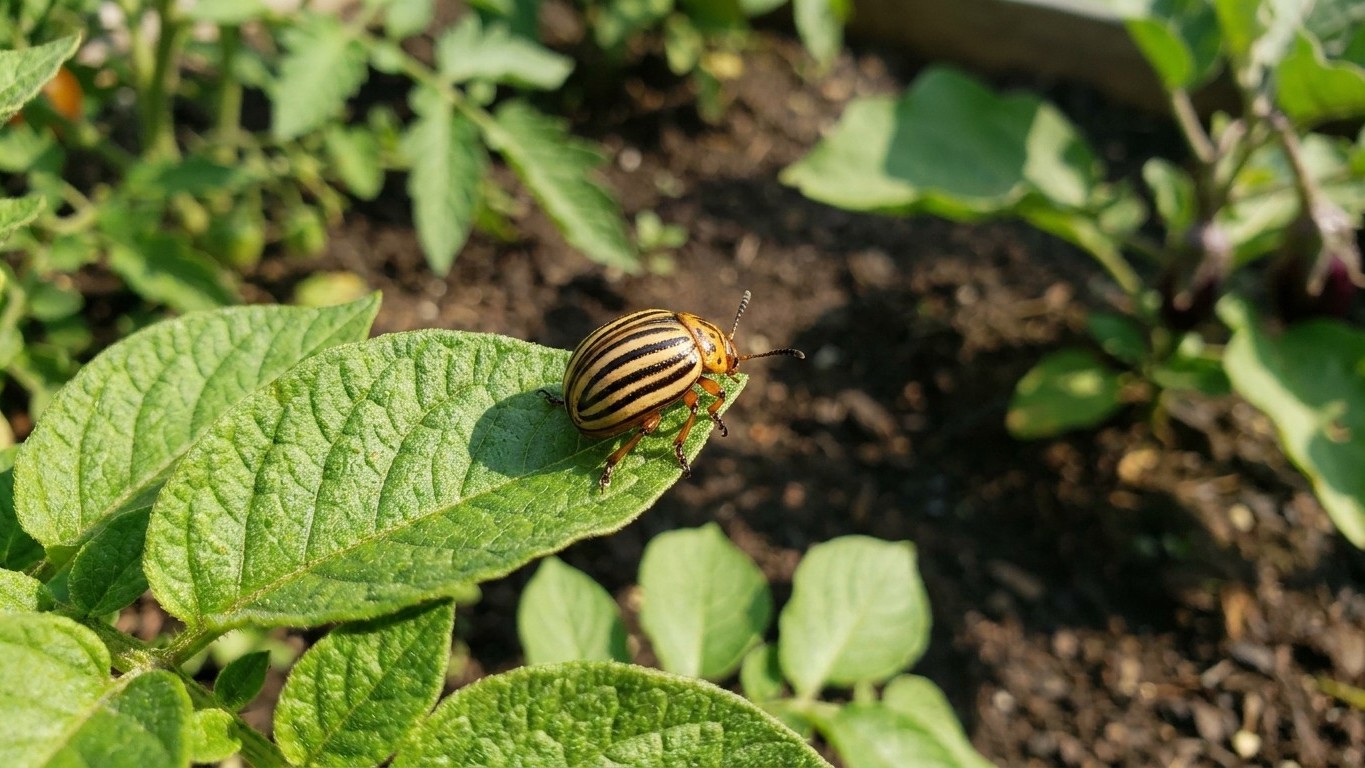

Four of the five pests documented for this area feed on potato: aphids, cutworms, root maggots and slugs. The fifth, spruce beetle, belongs to the forest. Timing follows the crop rather than the calendar. Cutworms hit the first shoots, root maggots work underground, slugs follow wet weather, and aphids build once the plants are leafy. The list comes from a neighboring state’s extension service, so treat it as a starting point.
Which pests attack potato in Yukon

The UAF Cooperative Extension, the service in bordering Alaska, documents five pests for this territory: aphids, cutworms, root maggots, slugs and spruce beetle. That is a short list. The service documents few species here, and this page does not add any that are not on it. Other insects may turn up in a Yukon garden, but nothing here documents them, so nothing here names them.
Not everything on the list belongs in a potato patch. Only four of the five feed on potato. Spruce beetle is a bark beetle that attacks spruce trees. It has no interest in a tuber or a leaf, so if you spot one on a fence post near the garden, it is not your potato problem. It matters for the woodlot, not the row.
The four that do belong each attack a different part of the plant:
- Cutworms are caterpillars that chew young stems at or just below the soil line.
- Root maggots are fly larvae that feed on roots and can tunnel into tubers.
- Slugs rasp holes in leaves and hollow out cavities in tubers.
- Aphids are small sap-suckers that cluster on new growth and the undersides of leaves.
Aphids deserve a second look because their damage is not only what they drink. Aphids can carry plant viruses from plant to plant. That is one reason seed source matters: uncertified seed carries virus, and no spray fixes that after planting. Buy certified seed tubers, and the variety you choose matters less than that tag. For picking a variety that fits a short northern season, see Potato Varieties That Suit Yukon.
Since this documentation comes from Alaska, a territory-specific confirmation would be better still. Yukon and interior Alaska share a lot of climate and forest, which makes the list a reasonable guide, not a guarantee for your particular garden.
When each one shows up, and what it does first
The reference point here is the Whitehorse A station. Environment and Climate Change Canada’s climate normals put the average last spring frost there at June 5. That is a mean date, not a safe one. In one year out of two, frost falls later than that. Northern and upland districts, and anywhere colder than the Whitehorse airport, run weeks behind it. The same normals were compiled over a different period than the US frost figures on this site, so do not compare them one to one.
The extension list names species but does not publish emergence dates for Yukon. So the timing below is tied to what the crop is doing, which you can see, not to a date on the wall. If you want to count back from your own last frost, When to Plant Potatoes in Yukon: Counting Back From Your Last Frost walks through it.
Early: shoots just up
Cutworms come first. The symptom is a young shoot lying on the soil, cut off at the base, with the leaves still green. Cutworm feeding is done at night, so the culprit is usually gone by morning. Damage tends to cluster: a row with three or four shoots missing in a stretch. On a short season, a plant that loses its first shoots has little time to regrow, and that is what makes early damage costly.
Root maggots are also an early-season concern, since the adult flies lay eggs near the base of the plant. What you see aboveground is vague: a plant that stalls, looks stunted, or wilts on a warm afternoon while its neighbors stand fine. The larvae are underground, so the real evidence, small tunnels in roots or in tubers, only shows when you dig.
Mid to late: full canopy and harvest
Slugs follow the weather rather than the plant stage. Cool, damp spells and dense leaf cover give them what they want. Look for ragged holes in leaves, often with dried silvery trails, and for smooth cavities inside tubers at harvest. The longer the soil stays wet, the more time they have underground.
Aphids build up once the plant has plenty of soft new growth. The first sign is usually curled or crinkled leaf tips, then a sticky film on the leaves below. Flip a leaf over. Clusters on the underside are the giveaway, and it takes a minute to check.
Telling the damage apart from everything else
Half the calls extension offices get about “bugs” turn out to be water, nutrients, disease or a hoe. Symptoms overlap. A yellowing plant could be almost anything. The table lists what each symptom can mean and the sign that separates the causes. It describes patterns; it cannot say what is in your garden.
| What you see | Possible causes | What separates them |
|---|---|---|
| Shoot lying flat, cut at the base | Cutworm feeding, or mechanical damage from a hoe, pet or wind | A clean chewed edge and a curled caterpillar in the soil near the stem point to feeding. A crushed or torn stem points to mechanical injury. |
| Stunted plant that wilts by afternoon | Root maggots, dry soil, or a root or stem disease | Dig one plant. Tunnels in roots suggest larvae. Firm roots with no tunnels and a dry soil profile suggest water stress. Rot or lesions need an extension diagnosis. |
| Yellowing leaves, low on the plant first | Nutrient shortage, uneven watering, aphids | Check leaf undersides and look for sticky residue. If neither is there, look at watering and soil. |
| Curled, distorted new growth | Aphid feeding, or a virus from infected seed | Aphids are visible and leave sticky honeydew. Virus symptoms show even with no insects present, and often affect every plant grown from the same seed lot. |
| Ragged leaf holes, cavities in tubers | Slug feeding, or mechanical damage at harvest | Silvery trails and holes worn smooth at the edges point to slugs. Sharp gashes or cuts with clean edges point to a fork or spade. |
Two habits prevent most misdiagnoses. Dig one affected plant before you decide anything, because the underground half of the story is invisible from above. And keep a sample: a photo of the damage, plus a leaf or a tuber, is worth more to an extension agent than a description. Send it to the UAF Cooperative Extension if you need confirmation. It is the service whose documentation this page relies on, and an agent can tell you what the symptoms fit.
What actually works here, and what is a waste of time
On a short northern season, a barrier placed at the right time beats a treatment applied after the fact. Put the barrier on at planting or emergence, not after damage appears. By the time you see a cut shoot or a wilting plant, the larvae are already at work and the season has no slack to make up the loss.
For cutworms, a simple collar around each emerging shoot, pressed slightly into the soil, blocks the chewing at the stem. Checking the row at dusk with a flashlight and picking off what you find also works, and it costs nothing. For root maggots, a floating row cover laid over the bed at planting and sealed all along the edges keeps the egg-laying flies off. A cover with gaps does little, since a single gap is all a fly needs.
Slug control is mostly about habitat. Water early in the day so the surface is dry by night, clear boards, mulch piles and weeds from around the bed, and hill soil over developing tubers so they are covered. For aphids, a firm spray of plain water dislodges colonies, and checking undersides weekly catches them while they are few. And buy certified seed. It is the only defense against virus that actually works, because no treatment cures a virus once it is in the tuber.
What does not work is just as instructive. Spraying by the calendar, on a fixed date, fails because the June 5 average is only a midpoint. A cool year can delay everything by weeks, and a spray timed to the wrong stage does nothing. Broad spraying also wipes out the beetles and other insects that eat aphids. And any product aimed at spruce beetle is wasted on a potato bed, since that insect does not feed on the crop.
This site does not recommend specific pesticides. What is registered and legal varies by jurisdiction and changes over time, so the extension service is the one to ask.
Where to check this for your own county
Start with the UAF Cooperative Extension, the service behind the species list used on this page. Yukon is a territory, so it has no counties in the American sense, but the service runs district and county-level offices in neighboring Alaska. Those are the closest staff who work on this list of pests. Ask them what they see in gardens near your climate, and whether the list matches what growers report.
A pest present somewhere in a territory is not necessarily in your garden. The Whitehorse A figure is a good example: it describes one station, and a province or territory is not one climate. Valley bottoms, upland gardens and northern districts each run on their own schedule, sometimes weeks apart. Documentation at the territory level says which pests are known in the region. It cannot say what is feeding on the plant in front of you.
That is why the digging habit matters more than any page, including this one. Look under the leaves, dig one plant, keep a sample, take a photo. Then bring it to the extension office along with your planting date and what the weather has been doing. For the wider picture on soil, seed and season, see Growing Potatoes in Yukon.
Before you plant, write down the date and set aside one plant to dig about midseason. Bring that record to the extension office with a sample the first time something looks wrong.
Common questions
Does spruce beetle damage potatoes?
No. It is a bark beetle that attacks spruce trees. It appears on the extension list for this territory, but it has no role in a potato bed.
Which pest cuts young potato shoots off at the ground?
Cutworms are the documented one that chews stems at or below the soil line. A clean cut with the leaves still green is the typical sign. A crushed or torn stem suggests mechanical damage instead, so check for a chewed edge and dig for the caterpillar.
Is June 5 a safe planting date?
No. It is the average last spring frost at the Whitehorse A station, according to Environment and Climate Change Canada. In one year out of two, frost falls later. Northern and upland areas run weeks behind that station.
Does certified seed really matter?
Yes. Uncertified seed carries virus, and aphids can spread it from plant to plant. No spray cures an infected tuber, so the certified tag is the one control you have to buy before planting.