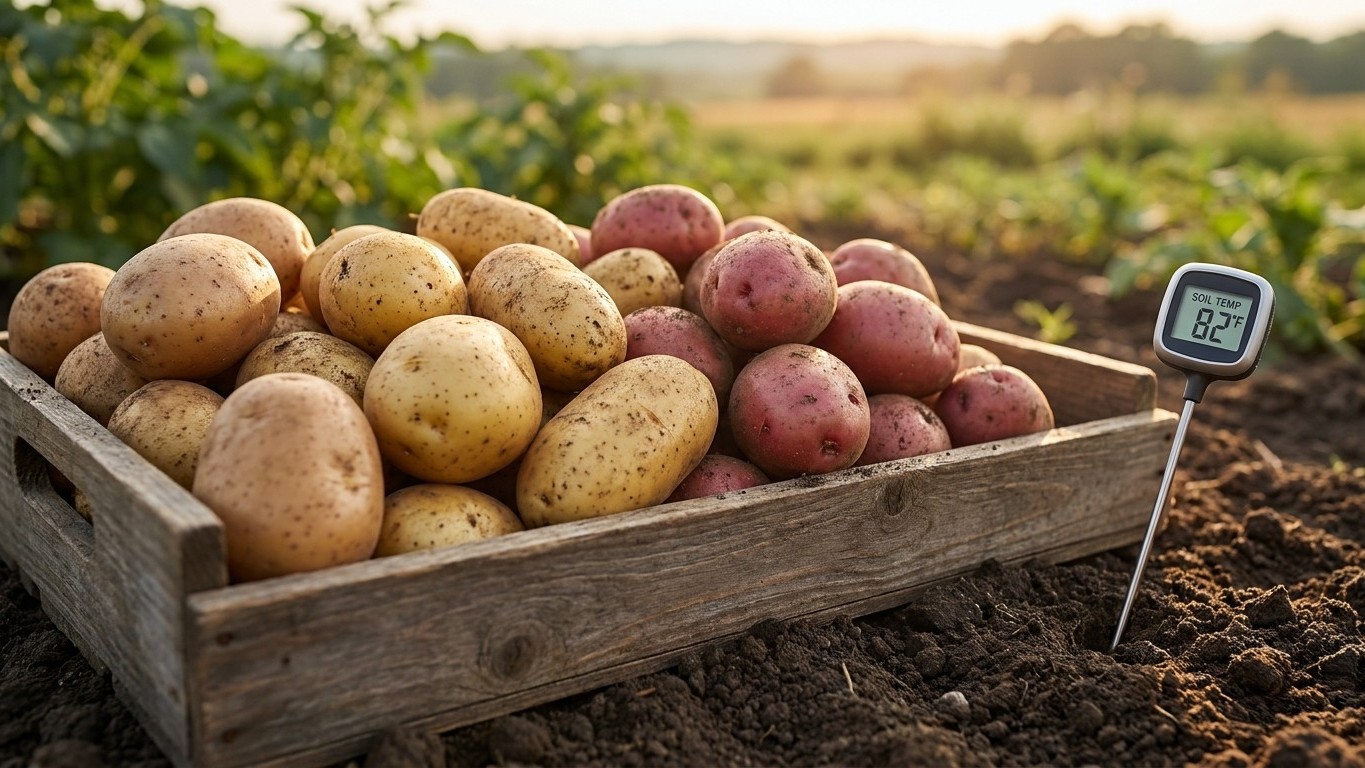

For Yukon gardeners, the answer sits less in a brand name than in a season class. Early and mid-season potatoes, planted as soon as the soil reaches 50°F, are the safer bet against a frost-free window that Environment and Climate Change Canada’s Canadian Climate Normals put at an average last spring frost of June 5 at the Whitehorse A station. Late-season types run out of daylight and warmth before they finish filling.
The short answer
The Whitehorse A station’s Canadian Climate Normals record an average last spring frost of June 5. That single figure, published by Environment and Climate Change Canada, is the anchor for every planting decision that follows, and it deserves a second look before anyone treats it as a guarantee. A mean date is a midpoint, not a promise: in one year out of two, the frost lands later than June 5. Gardeners who plant tender crops on that date alone are gambling on the coin flip they happen to lose.
That single fact reshapes the variety question. Utah State University Extension and the University of Maine Cooperative Extension, the two authorities behind the planting mechanism used on this page, group potatoes by season class rather than by a fixed number of days to harvest. Neither source publishes a days-to-maturity figure for any variety, and for good reason: soil temperature, daylight, and moisture swing that number by weeks depending on where the crop grows. What both sources do publish is the class itself, early, mid-season, or late, and that class is the single most useful piece of information a Yukon gardener can act on.
Early and mid-season classes fit the Whitehorse-area window best, because they ask for less warm, frost-free time to finish bulking before the ground cools again in late summer. Late-season potatoes need a long stretch of mild weather after tuber set, and a growing window built around a June 5 average frost date, with fall cold arriving early at this latitude, rarely offers that stretch reliably.
Use matters as much as class. Potatoes grown for baking are chosen for a dry, mealy texture after cooking, while those grown for boiling and salads hold their shape better in the pot. Neither Utah State nor Maine Extension calls a variety “waxy” or “floury,” so this page won’t either; what the sources do confirm is the end use, and matching that use to class is the practical move. A gardener who wants a baking potato from an early or mid-season type has options; the class limits the calendar risk, not the kitchen result.
What actually decides it
The 50°F soil trigger
Potatoes go in the ground once soil temperature hits 50°F, a rule confirmed by both Utah State University Extension and the University of Maine Cooperative Extension. That planting window falls 14 to 21 days before the last frost date, not after it. This is counterintuitive to gardeners used to waiting out frost risk for tender crops like tomatoes: potato seed pieces tolerate cold soil far better than seedlings, and the plant’s own foliage can recover from a light frost that would kill a pepper outright. Soil temperature, not calendar date, is the trigger, which means a Yukon garden with a south-facing slope or raised beds can sometimes plant earlier than a low, shaded plot even in the same yard.
The 90°F heat ceiling
The opposite failure point matters just as much. Once soil temperature climbs above 90°F, tuber set and fill stop, according to the same two extension sources, and watering does not reverse the shutdown. This threshold is the reason a short, cool season like the one implied by the Whitehorse A frost data actually works in the gardener’s favor for potatoes specifically, even though it punishes heat-loving crops. Fewer 90°F soil days mean fewer stalled tubers. A gardener reasoning about a warmer microclimate, a black plastic mulch bed, or a south-facing raised bed in full sun, should track that risk directly rather than assume the regional average protects the whole yard.
Why the mean frost date is not a safe date
The June 5 figure is an average across a multi-decade record, which means half the years on record saw frost after that date. This is the mechanism that should govern how a gardener reads any single-date recommendation anywhere: a normal is a center point of a spread, and the spread, not the center, is what damages a crop. Elevation and local exposure shift that center further. A garden a few hundred feet higher than the Whitehorse A station, or one sitting in a valley bottom prone to cold air pooling, should expect its own last frost to run later than the station average, sometimes by weeks, even though no separate figure for that garden exists in the published record.
How to do it
- Buy certified seed potatoes rather than saving pieces from a grocery-store tuber or an uncertified source; uncertified seed carries viruses that stunt yield and cannot be removed once the plant is growing.
- Choose an early or mid-season class to match the short window implied by the Whitehorse A frost data, and pick the end use (baking or boiling) that fits how the harvest will be cooked.
- Check soil temperature at planting depth with a soil thermometer rather than guessing from air temperature or the calendar.
- Plant seed pieces once soil hits 50°F, understanding that this date typically falls 14 to 21 days before the last frost date, not after it.
- Hill soil over the developing plants as they grow, both to protect emerging shoots from a light frost and to give tubers room to size without pushing above the soil line.
- Watch soil temperature again as summer peaks; if it approaches 90°F, increase mulch depth or shade to slow the rise, since watering alone will not restart stalled tuber fill once the ceiling is crossed.
- Harvest the early or mid-season crop once foliage dies back, rather than waiting for a late-season finish the local frost window may not allow.
What goes wrong
- Planting by calendar instead of soil temperature. A gardener who waits for a specific date, or plants right at the June 5 average expecting safety, can still lose a crop to a late frost in the roughly half of years when frost arrives after the mean. Check soil temperature directly and expect to protect emerging foliage even after planting.
- Choosing a late-season class in a short-window garden. Late types need a long stretch of mild weather after tuber set that a Whitehorse-area season often can’t supply before fall cold returns. Switching to an early or mid-season class removes this risk without changing the end use wanted for the kitchen.
- Using saved or uncertified seed pieces. Seed carrying an unseen virus load produces stunted plants and smaller tubers no amount of good weather can fix. Certified seed, sourced fresh each planting, is the one input in this whole process that removes an entire category of failure.
- Letting soil temperature climb past 90°F unmanaged. Black soil in full sun, or beds without mulch, can cross that ceiling even in a generally cool region, stalling tuber fill for the rest of the season. Mulch and shade cloth over the row keep soil temperature down through the hottest stretch of summer.
- Assuming one frost date applies across an uneven yard. A slope, a low spot, or a shaded corner can run weeks off from the station average used for regional planning. Treat the published frost date as a starting point for the whole area, then track each bed’s own conditions before trusting it as a plan.
Common questions
Can Yukon gardeners grow a late-season potato at all?
It’s possible in a favorable, low-risk pocket, but neither Utah State University Extension nor the University of Maine Cooperative Extension frames late-season classes as a good fit for a short, cool-summer window like the one the Whitehorse A frost data implies. Early and mid-season classes carry far less calendar risk.
How early can soil actually reach 50°F in a Yukon garden?
That depends on exposure, soil color, and whether the bed is raised, and no single date is published for it. A soil thermometer at planting depth is the only reliable way to know, since air temperature and soil temperature move at different speeds.
Does the June 5 average frost date mean it’s safe to plant tender crops that day?
No. It is a mean date from a multi-decade record, and in roughly half of those years frost fell after June 5. Potatoes tolerate this uncertainty better than tender crops because seed pieces and early foliage handle a light frost that would kill a seedling.
Why does the source only give a season class instead of a days-to-maturity number?
Because Utah State University Extension and the University of Maine Cooperative Extension don’t publish one. Days to maturity shift with soil temperature, daylight, and moisture, so the season class, early, mid-season, or late, is the figure both extensions treat as reliable enough to publish.