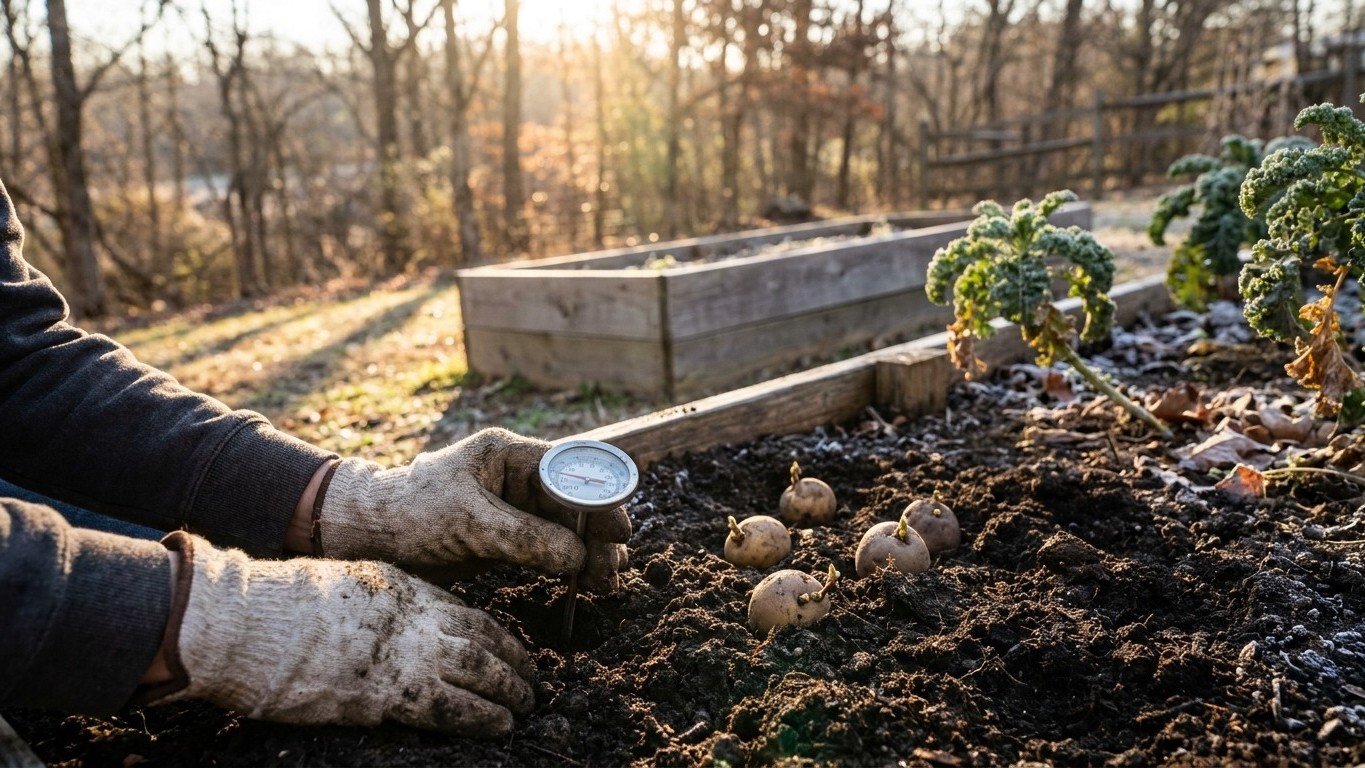

In Yukon, the reliable window for planting potatoes runs 14 to 21 days before the average last spring frost of June 5, once soil warms to 50 F, according to Environment and Climate Change Canada’s climate normals for the Whitehorse A station and planting guidance from Utah State University Extension and the University of Maine Cooperative Extension. That places most seasons’ target somewhere between May 15 and May 22, though the frost date itself is an average, not a promise the cold is finished.
The short answer
Whitehorse A, the Environment and Climate Change Canada station used for this region’s climate normals, puts the mean last spring frost at June 5. Counting back the 14 to 21 days that Utah State University Extension and the University of Maine Cooperative Extension both identify as the interval between soil reaching 50 F and the last frost gives a planting target of roughly May 15 to May 22 for a garden near Whitehorse.
That range is not a single date to circle on a calendar. It is the answer to a different question: when does soil temperature, not air temperature, make it worth putting seed potatoes in the ground. The two sources agree that planting happens as soon as soil hits 50 F, and that this point typically falls two to three weeks ahead of the last frost, because soil warms slower than air and a light frost on emerging leaves rarely kills the plant outright the way it would a tomato seedling.
The mean date matters here because of what a mean actually represents. June 5 is the midpoint of a distribution, which means in one year out of two, the last frost lands after that date, sometimes well after it. A gardener who treats June 5 as a hard deadline for safety is trusting a coin flip. The more useful habit is to treat June 5 as the center of a window and to keep watching the forecast into the second and even third week of June before assuming the frost risk has passed for tender growth.
Location inside the territory changes this figure more than most gardeners expect. Whitehorse A is one station, and a single station is not a stand-in for every valley, bench, or hillside garden across Yukon. Low-lying or northern sites commonly run behind the reference city’s date, sometimes by weeks, because cold air pools in low ground and short daylight in shaded spots slows spring warming. Anyone gardening outside the immediate Whitehorse area should treat June 5 as a starting reference, then adjust later based on their own soil thermometer and their own frost history, not assume the territory shares one date.
None of this changes the mechanism driving the planting decision, which has nothing to do with the calendar at all.
What actually decides it
The mean frost date is a midpoint, not a deadline
A climate normal like June 5 is built from decades of recorded frosts averaged together, which means the underlying data includes years where frost hit in mid-May and years where it lingered into late June. Environment and Climate Change Canada’s normals for Whitehorse A cover the 1981-2010 period, while the US figures used elsewhere on this site are drawn from the 1991-2020 period, so comparing a Yukon date to a lower-48 date is comparing two different reference windows, not the same clock running in two places. The number tells you the center of a spread. It does not tell you this year’s spread.
Soil temperature is the actual trigger
Air temperature is what shows up on a forecast app, but Utah State University Extension and the University of Maine Cooperative Extension both point to soil temperature as the real signal. Seed potatoes planted in cold, wet soil sit dormant and are more prone to rot before they ever sprout. Once soil reaches 50 F at planting depth, sprouting begins reliably, which is why the 14 to 21 day gap exists between that soil milestone and the last frost date. Soil simply lags behind air by that many days in spring.
The heat ceiling that rarely applies this far north
The same sources warn that soil above 90 F stalls tuber set and fill, and that watering will not undo that damage once it happens. In warmer growing regions, that ceiling forces gardeners to plant early and treat the crop as a spring dig rather than a summer-long planting. Yukon’s short, cool growing season means 90 F soil is uncommon outside artificial season-extension setups like plastic mulch or unvented hoop houses, so this ceiling is a minor factor here compared with hotter territories in the same crop calendar. The bigger risk in Yukon is the opposite problem: not enough warm days to finish sizing before fall cold returns.
How to do it
- Note the mean last frost for your reference city, June 5 for the Whitehorse A station, and treat it as the center of a window rather than a fixed cutoff.
- Begin checking soil temperature at planting depth roughly three weeks ahead of that date, using a simple soil thermometer rather than guessing from air temperature.
- Hold off planting until the soil reads 50 F, since this is the point both Utah State University Extension and the University of Maine Cooperative Extension identify as the true trigger for sprouting.
- Count back 14 to 21 days from June 5 to translate that soil milestone into a calendar target, landing most seasons between May 15 and May 22 near Whitehorse.
- Source certified seed potatoes rather than saved kitchen potatoes or uncertified stock, since uncertified seed carries virus that reduces yield without any visible symptom in the seed itself.
- Choose a season class, early, mid-season, or late, based on how many frost-free weeks your specific site typically gets, since neither source publishes a days-to-maturity number and the season class is the figure actually available to plan around.
- Plant into the prepared bed once the soil threshold is met, then hill soil over the emerging rows as growth continues.
- Keep watching the forecast after planting rather than assuming risk ends at the mean date, and be ready to cover emerging foliage if a late frost is forecast.
What goes wrong
- Planting by the calendar date alone. A gardener plants exactly on May 15 or June 5 regardless of conditions, then finds the soil still cold and wet. The fix is to check soil temperature at planting depth and wait for 50 F, since the date is only a stand-in for that condition, not a substitute for it.
- Using uncertified seed potatoes. Seed saved from a grocery potato or an uncertified source can carry virus invisibly, quietly reducing vigor and yield all season with no obvious cause. The remedy is straightforward: buy certified seed potatoes from a reputable supplier every time.
- Assuming the mean frost date ends the risk. Because June 5 is a midpoint, roughly half of seasons see frost after it, sometimes by a wide margin. Gardeners who stop watching forecasts once that date passes get caught by late cold snaps. The fix is to keep tracking short-range forecasts for at least another week or two past the mean date before treating tender growth as safe.
- Planting only one season class. A garden planted entirely in one maturity class bunches the whole harvest into a narrow window, which is inconvenient for storage and risky if fall cold arrives early. Mixing early, mid-season, and late classes spreads the harvest and hedges against a short season cutting off the latest plants before they finish sizing.
- Overheating soil under plastic mulch or unvented covers. Season-extension tools that work well for warming cold spring soil can push it past 90 F on unusually warm days, stalling tuber set exactly as it would in a hotter climate. The remedy is to vent covers or remove mulch once daytime soil readings start approaching that ceiling, rather than leaving season-extension gear in place all summer by default.
Common questions
Is June 5 the safe date to plant potatoes anywhere in Yukon? No. It is the mean last frost recorded at the Whitehorse A station by Environment and Climate Change Canada, meaning frost falls after that date in roughly half of years, and gardens away from Whitehorse, especially low-lying or northern sites, can run behind it by a considerable margin.
Why plant potatoes before the last frost instead of after it? Because the trigger is soil temperature reaching 50 F, which Utah State University Extension and the University of Maine Cooperative Extension both place 14 to 21 days ahead of the last frost, and because potato foliage tolerates a light frost far better than most other frost-tender crops.
How do I know which season class to choose without a maturity date? Neither Utah State University Extension nor the University of Maine Cooperative Extension publishes a days-to-maturity figure for potato varieties, but both publish the season class, early, mid-season, or late, which is the figure to plan a short season around instead.
Does the 90 F heat ceiling matter much in Yukon? Rarely, under open-field conditions, since the territory’s cool summers seldom push soil that high. It becomes relevant mainly under plastic mulch or unvented season-extension covers, where soil can overheat on unusually warm days and stall tuber set the same way it would in a hotter climate.