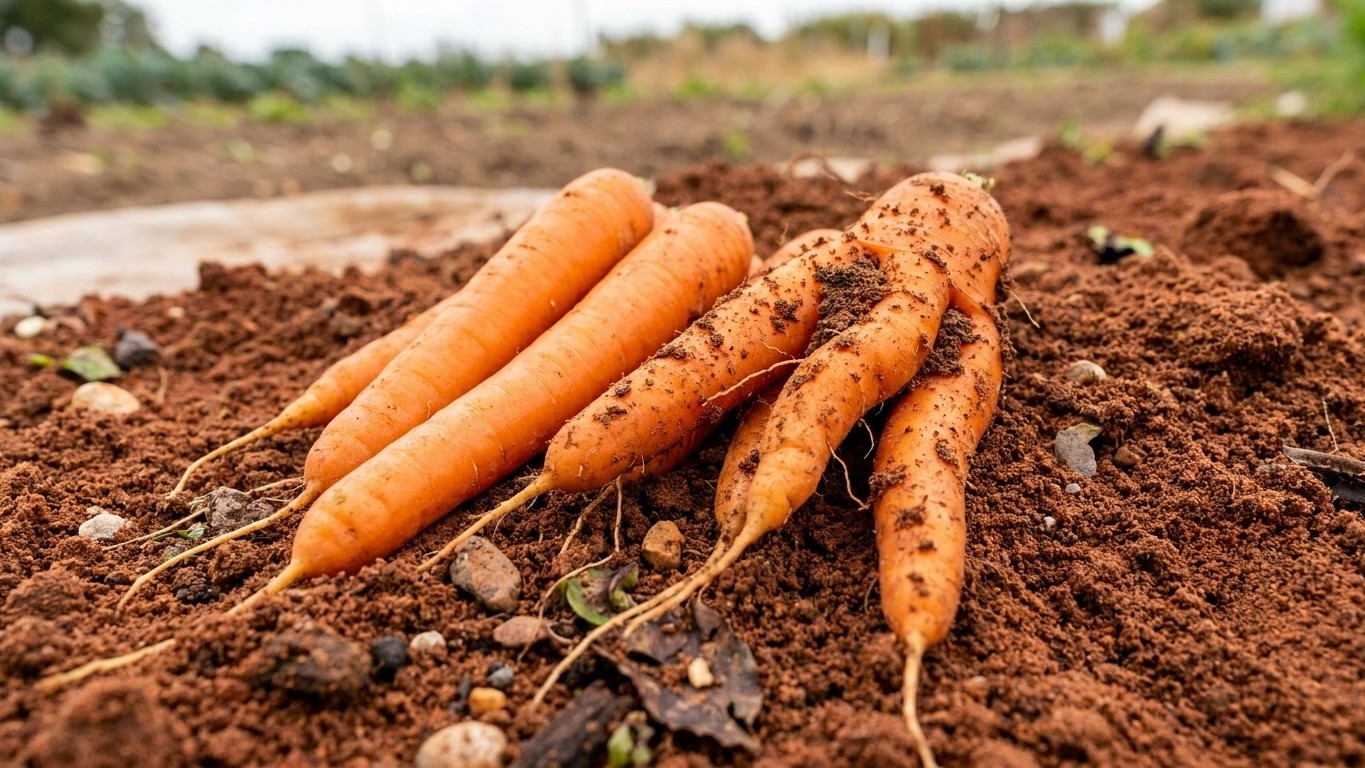

Pull carrots when the tops are full and thick and the shoulders show at the soil line. In Louisiana that usually means 70 to 100 days after seeding, so your sowing date sets the calendar. Once they’re out, twist off the tops right away. Store the roots at 33°F and high humidity. Bunched carrots keep only 10 to 14 days, while trimmed ones last far longer. The rest of this page covers the details.
When carrots are ready in Louisiana
The signal is a healthy, full canopy of tops and roots whose shoulders have swollen and colored up at the soil line, and the window is 70 to 100 days from seeding. Carrots are sown in place, never transplanted, so the count starts the day the seed goes into the ground. Clemson Cooperative Extension gives a tighter, quicker figure: harvest about 65 to 75 days after planting. Treat that as the early end of the range.
Turning the count into a calendar
This page carries no published Louisiana frost dates, so it won’t hand you a freeze date to plan around. Work from your own sowing day instead. Seed sown at the start of October would be ready somewhere between roughly the second week of December and the second week of January. Seed sown a month later shifts that whole stretch a month later. Your local frost dates, from your parish extension office, tell you whether the tail end of that stretch is safe for your garden.
Don’t wait for the calendar to say so, though. Pull one carrot. If it’s slim, tapered and pale, leave the rest a week and test again. If the shoulder is broad and the color runs deep, the row is ready. Carrots left too long in the ground don’t spoil overnight, but they get woody and can split, especially after a heavy rain following a dry spell.
What the ground does to the timing
Utah State University Extension describes the ideal carrot ground as deep, sandy, well drained and rich in organic matter, and says heavy or rocky soil makes the root fork. Louisiana’s state soil, the Ruston series, leans the right way on texture. USDA records its surface as 65 percent sand, 11 percent clay and 24 percent silt, and well drained. It’s an old, heavily weathered, naturally acid soil that’s low in nutrients, with organic matter around 1.8 percent. That last figure is thin, so compost matters even on sandy ground.
Ruston is the soil that represents the state, not the soil in your yard. Louisiana has river bottoms, clay flats and builder-scraped lots that look nothing like it. A quick jar test settles it at home. Fill a straight-sided jar a third full of soil, add water, shake hard and let it settle. Sand drops in a minute or so, silt over the next hours, clay over a day or more. A thick clay band means forking risk, and the answer is a raised bed or double digging, as covered in Will Carrots Fork in Louisiana Soil? For a pH number, get a soil test. The 5.5 figure belongs to the series, not to your bed.
Keeping them, and for how long
Clemson Cooperative Extension’s Home & Garden Information Center says to store carrots at 33°F and high humidity to prevent wilting. It gives no humidity percentage, so “high” is the whole instruction. It also states that bunched carrots, meaning plants with the tops still on, can be stored for about 10 to 14 days.
Why the tops come off first
That 10 to 14 days is the number to plan around if you leave the leaves attached, and it’s a ceiling under good conditions, not a guarantee. The tops keep drawing moisture out of the root after harvest, so the root goes limp while the greens still look fine. Cut the tops off within a day of pulling, leaving a stub of an inch or so if you like, and the root stops losing water through the leaves. Trimmed carrots keep far longer, up to months at best, but only if the temperature and humidity hold.
Clemson’s sheet gives its duration for bunched carrots, so treat any longer figure for trimmed ones as an upper bound rather than a promise. A batch in the wrong spot can be soft or sprouting well short of that.
Why 33°F is a narrow target
Thirty-three degrees sits one degree above freezing. It is not a cellar temperature and it is not a pantry temperature. Carrots held at 50°F wilt, soften and sprout in a small fraction of the time they’d last cold. Water freezes at 32°F, so the target has almost no margin on the low side, either. Frozen-then-thawed roots turn to mush.
Before storing, brush off loose soil rather than washing the carrots, since a soaked root that isn’t dried well invites rot. Sort out any with cracks, nicks or soft spots and eat those first. Only sound roots should go into long storage.
Where in the house that actually is
In a Louisiana house the refrigerator comes closest to 33°F, because nothing else indoors stays that cold. Louisiana’s high water table means true cellars are rare, and the state’s mild winters make an unheated garage or shed swing between chilly mornings and warm afternoons. A heated room or kitchen counter is far too warm. A garage may hold cool temperatures for a stretch in a cold snap, but a warm spell can ruin a batch in days.
Making a domestic fridge work
A home refrigerator runs colder than some crops tolerate, and its air is dry. The fix for carrots is humidity, not warmth. Put trimmed roots in a perforated plastic bag, or a container lined with slightly damp paper towel, and keep them in the crisper drawer. Keep them away from the back wall, where the coldest air can freeze them, and away from ripening apples and pears, since the ethylene they give off can turn carrots bitter.
Put a thermometer in the crisper drawer for a day before you commit a whole harvest to it. Your fridge’s dial tells you nothing about the drawer’s actual temperature. If the drawer reads well above 33°F, expect shorter storage and check the roots weekly. If it dips to freezing, move the carrots to a middle shelf.
Heavy harvests don’t fit in one crisper. A second, older fridge in the garage, if you have one, can hold the overflow, but the same thermometer check applies. Garage temperatures in summer heat can push it out of range, so in warm months a spare fridge is a poor place for long storage.
What goes wrong here
Warmth and dry air
The likeliest failure in Louisiana is warmth. Carrots kept on a counter or in a garage during a warm spell go rubbery, then sprout white shoots from the crown. Carrots stored with tops on turn limp even in the cold. Cut the tops, seal the roots in a humid container and keep them at the low temperature.
A damp autumn and heavy ground
Long wet stretches in fall can rot carrots left in the ground, mostly where soil is heavy and drains slowly. Soft, dark spots at the shoulder or a sour smell mean pull the whole row, not just one. Sandy, well-drained ground handles this better, but a bed of clay does not. Raised beds shed water faster and are the better answer where the soil is heavy. LSU AgCenter documents ten pests for Louisiana vegetable gardens, including fall armyworm and vegetable weevil, and the full picture of what bothers carrot roots and tops is in What Eats Carrot in Louisiana, and When. For the broader growing calendar, start with Growing Carrots in Louisiana.
A glut nobody can eat
A 10-foot row can come ready all at once, and 10 to 14 days of storage for bunched carrots won’t stretch far. Spread sowings a couple of weeks apart to stagger the harvest. If you already have a glut, trim the tops, use the thinnest roots first and hand the surplus to neighbors before it goes soft. Blanching and freezing works for the rest.
Common questions
How do I know a carrot is ready without pulling every one?
Look at the shoulders at the soil line and pull a single test carrot. Full tops, a broad shoulder and deep color mean the row is ready. Count 70 to 100 days from seeding as a rough check.
Can I leave carrots in the ground until I need them?
For a while, yes, especially in sandy, well-drained ground. Long wet spells raise the risk of rot and splitting, so check a few roots regularly and pull the row if any go soft.
Do I have to cut the tops off before storing?
Yes. The leaves keep pulling moisture out of the root. Clemson Cooperative Extension says bunched carrots keep about 10 to 14 days, and trimmed ones keep much longer under good conditions.
Is the refrigerator the right place to keep carrots?
It comes closest, since Clemson Cooperative Extension calls for 33°F and high humidity. Use a perforated bag or damp paper towel, and check the crisper drawer with a thermometer first.