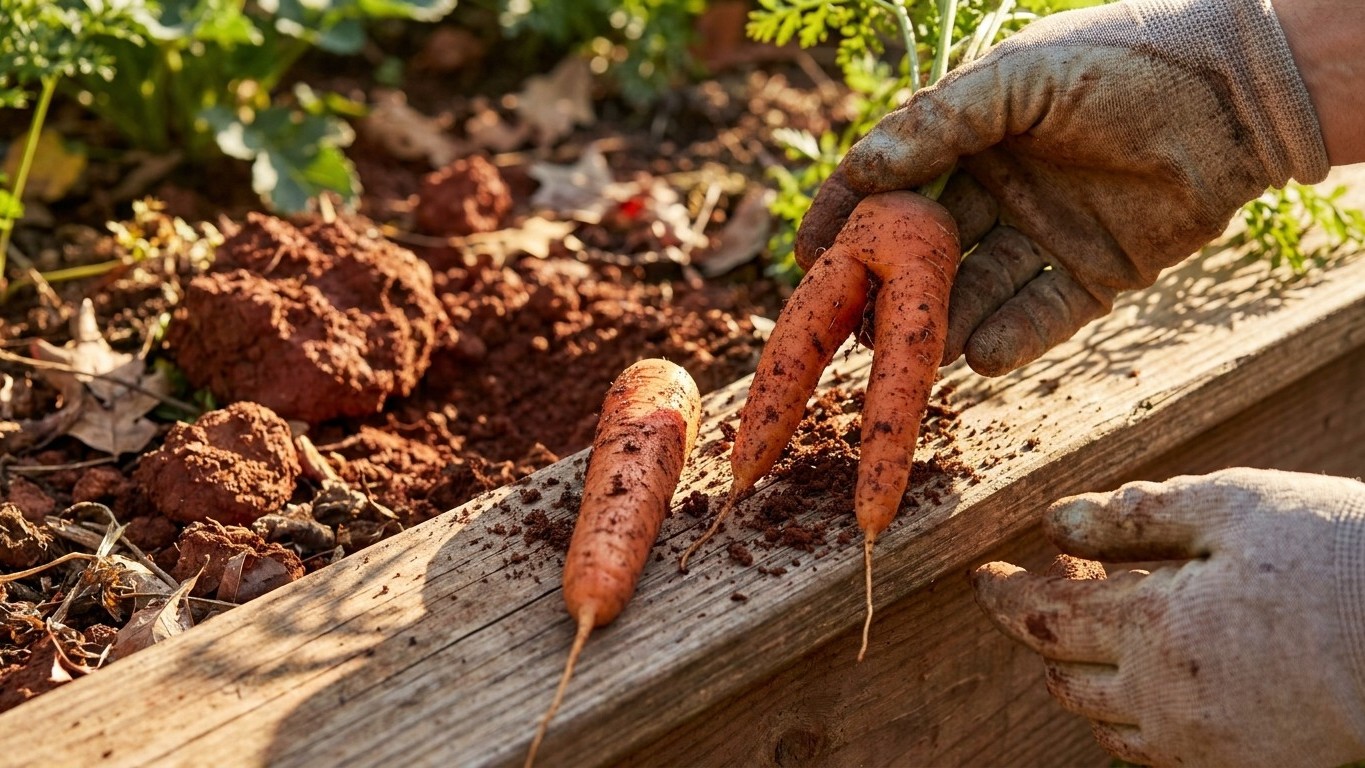

The Ruston series, the soil USDA lists as representative of Louisiana, is sandy and well drained: 65 percent sand, 11 percent clay, 24 percent silt. That texture is close to what carrots want. Forking is unlikely from this ground alone, but low organic matter and acid pH still call for compost, and a raised bed remains the safer bet if your own yard doesn’t match this profile.
The short answer
Start with the numbers. The Ruston series, the soil USDA’s State Soils program names as representative of Louisiana, runs 65 percent sand, 11 percent clay and 24 percent silt in its surface horizon, with organic matter around 1.8 percent and a surface pH near 5.5, slightly acid. It’s classed as an Ultisol, an old, heavily weathered and leached soil, and it drains well.
For a carrot, that texture is mostly good news. Utah State University Extension is blunt about what causes a forked root: heavy or rocky soil. A sandy loam like Ruston, low in clay and free of the compaction that comes with dense ground, gives a taproot room to push straight down without splitting around an obstruction. On texture alone, you’re not fighting the same battle a gardener in heavy clay country faces.
The catch is that texture isn’t the whole story. Organic matter at 1.8 percent is thin for a vegetable bed, and Extension’s guidance is equally direct on this point: carrots want soil rich in organic matter, not just loose and sandy. Sandy ground with almost nothing in it can still starve a carrot of the steady moisture and nutrients it needs to size up evenly, even if it never forks. And a surface pH of 5.5 sits on the acid side, which affects how available nutrients are to the plant, though the source given here doesn’t specify what carrots prefer, so don’t stretch that number further than it goes.
Put the two facts together and the fix is straightforward: work in compost before you sow, and double dig if you suspect any hardpan or compacted layer beneath the topsoil, since builders’ fill, foot traffic, or a previous owner’s driveway base can sit under sandy topsoil without ever showing on the surface. If you’d rather skip the guesswork, a raised bed filled with a loose, amended mix sidesteps the question of what’s underneath entirely.
None of this is a verdict on your particular yard. Louisiana spans hundreds of soil series, not one. Ruston is what USDA uses to represent the state as a whole, and river bottoms, hill country, and any lot a builder has graded or filled will differ from it, sometimes completely. Treat this section as the starting point, not the diagnosis.
The test that settles it in your own garden
A state soil profile tells you what the region tends toward. It doesn’t tell you what’s eighteen inches under your tomato bed. That answer takes ten minutes and a shovel.
- Dig a hole. Go down at least a foot, ideally deeper, in the spot you plan to plant. This is where you’ll find out if the loose topsoil everyone talks about actually goes anywhere, or if it sits on a hard, compacted layer a few inches down.
- Check the depth and look for stones. Carrots need a clear, unobstructed column of loose soil to grow straight. Note how far down you can dig before hitting rock, root mats, buried construction debris, or a dense clay layer. Any of those will turn a taproot sideways or force it to split around the blockage.
- Feel the texture. Grab a handful of moist soil and squeeze it. Sand falls apart immediately. Clay holds a ribbon shape and feels sticky or slick. Silt feels smooth, almost soapy, between sand’s grit and clay’s stickiness. Most garden soil is some blend of the three, and what you’re feeling for is whether clay dominates enough to compact and resist a root pushing through it.
- Watch how water drains. Fill your test hole with water and time how long it takes to disappear. Water that lingers for hours, or sits overnight, points to poor drainage and a soil structure dense enough to cause the same forking and rot problems heavy clay causes elsewhere. Water that vanishes in minutes suggests a light, fast-draining soil that may need more frequent watering and more organic matter to hold moisture where roots can use it.
Run this test in more than one spot if your yard has any slope, fill, or visible change in soil color. Beds near a foundation, a driveway, or an older structure often carry buried construction material that a single test hole on the far side of the yard would never reveal.
What goes wrong here
Sandy, acid, low-organic-matter soil doesn’t fail the same way heavy clay does, but it has its own list of ways to disappoint a carrot grower.
- Forking in heavy or compacted pockets. Even where the surface reads as sandy, isolated pockets of denser subsoil, old fill, or foot-traffic compaction can split a taproot the same way a full clay bed would. Utah State University Extension points to heavy or rocky soil as the direct cause of forking, and the remedy is the same regardless of how sandy the rest of the yard looks: work in compost and double dig the bed before sowing, breaking up any compacted layer rather than just loosening the top few inches.
- Poor germination during a hot spell. Carrot seed is slow and finicky to begin with, and sandy soil dries out fast under direct sun and high heat, which can crust the surface or dry the seed bed before the seed ever sprouts. Keeping the top inch of soil consistently moist through germination, with light, frequent watering rather than one deep soak, matters more in fast-draining sandy ground than it does in heavier soil that holds moisture longer on its own.
- Splitting from uneven water. A carrot that gets a stretch of dry soil followed by a heavy soak tends to split as the root swells faster than its skin can stretch. Sandy soil low in organic matter is especially prone to this swing, since it holds little water in reserve between waterings. Mulching the bed and watering on a steady schedule, rather than letting the bed dry out and then flooding it, keeps that growth rate even through the roughly 70 to 100 days it takes carrots to mature from seeding.
- Nutrient lockout in acid soil. A surface pH near 5.5 sits on the acid side, and acid soil can tie up certain nutrients so plants can’t take them up even when they’re present in the ground. Working compost into the bed helps buffer pH over time, and a simple home soil test will tell you whether the bed needs a targeted amendment beyond that.
Common questions
Does Louisiana’s state soil mean my carrots won’t fork?
It lowers the odds, since the Ruston series is sandy and well drained rather than heavy clay, but it’s not a guarantee. Compacted pockets, buried fill, or a hardpan layer can still cause forking even in generally sandy ground, which is why the dig-and-feel test in your own bed matters more than the state-level profile.
Do I need a raised bed if my soil is sandy like the state soil?
Not necessarily. Sandy, well-drained soil is close to what carrots want on texture alone. A raised bed becomes useful when you find compaction, rock, or debris in your test hole, or when you’d rather control the soil mix directly than amend what’s already there.
How much compost should I add before sowing carrots?
Utah State University Extension recommends working plenty of compost into the bed, especially in heavier soil, without giving a specific volume. The practical target is a loose, crumbly bed free of clumps and stones to the full depth a carrot root will reach.
When do I count the 70 to 100 days to maturity from?
From the day you sow the seed directly in the ground. Carrots aren’t started indoors and transplanted, so there’s no transplant date to count from, only the seeding date.