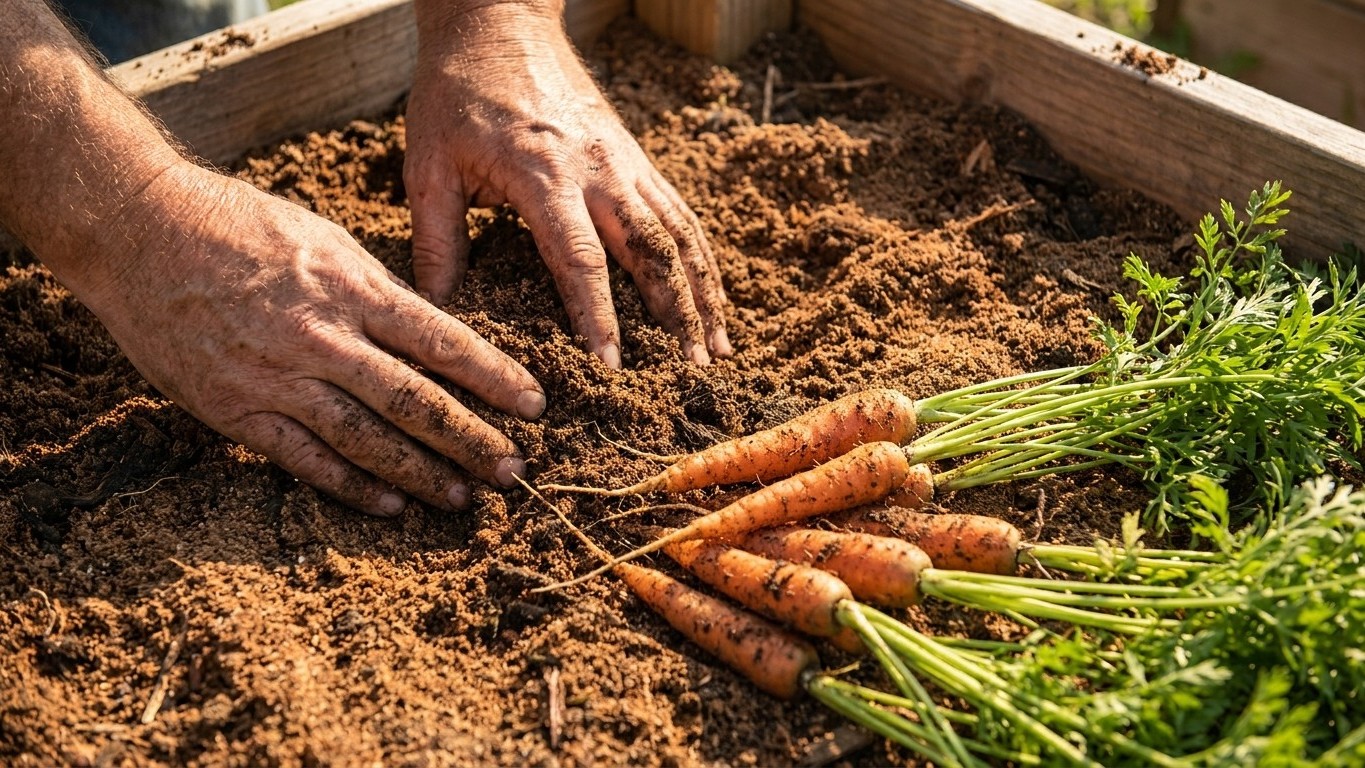

Louisiana gardeners get a partial break from the classic carrot problem. The soil USDA treats as representative of the state runs sandy rather than clay-heavy, which limits the forking that ruins root shape elsewhere in the South. But that same soil runs acidic and short on organic matter, so a carrot bed still needs building before seed goes in the ground, and getting the timing right matters just as much as the soil prep, as covered in When to Sow Carrots in Louisiana. The real answer depends on which of the state’s soil types actually sits under your yard, not a statewide average.
The short answer
The soil USDA lists as representative of Louisiana is the Ruston series, an Ultisol. That classification alone tells you a lot: Ultisols are old, heavily weathered, and leached soils, naturally acid and low in nutrients because centuries of rainfall have washed the minerals downward. The surface layer runs about 5.5 in pH, which is slightly acid, and its texture breaks down to 65 percent sand, 11 percent clay, and 24 percent silt. Organic matter sits around 1.8 percent. It drains well.
Put that texture next to what a carrot actually needs, and the picture gets clearer. Carrots want deep, sandy, well-drained soil rich in organic matter, according to Utah State University Extension. Heavy or rocky soil is what makes the root fork, splitting into two or three legs instead of growing straight down. At 11 percent clay and 65 percent sand, the Ruston series leans toward exactly the loose, sandy texture that lets a carrot push straight through instead of hitting resistance and branching around it, which is the core of the question of Will Carrots Fork in Louisiana Soil? Well-drained also matters, since carrots sitting in soggy soil rot before they ever get the chance to fork.
So the forking risk from texture alone looks lower here than in a heavy clay state. The catch is organic matter. At 1.8 percent, this soil is thin on the very ingredient carrots need most for that deep, rich root run Utah State describes. That’s not a forking problem, it’s a growth problem: thin, hungry soil grows short, pale roots even when it never forks them. The fix isn’t double digging through hardpan clay, since there mostly isn’t one here. It’s building organic matter into the top foot of soil with compost, worked in before sowing, so the sandy base gets the fertility it’s missing.
None of this is a diagnosis of your particular backyard. A state the size of Louisiana spans hundreds of soil series, and the Ruston benchmark describes what USDA maps as broadly representative, not what’s actually under any one garden. Bottomland soil near a river, hill country in the north-central parishes, and anything a builder scraped and refilled around a new house can all differ completely from this profile. Treat the Ruston numbers as a starting point for what the region’s ground tends to do, not a substitute for checking your own dirt.
The test that settles it in your own garden
The only way to know what you’re actually working with is to look at it directly. None of these steps require lab equipment, just a shovel, a bucket of water, and some patience.
- Dig a shovel-depth hole in the spot you plan to plant, and look straight down the wall of it for rock, clay lenses, or a sudden change in color that signals a buried hardpan or fill dirt left behind by construction.
- Note how deep the loose, workable soil runs before you hit a denser layer, and count any stones or rock fragments in that top layer. Anything that stops a shovel blade is exactly what will stop a carrot root and send it forking around the obstruction.
- Take a handful of moist soil and rub it between your fingers. Gritty and loose means sand-heavy, similar to the state’s own Ruston benchmark. Slick and sticky when wet means clay, which is what forks carrot roots. A soil that forms a short ribbon but breaks apart easily sits somewhere in between, usually called loam.
- Fill the hole with water and watch how it drains. Water that disappears within a few hours points to a well-drained profile, similar to the Ruston series described above. Water that still stands well after most of the day signals a heavy, poorly drained spot that needs raised beds or generous compost worked in before carrots go anywhere near it.
- Repeat the dig-and-drain test in two or three spots around the yard, not just one. Soil can shift character within a few feet, especially near a foundation, a driveway, or an old fill line, and the results from your own ground matter far more than any state average.
When to sow here
Carrots are sown directly in the ground, never transplanted, so every count below runs from the seeding date, not from a start indoors. Getting that count right matters more here than it does farther north, because Louisiana’s frost calendar behaves differently from the textbook version.
- Confirm the soil itself has warmed to at least 40F before sowing anything. Carrot seed sitting in colder, wetter soil doesn’t just wait patiently, it tends to rot before it ever sprouts.
- Count back from the local last spring frost. At the NOAA climate station serving this region, the 1991-2020 normal window for the last 32F freeze falls between January 18 and February 8. Sowing carrot seed 2 to 3 weeks ahead of that window points toward early January across much of the state.
- Don’t treat that frost window as a hard line. The same NOAA record shows a 32F freeze occurs in only 86.8 percent of years at this station, meaning close to one winter in seven never dips to freezing at all. The window itself straddles the New Year rather than marking a clean seasonal boundary, which is unusual compared with most of the country.
- Use germination temperature, not the frost calendar, as the real trigger. Carrot seed germinates best between 55F and 65F, and in much of Louisiana the soil reaches that range well before the last-frost window even closes.
- Watch the far end of the season just as closely. Because the state’s real limiting factor is summer heat rather than frost, waiting too long to sow lets soil temperatures climb past the germination range before a root that needs 70 to 100 days from seeding has time to mature.
- Adjust for where you garden within the state. North Louisiana freezes far more reliably than the south, so gardeners there can lean closer to the standard 2 to 3 week countdown before last frost. In south Louisiana, where any given winter may skip freezing entirely, a soil thermometer tells you more than the frost calendar ever will.
What goes wrong here
- Forking in heavier pockets. Even where the region’s benchmark soil runs sandy, low-lying or fill-dirt spots can carry far more clay than the Ruston average. If the finger test above comes back slick and sticky, work compost deep into the bed or switch to a raised bed rather than fighting the native ground.
- Poor germination during a hot spell. Carrot seed wants 55F to 65F to sprout well, and Louisiana soil can blow past that range fast once spring turns to early summer. Sowing at the front edge of the recommended window, and watering to keep the seedbed cool, cuts down on the stalled, spotty germination that shows up when soil runs hot.
- Splitting from uneven watering. A root that dries out and then gets soaked again tends to crack down the middle. Consistent moisture, helped along by a layer of mulch over the bed, keeps growth steady instead of stop-and-start.
- Stunted, pale roots from thin soil. At around 1.8 percent organic matter, the region’s representative soil simply doesn’t carry the fertility carrots want for a long, well-developed root. Working several inches of compost into the top of the bed before sowing addresses this directly, regardless of whether forking is also a concern.
Checking this against your own county
Everything above describes tendencies tied to one representative soil series and one set of climate normals from a single weather station. Neither one is a substitute for information specific to your county, your parish, or your particular block. The LSU AgCenter runs the extension service for the state and can point you toward soil testing, local planting calendars, and county-level guidance that accounts for the differences between, say, a river-bottom parish and a sandy pine-belt one. A soil test through that same office will also give you an actual pH and nutrient reading for your bed, rather than the statewide estimate discussed here. That single step turns a general starting point into a plan built around the dirt you’re actually standing on.
Common questions
Does Louisiana’s sandy state soil mean I can skip compost?
No. The Ruston series’ sandy texture lowers the forking risk from heavy clay, but its organic matter content runs around 1.8 percent, which is thin for a root crop that wants rich, deep soil. Compost still matters for growth even where forking isn’t the main worry.
Should I count sowing dates from when I plan to transplant seedlings?
There’s no transplanting with carrots. They’re sown directly in the ground, and every date, including the 70 to 100 days to maturity, runs from the seeding date itself.
Why does the frost window matter so little in south Louisiana?
Because a 32F freeze only shows up in about 86.8 percent of years at the regional NOAA station, meaning roughly one winter in seven never freezes at all. Soil temperature and summer heat control the sowing calendar there far more than frost does.
Is north Louisiana’s planting window different from the south’s?
Yes, in reliability if not always in date. North Louisiana sees freezes far more consistently than the south, so the standard 2 to 3 week countdown before last frost holds up better there than in parishes closer to the Gulf.