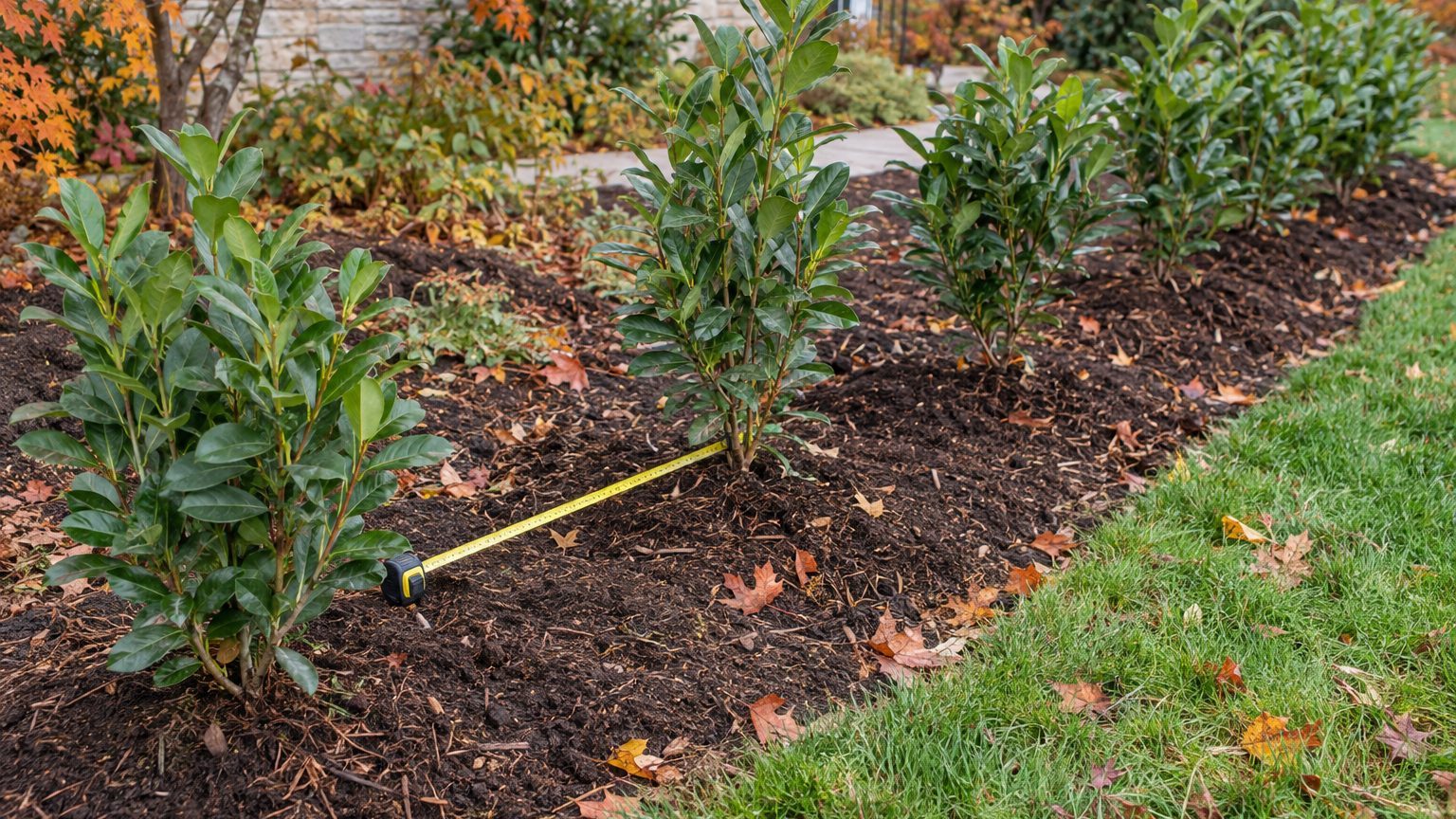

Plant cherry laurel at half to two-thirds of the mature width printed on the tag for your specific cultivar. A label reading 5 feet wide means roughly 2.5 to 3 feet 4 inches between trunks. The 8 to 10 feet an untrimmed, wild-type plant can reach is a ceiling, not a spacing. Using it would leave gaps a young hedge takes years to close.
How far apart to plant cherry laurel
The method is one multiplication. Find the mature width for the exact cultivar on the plant tag or the grower’s listing, then multiply by one-half for the tight end and two-thirds for the roomy end. Half suits a screen that has to close fast. Two-thirds suits plants that stay healthy longest, and it is the number to pick if you can stand waiting.
A worked example
Take a made-up label that reads 5 feet wide at maturity. Half is 2.5 feet. Two-thirds is 3 feet 4 inches. The number for your shopping list is 2.5 to about 3 feet 4 inches between plants, measured trunk to trunk, and a spacing of 3 feet sits comfortably in the middle. Repeat the same two steps with your own cultivar’s number and you have your range.
| Width on the label | Half (fast screen) | Two-thirds (longest-lived) |
|---|---|---|
| 4 feet | 2 feet | 2 feet 8 inches |
| 5 feet | 2 feet 6 inches | 3 feet 4 inches |
| 6 feet | 3 feet | 4 feet |
Those three widths are sample labels, not a claim about any particular cultivar. Read your own tag.
Why the species width is the wrong number
Cherry laurel (Prunus laurocerasus) left alone can spread 8 to 10 feet wide, according to the NC State Extension Gardener Plant Toolbox. That figure describes the type species with nobody holding shears. Hedges are usually built from selected cultivars that run narrower, and then they get clipped every year. So the width to trust is the one on the label in your hand. Treat 8 to 10 feet as the upper bound of what an unclipped plant will do if you ever stop trimming.
One more check before you buy. Cherry laurel is rated for USDA zones 6 to 8, so confirm your zone first. Spacing math won’t rescue a plant sited outside its range.
What planting them closer really buys you
About a year, maybe. A row set at the tight end closes its gaps sooner than a row set at the roomy end, and then the plants spend the next twenty years competing with each other. Roots fight for the same strip of soil. Lower branches lose light and drop their leaves. The middle of the hedge stops moving air.
Cherry laurel doesn’t need shoving together to look like a hedge. It grows 1 to 2 feet a year, which is quick by hedge standards, and a finished hedge runs 6 to 15 feet tall. A plant with that much vigor closes a 3-foot gap on its own without much delay. Squeezing them to save one season gets you a hedge that thins at the base and stays damp in the middle.
Damp, still air matters because this species has a known weak spot. Shot hole fungus riddles the leaves with small holes, and leaves that stay wet longer give it an easier time. A crowded row holds moisture right where you can’t see it, deep inside the foliage. The other killer is root rot in heavy, wet soil. Tight spacing leaves little room for the soil between plants to dry out, so if your yard drains slowly, fix the drainage before you fuss over inches.
The rescue that makes cherry laurel forgiving
Here is the good news. Cherry laurel regrows from old wood. It carries dormant buds under the bark, so a hedge that has gone leggy or overgrown can be cut hard, even down to bare brown stems, and it will sprout again. A conifer could never survive that treatment, which is a big reason people choose this plant for a boundary they intend to keep for decades.
Do that renovation in late spring, after flowering. The exact timing moves by weeks across the country because your own frost dates set it, so ask your state’s Cooperative Extension office for the local window rather than trusting a calendar. Renovation fixes the top of the plant. It does nothing for roots that have spent years fighting their neighbors, and it can’t cure the fungus a cramped row invites.
One row or two
A single row is what most yards need. One line of plants at the spacing worked out above gives a solid screen in a few seasons, leaves you room to clip both faces, and keeps air moving through the foliage. For a side yard, a front boundary or a fence line with limited depth, it is the right call.
A staggered double row closes faster and screens better. Set the second row so its trunks fall halfway between the trunks of the first, and the zigzag leaves almost no see-through gap. The price is roughly twice the plants and twice the width. Using the 5-foot sample label, with plants 3 feet apart and the rows 3 feet apart, the planted band is 8 feet across at maturity (3 feet of row separation plus the 5-foot plant width), against 5 feet for a single row. On a 30-foot run, that is 22 plants instead of 11.
Choose the double row when the goal is a tall, dense wall, say screening a road or a neighbor’s second-story window, and you have the depth to give up. It also makes sense when you want the hedge at the upper end of the 6 to 15 foot range. Skip it when the strip is narrow, when the soil drains slowly, or when you’d have trouble reaching the inner row with shears. A row you can’t clip or ventilate is the one most likely to develop the problems described earlier.
If you are blending species in one boundary, each one needs its own math. Our guides on how far apart to plant holly for a hedge and how far apart to plant arrowwood viburnum for a hedge cover those plants separately.
Working out how many plants you need
The arithmetic is plain. Run length divided by spacing, plus one. The plus one is there because a row has a plant at both ends, so it always has one more plant than it has gaps.
- Measure the run in feet.
- Pick a spacing from your label range.
- Divide the length by the spacing.
- Add one, and round up if there is a remainder.
A 30-foot run at 3-foot spacing works out to ten gaps, so a single row needs 11 plants. For a staggered double row, do the sum once and double it. Price the total locally, since costs shift with region and plant size.
Corners and setbacks
Two things change the answer. The first is a corner. The plant at the bend belongs to both legs, so count it once. Picture an L with a 30-foot leg and an 18-foot leg at 3-foot spacing. The long leg needs 11 plants, the short one needs 7, and you subtract the shared corner plant for a total of 17.
The second is the setback from the boundary. The plan on paper shows a line of dots, but the living plant will reach its full label width whatever the plan says. Keep the trunk line at least half the mature width away from a fence, wall or property line, and add room to stand and clip on the side facing you. With the 5-foot sample label, that means the trunks sit no closer than 2.5 feet from the boundary. Many towns and counties also cap hedge height near property lines, so check local rules before you plant a row meant to reach 15 feet.
For more on picking and planting boundary shrubs, browse our wider section on hedges.
Common questions
Can I plant cherry laurel 2 feet apart?
Only if the cultivar’s label reads about 4 feet wide, because 2 feet is half of that. On a wider cultivar, 2 feet is tighter than half, and you’d be paying for it later with thin bases and damp, crowded foliage. Do the multiplication with your own tag before you dig.
How far from a fence or property line should I plant it?
Set the trunks at least half the mature width from the boundary, then add working room for clipping. For a cultivar labeled 5 feet wide, that is 2.5 feet at the very least. The plant will reach its full width regardless of where you place it on paper.
Will cherry laurel come back if I cut it hard?
Yes. It regrows from old wood through dormant buds under the bark, so hard renovation of an overgrown hedge works. Do it in late spring, after flowering, and check with your state’s Cooperative Extension office for the local timing, since frost dates move the window from place to place.
How fast will the hedge fill in?
Cherry laurel grows 1 to 2 feet a year and reaches 6 to 15 feet as a hedge, in USDA zones 6 to 8. Watch the leaves as it settles in. Shot hole fungus shows up as small holes, and root rot is the risk in heavy, wet soil, so good drainage does more for a young row than any spacing trick.
Sources : plants.ces.ncsu.edu