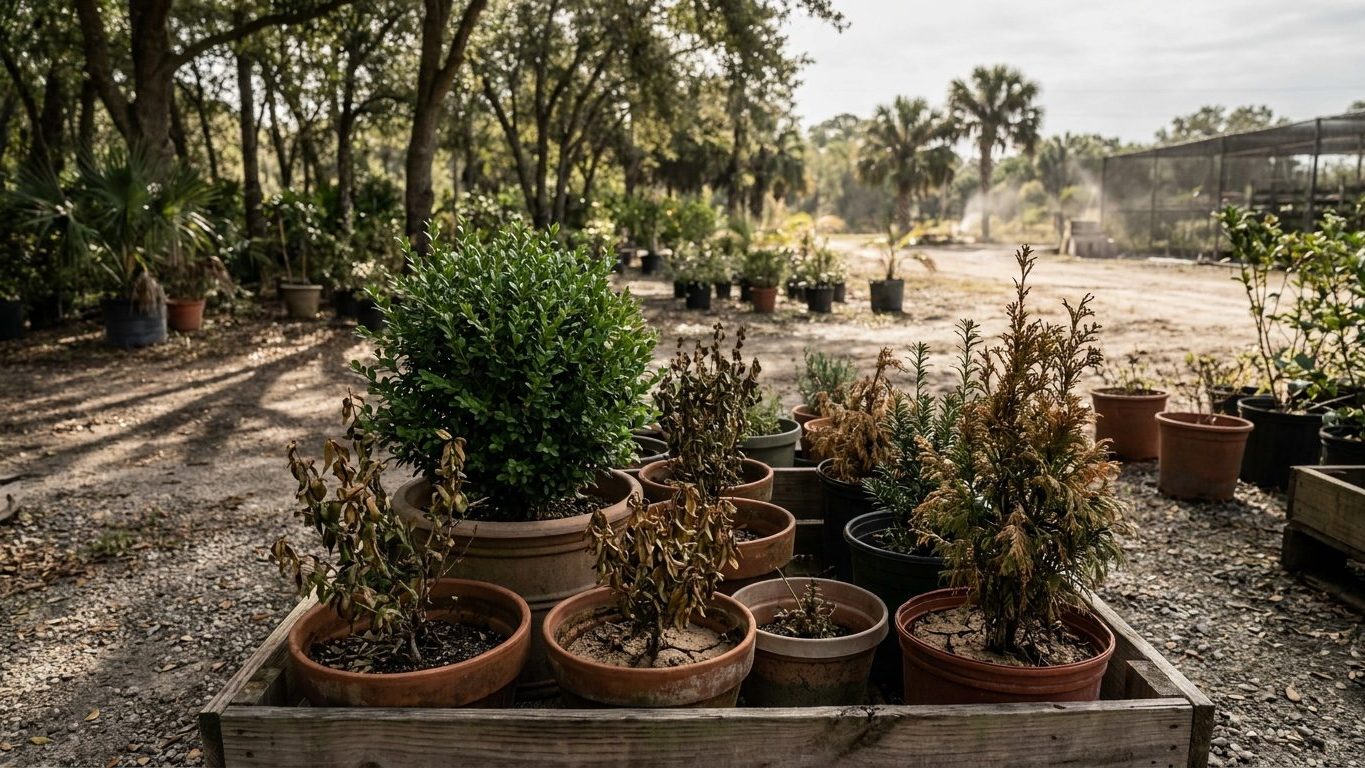

Nothing on our list of 12 hedge plants dies of cold anywhere in New Jersey. All 12 hold from the northwest hills to the Shore. The plants that fail here fail for other reasons: a size you can’t reverse, a pruning window missed, sandy ground that dries faster than a new root can follow. Those are the failures worth planning around.
What actually holds in New Jersey
What the zone number measures
The USDA Plant Hardiness Zone Map 2023 puts New Jersey at 6a to 7b. That system rests on a single variable, the average annual extreme minimum temperature. It tells you whether a plant survives the worst night of a typical winter. It says nothing about summer heat, drought, wet feet or wind.
Cross that 6a-7b span with the documented hardiness ranges (drawn from the NC State Extension Gardener Plant Toolbox) and the tally is lopsided. Twelve species hold across the whole state. Zero hold in only part of it. Zero fail everywhere. The full list: boxwood, American hornbeam, Leyland cypress, inkberry holly, winterberry holly, eastern red cedar, privet, cherry laurel, yew, arborvitae, eastern hemlock and arrowwood viburnum. A gardener in the cold pockets of the northwest and one near the southern coast can pick from the same list.
Plants outside this list are simply not documented here, so no verdict is given on them. If a nursery sells you something else, ask for its hardiness range and hold it against 6a to 7b.
Survives is not thrives
“Holds” means survives. It does not mean happy. The top of a plant’s hardiness range is often a heat limit rather than a cold one, and the warm end of the state at 7b sits closer to that ceiling than the cold end at 6a. A hedge can get through every winter and still look tired by August. Give it the right exposure and steady water in its first two summers, and the zone number stops being the thing that decides.
Frost dates are a Newark figure
NOAA’s 1991-2020 climate normals for the Newark airport station put the last spring freeze at March 29 to April 6 and the first fall freeze at November 4 to November 16 (the 30-70% probability band for 32°F). Those are reference-city numbers, not a state guarantee. Suburban and rural gardens usually see the last spring frost later and the first fall frost earlier, often by one to two weeks, and more at elevation. Check your own county with Rutgers Cooperative Extension before you fix a date on the calendar.
It’s late September. If you’re planting a hedge this fall, the clock on the Newark figures is about five to six weeks, less in the hills. Get plants in the ground this week, not next month.
The hedges you can never cut back down
Of the 12, three cannot regrow from old wood. Cut into the bare, leafless interior and the branch stays bare. There’s no second chance and no rejuvenation pruning years later. Here is what each one demands:
- Leyland cypress grows 3 to 4 feet a year and reaches 15 to 25 feet as a screen. At that pace 15 feet arrives in roughly four to five years of growth. Prune late spring to midsummer, and start early, because you can’t undo neglect.
- Arborvitae is slower, at 6 to 9 inches a year, and runs 4 to 15 feet as a hedge. Prune in late winter before growth starts, or in midsummer.
- Eastern red cedar adds 12 to 24 inches a year and reaches 8 to 20 feet as a screen. It takes light cuts only, in late winter.
The practical rule for all three: choose the variety whose mature height fits the space, then trim only the green growth at the tips. A Leyland planted 6 feet from a property line to “grow in fast” is the classic mistake, and the price is a removal job in year eight.
The other nine forgive you. Boxwood, American hornbeam, inkberry, winterberry, privet, cherry laurel, yew, hemlock and arrowwood viburnum all regrow from old wood. An overgrown privet cut hard in late winter comes back, and so does a leggy yew. Hemlock is on the forgiving side of the ledger too, though its own pruning note says light cuts only, so treat it gently anyway.
Forgiving doesn’t mean fast, though. A hard cut on slow boxwood, which adds just 3 to 6 inches a year, means years of staring at a stubby hedge. Recovery speed tracks growth rate. Privet, at 2 to 3 feet a year, refills in a season or two. That’s the reason it wants two trims a season, one in spring and one in midsummer.
Matching the plant to the job
With every species surviving the winter, the choice comes down to how tall you need the hedge, how fast you’ll tolerate waiting, and how much trimming you’ll actually do. The table sets all 12 side by side on those terms.
| Plant | Height | Growth a year | Prune | Regrows from old wood |
|---|---|---|---|---|
| Boxwood | 2 to 6 ft | 3 to 6 in | Late spring, after last frost | Yes |
| Yew | 3 to 8 ft | 6 to 12 in | Late spring, after new growth hardens | Yes |
| Privet | 4 to 12 ft | 2 to 3 ft | Spring and midsummer | Yes |
| Arborvitae | 4 to 15 ft | 6 to 9 in | Late winter or midsummer | No |
| Inkberry holly (evergreen) | 5 to 15 ft | 6 to 12 in | Late winter, dormant | Yes |
| Winterberry holly (deciduous) | 5 to 15 ft | 6 to 12 in | Late winter, dormant | Yes |
| Cherry laurel | 6 to 15 ft | 1 to 2 ft | Late spring, after flowering | Yes |
| American hornbeam | 6 to 15 ft | 12 in | Midsummer, after first flush | Yes |
| Arrowwood viburnum | 6 to 10 ft | 12 to 24 in | Right after flowering | Yes |
| Eastern red cedar | 8 to 20 ft | 12 to 24 in | Late winter, light cuts | No |
| Eastern hemlock | 10 to 20 ft | 12 to 24 in | Late spring, light cuts | Yes |
| Leyland cypress | 15 to 25 ft | 3 to 4 ft | Late spring to midsummer | No |
For a low, formal edge along a walk or foundation, boxwood and yew are the two that top out at 6 to 8 feet or less. Boxwood’s slowness is the point: it stays tidy with one trim a year. Yew is only a bit livelier and tolerates a firm shearing.
For a privacy screen along a property line, the useful question is how much height you need and how soon. Leyland delivers fastest and leaves you with the biggest maintenance problem. Eastern red cedar and hemlock offer height at a moderate pace, while cherry laurel and arborvitae fill in the middle range. Inkberry, an evergreen, gives a mid-height barrier with less bulk.
For a looser, informal boundary, arrowwood viburnum (prune right after flowering) and winterberry (bare in winter) suit a mixed border better than a clipped wall. The trade is that a deciduous hedge screens in summer and shows the neighbor’s fence by January. Privet clipped twice a season sits in between: quick, dense and demanding on your weekends.
The broader logic, and how these species stack up against other regions, lives in the Hedges hub.
The ground you are planting into
The USDA names the Downer series as New Jersey’s representative state soil. It’s an Ultisol, an old, heavily weathered and leached soil that runs naturally acid and low in nutrients. The surface horizon averages a pH of about 6.3 (slightly acid), 79 percent sand, 6 percent clay, 15 percent silt and roughly 1.2 percent organic matter. It drains well.
Read that as a tendency, not a diagnosis. Those figures are representative values from the USDA NRCS Soil Data Access database, queried on August 29, 2026, for the surface layer of the major Downer components (133 of them). They describe a mapped soil, not your bed. New Jersey has hundreds of soil series. River bottoms, clay-heavy hill country, and any lot a builder scraped and backfilled can look nothing like this. Don’t treat 6.3 as your pH.
What the Downer profile does say is what sandy, low-organic ground tends to do. Water moves through quickly, so new hedge roots sit in a dry zone between rains. Nutrients wash out rather than bank. For a hedge, that means the first two summers matter most. A slow soak once a week beats a daily sprinkle, because it pulls roots downward instead of keeping them at the surface.
Mixing compost into the planting hole is standard advice, but a wider zone works better than a deep pocket. A pocket of rich soil surrounded by sand can turn into a bathtub or a sponge that dries out at the edges. Dig a broad hole, blend in modest compost, and mulch the surface to hold moisture.
A soil test costs little and settles the pH question with your own number. Rutgers Cooperative Extension, at njaes.rutgers.edu, is the state’s land-grant extension service and the place to ask about testing and about local conditions in your county.
Common questions
Which hedge plants are hardy across all of New Jersey?
All 12 documented here: boxwood, American hornbeam, Leyland cypress, inkberry holly, winterberry holly, eastern red cedar, privet, cherry laurel, yew, arborvitae, eastern hemlock and arrowwood viburnum. Each holds through the state’s 6a to 7b range on the USDA 2023 map. Holding through winter isn’t the same as thriving in summer heat, so site and watering still count.
Can I cut back an overgrown arborvitae, Leyland cypress or red cedar?
No. These three don’t regrow from old wood, so a hard cut into bare interior growth leaves a permanent hole. Keep them trimmed to their target size from the start, and only cut green growth. If one has outgrown its spot, replacement is usually the only fix.
When can I plant a hedge this fall?
Soon. At the Newark airport station, the first 32°F freeze falls between November 4 and November 16 (NOAA 1991-2020 normals). Suburban and rural sites often freeze one to two weeks earlier, and higher ground earlier still. Check your county’s dates with Rutgers Cooperative Extension before you count on the later window.
Do I need a soil test before planting?
It’s worth doing. New Jersey’s state soil, the Downer series, is sandy, acid, low in organic matter and well drained, but your yard may not resemble it, especially if the lot was graded or filled. A test gives you your own pH and nutrient numbers, and Rutgers Cooperative Extension can direct you to one.