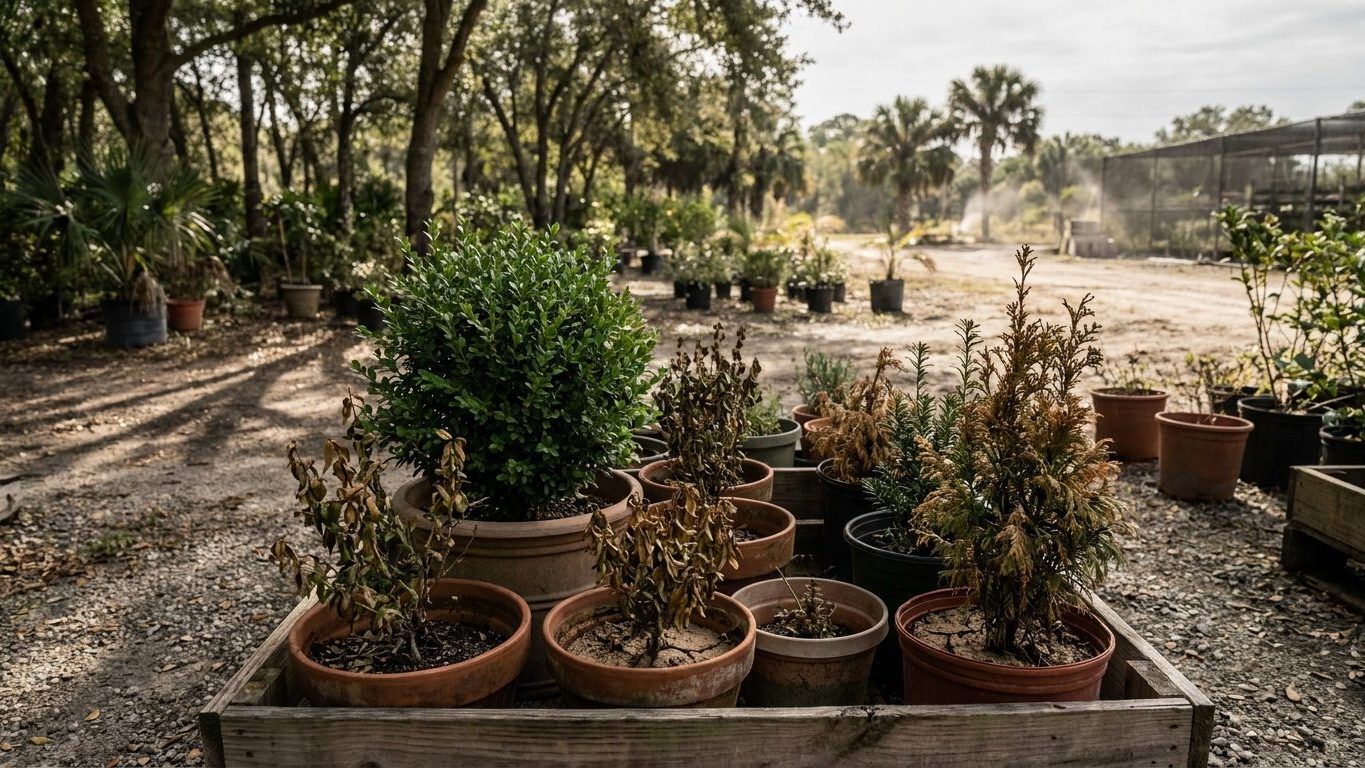

Of the twelve hedge plants covered here, six survive anywhere in North Carolina and six only in part of it. None fails statewide. The trap is subtler: a yew that thrives in one county can quietly die in another, and three of the conifers on the list can never be cut back to size once they outgrow the spot. Check your zone first, then the pruning rule, then the plant.
What actually holds in North Carolina
The USDA Plant Hardiness Zone Map 2023, built on 1991-2020 normals, places North Carolina anywhere from zone 5b to 8b. That is seven half-zone steps, wide enough that a mountain yard and a coastal one are not playing the same game. The map rests on one variable, the average annual extreme minimum temperature. It says nothing about summer heat, humidity or drought. The ranges below come from the NC State Extension Gardener Plant Toolbox, crossed with that zone range.
The six that fail somewhere
Four stop at the warm end. Privet, yew, arborvitae and eastern hemlock are listed only for 5b through 7b, which leaves zones 8a and 8b out. Two stop at the cold end: Leyland cypress and cherry laurel are listed for 6a through 8b, so zone 5b is outside their range.
| Plant | Listed zones | Not listed for |
|---|---|---|
| Privet (Ligustrum vulgare) | 5b to 7b | 8a, 8b |
| Yew (Taxus x media) | 5b to 7b | 8a, 8b |
| Arborvitae (Thuja occidentalis) | 5b to 7b | 8a, 8b |
| Eastern hemlock | 5b to 7b | 8a, 8b |
| Leyland cypress | 6a to 8b | 5b |
| Cherry laurel | 6a to 8b | 5b |
“Holds” here means survives, not thrives. The map measures winter only, so a warm-end cutoff is often a heat limit, and a plant sitting at the top of its range can live for years while looking tired. Look up your own zone by ZIP code before buying, and treat the edge of a range as a warning rather than a promise.
The six that hold from 5b to 8b
Boxwood, American hornbeam, inkberry holly, winterberry holly, eastern red cedar and arrowwood viburnum are listed across the whole state range. Inkberry is the evergreen holly; winterberry drops its leaves in winter. These are the safe picks when you are unsure of your zone or sit near a boundary. Neighboring pages sort the same kind of list by their own ranges, such as Hedge Plants for Delaware: What Holds, and What Only Looks Hardy and Hedge Plants for Oklahoma: What Holds, and What Only Looks Hardy.
The hedges you can never cut back down
Three plants here will not sprout from old wood: Leyland cypress, arborvitae and eastern red cedar. Cut into the bare interior and the gap stays a gap. Everything else on the list regrows from old wood, including boxwood, yew, privet, cherry laurel, hornbeam, both hollies, arrowwood viburnum and hemlock. That is the real dividing line between a hedge you can rescue and one you can only replace.
Leyland cypress
It grows 3 to 4 feet a year and reaches 15 to 25 feet as a screen. Five seasons at that pace is 15 to 20 feet, already inside its full range. Pruning runs from late spring to midsummer, and the height you want has to be chosen at planting, then held by trimming every year. Wait until it towers over the fence line and there is no cutting it back down. It is also listed only for 6a through 8b, so a cold-zone yard is a poor bet from the start.
Arborvitae and eastern red cedar
Arborvitae is far slower, at 6 to 9 inches a year, and stays 4 to 15 feet as a hedge. Trim it in late winter before growth starts, or in midsummer. The slow pace cuts both ways: a bad cut takes years to hide, and the plant never regrows from old wood. It is also listed only for 5b through 7b, so a warm-zone yard carries two risks at once.
Eastern red cedar is the odd one out. It grows 12 to 24 inches a year, reaches 8 to 20 feet as a screen, takes light cuts only in late winter, and holds across the whole state. It is the only no-regrowth plant here without a zone catch. Regrowing plants are not fearless either: hemlock regrows but still wants light cuts only, in late spring.
Matching the plant to the job
A low formal edge points to boxwood, which grows 3 to 6 inches a year and stays 2 to 6 feet as a hedge. Yew does 3 to 8 feet at 6 to 12 inches a year but only in 5b through 7b. Both are slow, which means few trims and a slow payoff. Privet moves faster, at 2 to 3 feet a year and 4 to 12 feet as a hedge, again for 5b through 7b.
Fast privacy is a different job. Cherry laurel adds 1 to 2 feet a year and reaches 6 to 15 feet, while eastern hemlock adds 12 to 24 inches and reaches 10 to 20 feet. Winterberry is the wrong tool for winter screening, since it loses its leaves. Inkberry, the evergreen holly, holds 5 to 15 feet at 6 to 12 inches a year. Arrowwood viburnum (6 to 10 feet, 12 to 24 inches a year) and American hornbeam (6 to 15 feet, 12 inches a year) suit a looser, more seasonal hedge.
Timing matters as much as species. The pruning windows group like this:
- Late winter, while dormant: inkberry and winterberry.
- Right after flowering: arrowwood viburnum.
- Late spring: boxwood (after the last frost), yew (after new growth hardens), cherry laurel (after flowering) and hemlock (light cuts).
- Late spring to midsummer: Leyland cypress.
- Midsummer: hornbeam after its first flush, and privet twice a season, spring and midsummer.
For a reference point, NOAA NCEI 1991-2020 normals put Charlotte’s last spring freeze between March 23 and April 5 (the 30-70% probability band). Charlotte is Piedmont: the Blue Ridge runs weeks later in spring and the coastal plain earlier, so shift the boxwood date to match your own yard. The wider Hedges hub covers the general habits behind these schedules.
The ground you are planting into
USDA lists the Cecil series, an Ultisol, as North Carolina’s representative soil. Ultisols are old, heavily weathered and leached, so they run naturally acid and low in nutrients. USDA NRCS records for the surface layer of the series show a pH of about 5.5 (slightly acid), a texture of 68 percent sand, 13 percent clay and 20 percent silt, and organic matter of about 0.8 percent. It is well drained.
Read that as a tendency. Ground like this sheds water and holds little in reserve, so a newly planted hedge dries out fast in a hot spell. Almost no organic matter means little cushion in either direction. Well-drained ground is kind to plants that resent standing water, but it asks for steady watering during the first seasons.
Test before you amend
Those figures describe the mapped surface of a state soil, not your garden bed. North Carolina spans hundreds of soil series, and river bottoms, hill country and any lot a builder has scraped or filled can differ completely. Nothing here is your pH. A soil test gives your own number, and your county office of NC State Extension can tell you how to submit a sample. Do that before adding lime, sulfur or fertilizer, because amending blind can push a soil the wrong way.
Common questions
Which hedge plants hold across all of North Carolina?
Boxwood, American hornbeam, inkberry holly, winterberry holly, eastern red cedar and arrowwood viburnum are listed for the full 5b to 8b range. Surviving is the claim, not thriving, so match the plant to your soil and watering too.
Can I grow Leyland cypress in the warmest part of the state?
It is listed through zone 8b, so it survives at the warm end. The gap is zone 5b, which is outside its range. Remember that it grows 3 to 4 feet a year and never regrows from old wood, so it needs regular trimming.
Which hedges can I cut back hard if they overgrow?
Those that regrow from old wood: boxwood, hornbeam, both hollies, arrowwood viburnum, yew, privet, cherry laurel and hemlock. Leyland cypress, arborvitae and eastern red cedar cannot be cut back once they overgrow. Hemlock still wants light cuts only.
Can I prune this month?
None of the windows in this article fall in late September. They run from late winter through midsummer, and the first freeze at Charlotte typically arrives between October 30 and November 8 (NOAA NCEI 1991-2020, 30-70% band). That is a Piedmont figure, so the mountains and the coast will differ, and your county Extension office can confirm local dates.