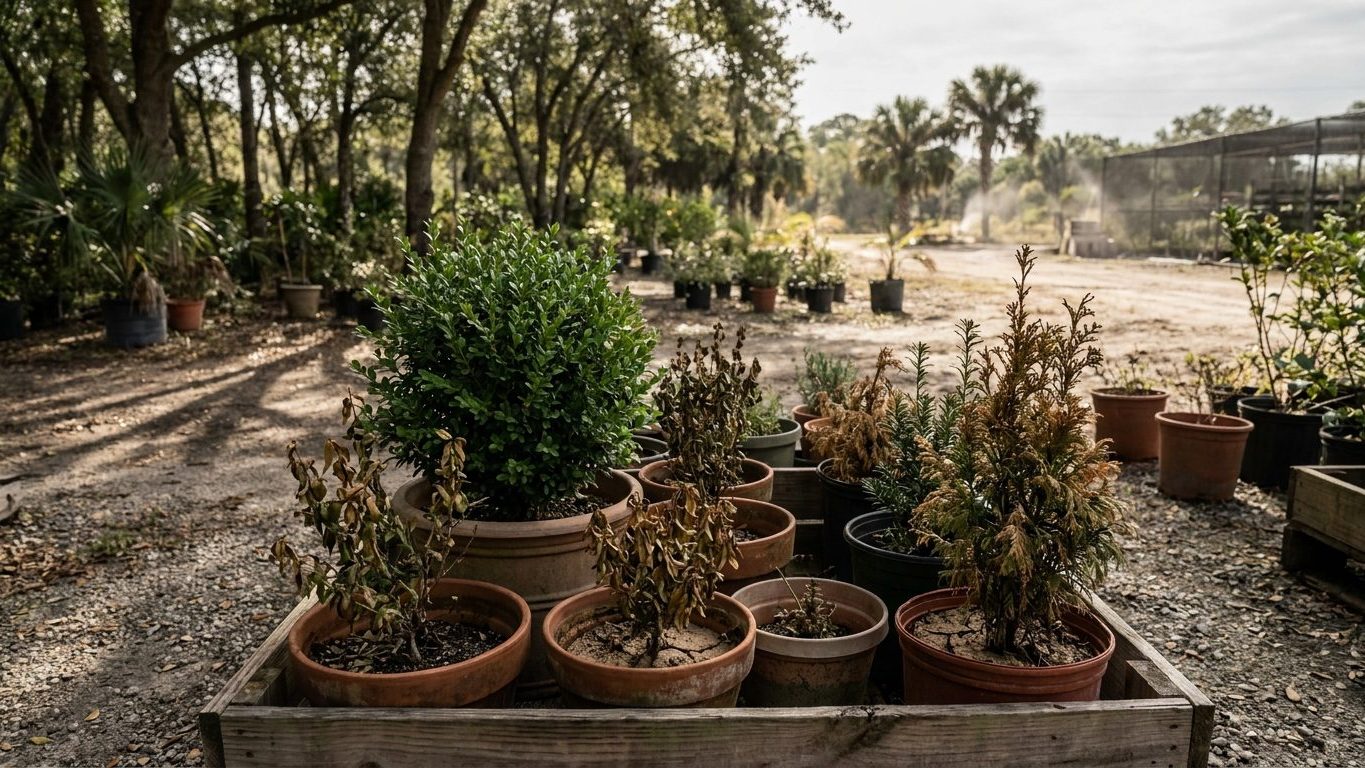

Six of twelve common hedge plants hold across all of Tennessee, from the Cumberland Plateau to the warmer low ground. The other six survive in only part of the state. Leyland cypress and cherry laurel give out at the cold end, while privet, yew, arborvitae and hemlock give out at the warm end. Three plants on the list, Leyland cypress, arborvitae and eastern red cedar, share a trait that matters even more than zone: they never regrow from old wood.
What actually holds in Tennessee
Tennessee runs from USDA zone 5b to 8a on the USDA Plant Hardiness Zone Map 2023. That system rests on one number, the average annual extreme minimum temperature, so it says nothing about a July heat wave. The hardiness ranges used here come from the NC State Extension Gardener Plant Toolbox. “Holds” means the plant survives, which is a lower bar than thriving. The upper end of a range is often a heat limit, and a shrub that survives in 8a may still look tired by late August.
Which hedge plants fail in part of Tennessee?
Six of the twelve do. None of the twelve fails everywhere in the state, but each of these six needs a zone check before you buy.
| Plant | Holds in zones | Growth a year | Regrows from old wood? |
|---|---|---|---|
| Leyland cypress | 6a to 8a | 3 to 4 feet | No |
| Cherry laurel | 6a to 8a | 1 to 2 feet | Yes |
| Privet | 5b to 7b | 2 to 3 feet | Yes |
| Yew | 5b to 7b | 6 to 12 inches | Yes |
| Arborvitae | 5b to 7b | 6 to 9 inches | No |
| Eastern hemlock | 5b to 7b | 12 to 24 inches | Yes |
Leyland cypress and cherry laurel start at 6a. The coldest pockets of 5b fall outside their range, and a hard winter there can kill them outright. The other four stop at 7b, so a garden in 8a is past their listed range. East Tennessee and the Cumberland Plateau run cooler and later in spring than Nashville, so those are the places where the cold-end plants deserve the most suspicion.
Privet carries a second caution. Ask your county extension office before planting it.
Which hedge plants hold across the whole state?
Six hold from 5b through 8a: boxwood, American hornbeam, inkberry holly, winterberry holly, eastern red cedar and arrowwood viburnum. If you do not know your zone, or you garden near a zone boundary, this is the safe list. Survival is guaranteed on paper only, and the next sections cover how each one behaves once it is in the ground. Eastern red cedar comes with the same warning as Leyland cypress and arborvitae, which is where the next section starts.
The hedges you can never cut back down
Most hedge plants forgive a bad haircut. Cut them hard into bare wood and they sprout new shoots from the old stems. Three plants on this list do not. Cut into the brown, leafless interior and the wood stays bare for good. No amount of fertilizer or patience changes that, so the decision about final height has to be made at planting, not ten years later.
Which hedges never regrow from old wood?
- Leyland cypress grows 3 to 4 feet a year and reaches 15 to 25 feet as a screen. Prune from late spring to midsummer. It holds only in zones 6a through 8a.
- Arborvitae grows 6 to 9 inches a year and makes a 4 to 15 foot hedge. Prune in late winter before growth starts, or in midsummer. It holds only in zones 5b through 7b.
- Eastern red cedar grows 12 to 24 inches a year and reaches 8 to 20 feet as a screen. Make light cuts only, in late winter. It holds everywhere in the state.
Leyland cypress is the one that catches people. A plant adding 3 to 4 feet a year outruns a once-a-year trim in short order, and it does not regrow from old wood. Once it is too tall, the choices are to live with it or pull it out. Plant it only where 25 feet of height will be welcome, and start trimming in the first summers rather than waiting.
Which hedges forgive a hard cut?
The rest can be renovated. American hornbeam, inkberry holly, winterberry holly, arrowwood viburnum, boxwood, privet, cherry laurel and yew all regrow from old wood. Eastern hemlock regrows too, but it wants light cuts only, so treat it as a plant to keep trimmed rather than one to rescue.
Timing differs by plant. Inkberry and winterberry take their cuts in late winter while dormant. Arrowwood viburnum is pruned right after flowering. Hornbeam goes in midsummer after the first flush of growth. Boxwood waits until late spring after the last frost, and the Nashville reference station in the NOAA NCEI 1991-2020 normals puts the usual last freeze between March 31 and April 12. East Tennessee and the Plateau run later.
For this month, put the shears away. The typical first 32 F freeze at that station falls between October 28 and November 8, and a cut made now invites soft new growth that frost will burn. Fall is a fine time to plant, but hold the trimming until the timing for each plant comes around.
Matching the plant to the job
Height, speed and winter leaf cover sort these plants into jobs better than hardiness does. Once a plant passes the zone test, ask what you want it to do.
| Job | Plants that fit | Height as a hedge |
|---|---|---|
| Tall evergreen screen | Leyland cypress (6a to 8a), eastern red cedar, eastern hemlock (5b to 7b) | 8 to 25 feet |
| Medium evergreen hedge | Inkberry holly, cherry laurel (6a to 8a) | 5 to 15 feet |
| Low, formal edge | Boxwood, yew (5b to 7b) | 2 to 8 feet |
| Leafy hedge with seasonal change | American hornbeam, arrowwood viburnum, winterberry holly | 5 to 15 feet |
What works for a tall screen in Tennessee?
Eastern red cedar is the dependable choice across all zones, at 8 to 20 feet and 12 to 24 inches a year. Eastern hemlock reaches 10 to 20 feet at the same pace but only holds in 5b through 7b. Leyland cypress is the fastest at 15 to 25 feet, with the cold-end limit and the no-regrow problem already described. For a neighbor-blocking planting that must still look right for years, the cedar is the safer pick. It cannot be cut back, so give it room.
What works for a low or formal hedge?
Boxwood grows 3 to 6 inches a year and stays at 2 to 6 feet, so it rarely outgrows its spot, and it holds statewide. Yew is similarly slow, at 6 to 12 inches a year and 3 to 8 feet, but it is out of range in 8a. Slow growth means more patience at the start and fewer trims later. Both regrow from old wood, which makes mistakes forgivable.
Winterberry holly loses its leaves in winter, so it screens only in the growing season. If you want year-round cover, inkberry holly is the evergreen version, at 5 to 15 feet and 6 to 12 inches a year. Hornbeam adds 12 inches a year and arrowwood viburnum 12 to 24 inches. Both are good for informal boundaries.
Gardeners comparing lists will find that the neighboring state has its own rules, as in Hedge Plants for Kentucky: What Holds, and What Only Looks Hardy. A very different climate changes the list completely, as Hedge Plants for Nevada: What Holds, and What Only Looks Hardy shows. The broader Hedges section covers the basics that apply everywhere.
The ground you are planting into
Tennessee’s state soil is the Dickson series, an Ultisol. That is an old, heavily weathered, leached soil that is naturally acid and low in nutrients. USDA’s representative surface values for it show a pH of about 5.0, which is strongly acid. The texture is 11 percent sand, 20 percent clay and 68 percent silt, a loam to silt, with about 1.5 percent organic matter. It is moderately well drained.
What does Tennessee’s typical soil do to a hedge?
Silty ground with that little sand tends to hold water longer than a sandy bed does. Moderately well drained means the soil can sit wet after a long rain. Plants that dislike wet roots do better on a slight mound or a gentle slope than in a low spot. The low organic matter means the surface is not rich, so a ring of mulch and some compost worked into the planting hole help young hedges settle in.
These numbers describe the soil chosen to represent the state, not the soil in your yard. Tennessee has hundreds of soil series. River bottoms, hill country and ground a builder has scraped or filled can differ completely. Use the Dickson values as a hint about what the region’s ground tends to do, and never assume your own pH is 5.0.
How do you test your own soil?
Collect a few small samples from the planting line, mix them, and send them in for a test. The county office of University of Tennessee Extension can explain how to submit a sample and how to read the result. The report gives your actual pH and nutrient levels before planting. Ask the same office about drainage if you plan a long run of hedge across a low or compacted spot.
Common questions
What is the fastest-growing hedge plant for Tennessee?
Leyland cypress, at 3 to 4 feet a year, but it only holds in zones 6a through 8a and never regrows from old wood. Eastern red cedar, eastern hemlock and arrowwood viburnum each grow 12 to 24 inches a year, and the cedar and viburnum hold across the whole state.
Can I cut an overgrown hedge back hard?
Yes for hornbeam, inkberry, winterberry, arrowwood viburnum, boxwood, privet, cherry laurel and yew. Not for Leyland cypress, arborvitae or eastern red cedar, which stay bare if you cut into old wood. Hemlock takes light cuts only.
Which hedge plants hold in every part of Tennessee?
Boxwood, American hornbeam, inkberry holly, winterberry holly, eastern red cedar and arrowwood viburnum survive from zone 5b through 8a. Winterberry loses its leaves in winter, and inkberry keeps its leaves.
Should I prune my hedge this month?
Not yet. The usual first 32 F freeze at the Nashville reference station falls between October 28 and November 8, and fall cuts push tender growth that frost will damage. Wait for each plant’s window, such as late winter for inkberry and winterberry or right after flowering for arrowwood viburnum.