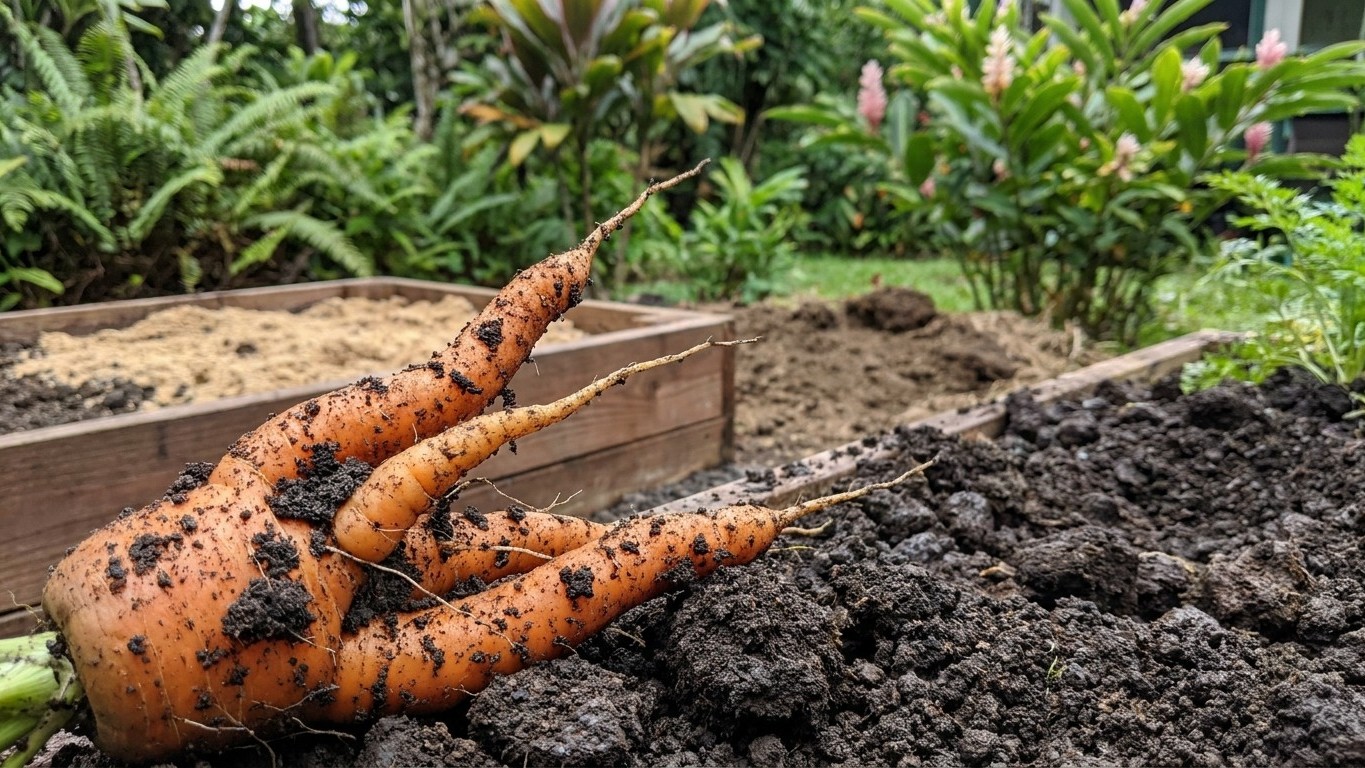

Pull carrots when the tops are full, the shoulders at the soil line have turned deep orange, and roughly 70 to 100 days have passed since the seed went in the ground. After that, twist off the tops right away and chill the roots near 33 °F with high humidity. Carrots stored that way can last for months at best, but that figure is a ceiling, not a promise. The rest of this page covers how to read the row and where to put them once they’re out.
When carrots are ready in Massachusetts
The signal is the plant itself: shoulders colored up to a deep, even orange at the soil line and tops that look thick and healthy. The rough window is 70 to 100 days from seeding. That range runs on the seed packet clock, not the calendar, and it leaves out frost dates on purpose. Frost dates on the Cape, in the Pioneer Valley and in the Berkshires are far enough apart that a single date printed here would be wrong for most readers, and this page does not publish one. Look up the average last spring frost for your own town, note the day you sowed, and count forward.
Why the count starts at seeding
Carrots are sown in place. They resent being moved, so there is no transplant date to count from, and every day of the 70 to 100 begins when the seed goes into the row. Clemson Cooperative Extension gives a tighter and earlier figure, harvesting about 65 to 75 days after planting. That is the fast end of what a row can do. Treat it as the first day worth testing, not the day the whole row is done.
The spread between 70 and 100 comes from the variety, the weather and the ground. Cool spells slow a row down, which is why a crop sown late in summer for autumn picking often takes longer than the packet suggests. Thin, crowded rows also take longer to fatten. Sow thickly and skip the thinning, and you’ll be pulling pencils.
What your soil does to the answer
Massachusetts’ official state soil, the Paxton series, gives a hint about what the ground tends to do. USDA records its surface layer as 61 percent sand, 7 percent clay and 32 percent silt, well drained, with about 5.5 percent organic matter and a pH near 5.5, slightly acid. That is the soil chosen to represent the state, not the soil in your yard. The state spans hundreds of soil series, and river bottoms, hill country and any lot a builder has scraped or filled can look nothing like it.
Utah State University Extension says carrots want deep, sandy, well-drained soil rich in organic matter, and that heavy or rocky soil makes the root fork. New England ground is famously stony, so check yours before blaming the seed. A forked or stubby carrot is usually ready on schedule but misshapen, and Will Carrots Fork in Massachusetts Soil? covers the fix in detail. The quick home check is a jar test: fill a straight-sided jar a third full of soil, add water, shake hard, and let it settle for a day to see the sand, silt and clay layers. A pH kit or a lab test then gives you your own acidity number instead of the state soil’s.
Before you pull, don’t yank. Test one carrot, then loosen the row with a garden fork set a few inches to the side. If the ground is dry and hard, water the day before. A snapped carrot is a carrot that won’t store.
Keeping them, and for how long
Clemson Cooperative Extension’s Home & Garden Information Center has the clearest numbers. It says to store carrots at 33 °F and high humidity to prevent wilting, and that bunched carrots, meaning plants with the tops still on, keep for about 10 to 14 days. The full factsheet is at Clemson’s carrot, beet, radish and parsnip page. The source gives no percentage for “high humidity,” so this page doesn’t invent one. What it does tell you is that dry air is the enemy.
Cut the tops first
The 10 to 14 days is short because the leaves keep pulling moisture out of the root long after it leaves the soil. A wilted, rubbery carrot has often been drained by its own foliage. Cut the tops off as soon as the carrots are out of the ground, leaving a small stub, and the same root keeps far longer. Trimmed carrots kept cold and moist can last for months. That is a maximum under optimal conditions, not a shelf life to plan around, and a carrot that starts soft in week three has not broken any rule.
Why 33 °F is not a cellar temperature
Thirty-three degrees is one degree above freezing. It is much colder than the 50 °F of a typical basement corner. Carrots kept at 50 °F sprout, soften and turn rubbery in a fraction of the time. The target sits just above freezing, and the margin above the freezing point is narrow, which becomes a practical problem in an unheated space.
Before storing, brush off the loose soil but don’t scrub. Washing can be done at the sink before use, and damp roots in a closed space invite rot. Pick out any carrot with a nick, a split or a soft spot, and eat those first. One bad root in a bag can spoil its neighbors.
Sorting matters as much as temperature. Store only sound roots, and treat everything else as this week’s dinner.
Where in the house that actually is
Very few places in a house sit steadily at 33 °F. A heated room is far too warm. A garage swings with the weather, which in Massachusetts means mild afternoons in October and hard freezes by January. An unheated cellar or basement corner can be close in mid-autumn and then wander in either direction. A domestic fridge is the one place that stays cold on a schedule, but its air is dry, so carrots left bare in it wilt.
| Place | How it behaves | Verdict for carrots |
|---|---|---|
| Refrigerator crisper | Cold and steady, but dry air | Closest match, if roots are bagged |
| Unheated basement or cellar | Follows the season, can drift warm early and freeze late | Works only if a thermometer says so |
| Garage or shed | Swings day to night and week to week | Risky, freezing is the main danger |
| Heated room or kitchen | Warm and dry | Too warm, roots sprout and soften |
For most households the fridge comes closest, with the carrots trimmed, unwashed, and sealed in a perforated bag or wrapped in a barely damp towel to hold humidity. A home fridge will hold only a modest harvest, though. A larger crop calls for the coolest corner of a basement, ideally against an outside wall on the north side, in a bin of damp sand or a lidded container.
Whichever spot you pick, put a thermometer in it for a few days before you commit the harvest, and read it morning and evening. Fridge dials and basement guesses are often several degrees off, and a spot that reads warm on a mild day may drop below freezing on the first hard night. A cheap thermometer costs a few dollars. Skipping it can cost the whole crop.
What goes wrong here
The first failure is freezing. A cellar or garage that looked fine in October can go below 32 °F in a January cold snap, and frozen carrots thaw into mush. It shows as glassy, dark, limp roots that leak when squeezed. Prevention is the thermometer routine above, plus a fallback such as moving the bin into the house during a forecast cold spell.
The second is a damp autumn. Carrots left in wet ground can split after heavy rain, and mud-packed roots that go into storage damp turn slimy and grow mold. If the forecast is wet, pull on the driest day you can find, let the roots air-dry briefly in shade, and sort out any cracked ones for immediate use. Carrots that stay in the ground into cold weather should be covered with a thick mulch layer, and they can be dug until the soil freezes solid. After that they are trapped until thaw.
The third is the glut nobody can eat. A 10-foot row can produce a lot more carrots than a household finishes in the 10 to 14 days bunched roots survive. Plan the harvest in stages rather than all at once, and give away, freeze or cook the excess while it is fresh. If you also lose roots to what chews them in the ground, What Eats Carrot in Massachusetts, and When covers the field side, and Growing Carrots in Massachusetts has the full season from sowing on.
Common questions
How do I know a carrot is ready without pulling the whole row?
Pull one. Check for deep orange color through the shoulder and a full, firm root, and count the days since seeding against the 70 to 100 day range. If it’s pale or thin, give the row another week and test again.
Can carrots stay in the ground into winter in Massachusetts?
Yes, for a while. A thick mulch keeps the soil workable so you can dig as needed, but once the ground freezes solid you can’t get them out until it thaws. Pulling and storing the rest is safer for a large crop.
Do I really need to cut the tops off?
Yes. Clemson Cooperative Extension says bunched carrots, with the tops on, keep about 10 to 14 days. The leaves draw moisture from the root, so trimming them right after harvest is what allows longer storage.
What temperature should I store carrots at?
Clemson Cooperative Extension says 33 °F and high humidity to prevent wilting. That is just above freezing, much colder than a typical basement, and the reason a thermometer belongs wherever you store them.