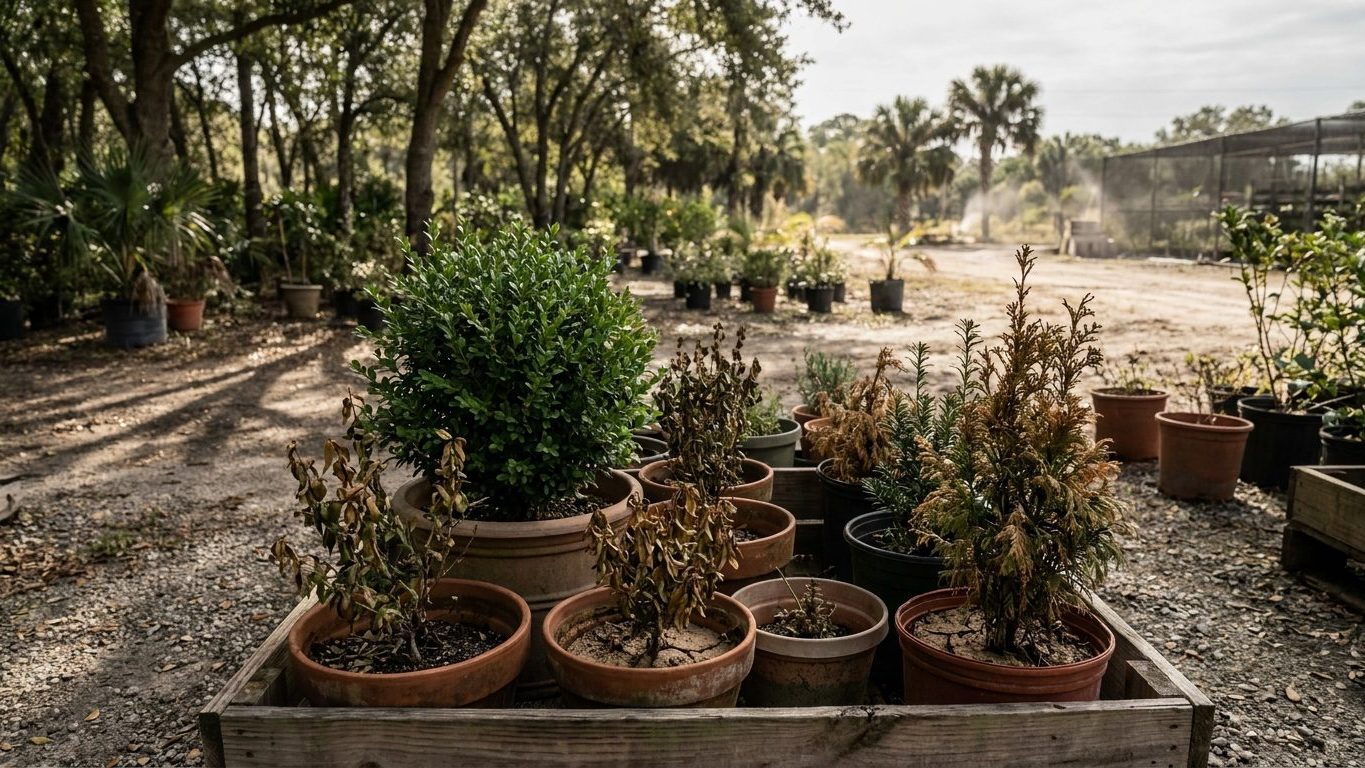

Of the 12 hedge species documented on this site, 8 survive everywhere in Oklahoma, from zone 6a to zone 8a on the USDA map. Four survive only in zones 6a through 7b. None fail statewide. Three of the 12, Leyland cypress, Eastern red cedar and arborvitae, carry a second trap: once they outgrow their space, they cannot be cut back down. Sorting by those two facts settles most of the buying decision before you compare price or looks.
What actually holds in Oklahoma
Why the zone number tells only half the story
The USDA Plant Hardiness Zone Map (2023 edition, built on 1991-2020 normals) rests on a single variable: the average annual extreme minimum temperature. Oklahoma spans zones 6a to 8a under that system. It measures winter cold and nothing else, so the top of a plant’s listed range is often a heat limit the map never sees. “Holds” means survives. A hedge can survive and still look tired by August.
Zone lines also cut across the state, so a statewide answer only goes so far. Look up your own ZIP code on the USDA map before you shop, then read the rest against that zone.
The four that stop at zone 7b
Privet, yew, arborvitae and Eastern hemlock are documented for zones 6a, 6b, 7a and 7b only (hardiness ranges from the NC State Extension Gardener Plant Toolbox, crossed with Oklahoma’s USDA range). In zone 8a, the warmest ground in the state, none of the four holds. Planting them there is a gamble, not a plan.
| Plant | Zones | Height as a hedge | Growth a year | Regrows from old wood |
|---|---|---|---|---|
| Privet (Ligustrum vulgare) | 6a to 7b | 4 to 12 feet | 2 to 3 feet | Yes |
| Yew (Taxus x media) | 6a to 7b | 3 to 8 feet | 6 to 12 inches | Yes |
| Arborvitae (Thuja occidentalis) | 6a to 7b | 4 to 15 feet | 6 to 9 inches | No |
| Eastern hemlock (Tsuga canadensis) | 6a to 7b | 10 to 20 feet | 12 to 24 inches | Yes |
Arborvitae is the one to skip if you sit near the line. It fails the zone test in 8a and it cannot be cut back if it outgrows its spot. Yew, hemlock and privet at least regrow from old wood when a cut goes too deep.
The eight that hold across the whole state
Boxwood, American hornbeam, Leyland cypress, inkberry holly, winterberry holly, Eastern red cedar, cherry laurel and arrowwood viburnum are documented for the full 6a to 8a range. Since nothing on the list fails everywhere, the real sorting happens on size, speed, pruning and winter look. The two hollies show why. Inkberry is evergreen and winterberry loses its leaves in winter. Same genus, both hardy statewide, and a January screen looks very different with each.
The same 12 species get a different verdict in other states. The Hedge Plants for North Carolina: What Holds, and What Only Looks Hardy and Hedge Plants for Hawaii: What Holds, and What Only Looks Hardy pages show how the sort changes, and the Hedges hub ties them together.
The hedges you can never cut back down
Three plants with no second chance
Leyland cypress, Eastern red cedar and arborvitae do not regrow from old wood. Cut into the brown, leafless interior and that branch stays bare. Whatever height you let them reach becomes the height you keep, unless you pull them out.
Leyland is the sharpest case. It grows 3 to 4 feet a year and reaches 15 to 25 feet as a screen, with pruning from late spring to midsummer. Skip trimming for three seasons and you have added roughly 9 to 12 feet. Eastern red cedar is slower, at 12 to 24 inches a year and 8 to 20 feet as a screen, and it takes light cuts only, in late winter. Arborvitae adds 6 to 9 inches a year, tops out at 4 to 15 feet as a hedge, gets trimmed in late winter before growth starts or in midsummer, and holds only in zones 6a through 7b.
The workable approach with all three is to buy for mature height, not for the size in the pot. A plant that can reach 25 feet on a lot where you want 8 is a maintenance problem you cannot prune your way out of. Trim lightly and often, inside the green growth, starting when the plant is at the height you want to keep.
The ones that forgive a hard cut
Privet, yew, hemlock, boxwood, hornbeam, both hollies, cherry laurel and arrowwood all regrow from old wood. Forgiving is not the same as fast, though. Boxwood adds only 3 to 6 inches a year, so a 2-foot cut takes roughly 4 to 8 years to grow back. Privet, at 2 to 3 feet a year, makes up a similar cut in about a year, and it gets trimmed twice a season, in spring and midsummer.
Cherry laurel adds 1 to 2 feet a year and is cut in late spring, after flowering. Arrowwood viburnum is cut right after flowering. If you inherited an overgrown hedge and cannot tell what it is, that identification comes first, because it decides whether a hard renovation cut is possible or whether the plant has to come out.
Matching the plant to the job
Low edge, mid hedge or tall screen
Height decides this. Boxwood is the only one of the eight statewide plants that stays in the 2 to 6 foot range, and at 3 to 6 inches a year it barely needs attention. Arrowwood, inkberry, winterberry and hornbeam sit in the middle at 5 to 15 feet. Leyland and Eastern red cedar are the tall screens. My own pick for most suburban lots would come from the middle group, since all four regrow from old wood and none cap out at a height you cannot manage.
| Plant | Height | Growth a year | Prune | Regrows from old wood |
|---|---|---|---|---|
| Boxwood | 2 to 6 feet | 3 to 6 inches | Late spring, after the last frost | Yes |
| Arrowwood viburnum | 6 to 10 feet | 12 to 24 inches | Right after flowering | Yes |
| Inkberry holly | 5 to 15 feet | 6 to 12 inches | Late winter, while dormant | Yes |
| Winterberry holly | 5 to 15 feet | 6 to 12 inches | Late winter, while dormant | Yes |
| American hornbeam | 6 to 15 feet | 12 inches | Midsummer, after the first flush | Yes |
| Cherry laurel | 6 to 15 feet | 1 to 2 feet | Late spring, after flowering | Yes |
| Eastern red cedar | 8 to 20 feet | 12 to 24 inches | Late winter, light cuts only | No |
| Leyland cypress | 15 to 25 feet | 3 to 4 feet | Late spring to midsummer | No |
What this month allows
It is late September, and none of the pruning windows above opens now. Leave the shears in the shed. The month suits planting and planning instead, with frost still weeks off.
For a frost reference, the NOAA NCEI U.S. Climate Normals for 1991-2020 use Oklahoma City’s airport station. In its 30 to 70 percent probability band for a 32°F freeze, the last spring frost falls between March 28 and April 10, and the first fall frost between October 29 and November 8. Suburban and rural gardens typically see the last spring frost later and the first fall frost earlier, often by one to two weeks. Check your own county before you set a planting or pruning date around those numbers.
The ground you are planting into
What the state soil tends to do
Oklahoma’s official state soil, named by law in 1987, is the Port series, a Mollisol: the deep, dark prairie soil of the kind that built the Corn Belt. USDA NRCS records its surface horizon as loam to silt, at 12 percent sand, 19 percent clay and 69 percent silt. Organic matter is about 2.0 percent, pH is about 7.0 (near neutral), and it is well drained. Those are representative values across 93 mapped components, queried in August 2026.
Read that as a tendency. Silty, well-drained ground sheds water rather than holding it, which matters most for a newly planted hedge with a small root ball. A near-neutral pH is also a starting point, not a verdict on any one plant.
Why your own bed may differ
The Port series represents the state. It does not describe your yard. Oklahoma has hundreds of soil series, and river bottoms, hill country and any lot a builder has scraped or filled can look nothing like it. Those figures come from the surface layer of mapped ground, not from a worked garden bed, and your pH could sit well away from 7.0.
A soil test gives you your own number for a modest fee. Oklahoma State University’s Extension service, at extension.okstate.edu, is the place to ask how to submit a sample through your county office. Do it before you buy 30 plants, not after.
Common questions
Which hedge plants fail in southern Oklahoma?
Privet, yew, arborvitae and Eastern hemlock are documented only for zones 6a through 7b, so they do not hold in zone 8a, the warmest part of the state. Check your zone by ZIP code on the USDA map. The eight others hold from 6a to 8a.
What is the fastest hedge that still regrows if I cut it hard?
Privet grows 2 to 3 feet a year and regrows from old wood, but it holds only in zones 6a through 7b. Cherry laurel adds 1 to 2 feet a year and holds statewide. Leyland grows faster, at 3 to 4 feet a year, but never regrows from old wood.
When are the frost dates for Oklahoma?
At the Oklahoma City airport station, the last spring 32°F frost falls between March 28 and April 10, and the first fall frost between October 29 and November 8 (NOAA NCEI, 1991-2020 normals). Suburban and rural sites often run one to two weeks later in spring and earlier in fall.
Can I cut an overgrown hedge back hard?
Only if it is one of the plants that regrow from old wood. Leyland cypress, Eastern red cedar and arborvitae do not, so a hard cut leaves bare branches. Boxwood does regrow, but at 3 to 6 inches a year, a 2-foot cut takes roughly 4 to 8 years to fill back in.