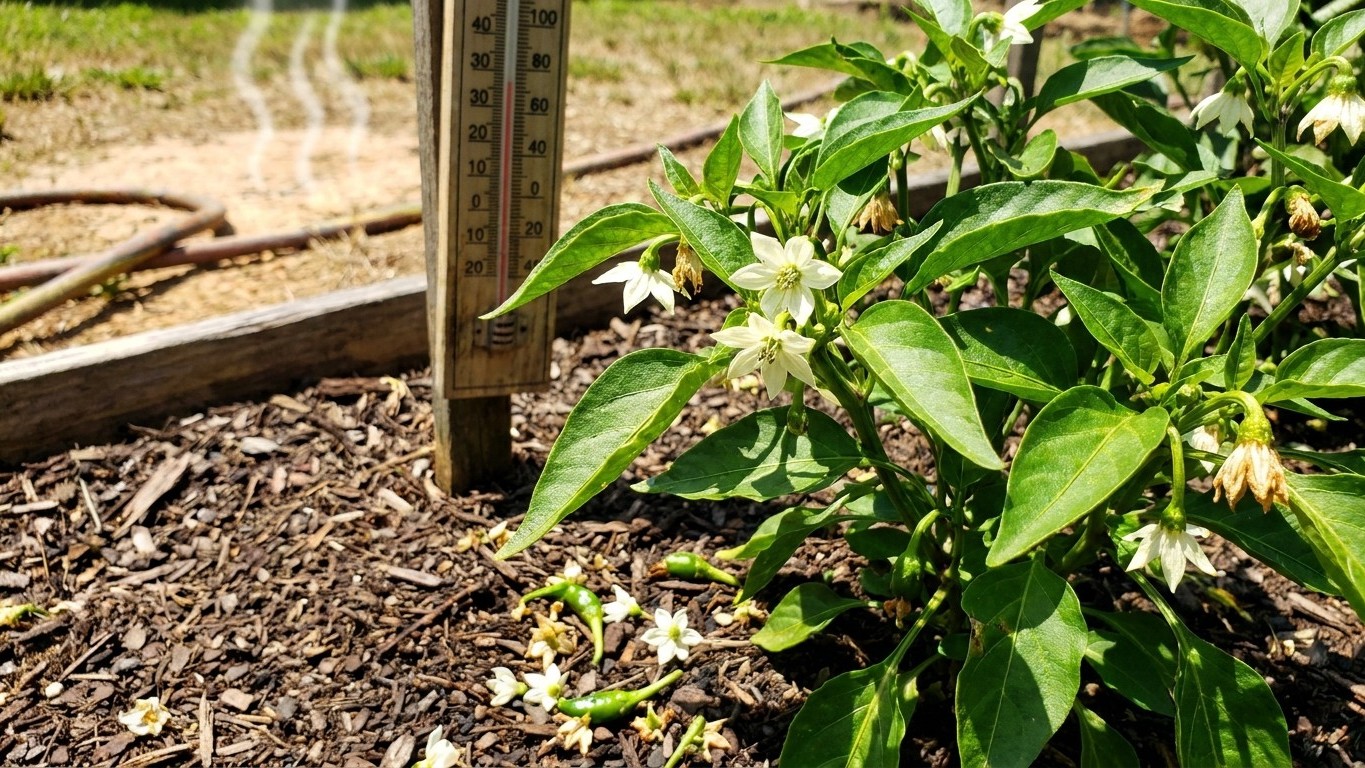

Peppers in the Yukon almost never fail because of heat. This territory averages 0.0 days a year at or above 90 F, so the hot-end trigger for blossom drop barely exists here. What does exist is the cool end: pepper flowers stop setting fruit when nights drop below 55 F, and Yukon summer nights run cold enough, often enough, that this is very likely the real cause of empty pepper plants.
The short answer
Start with the number that matters most: 0.0 days a year at or above 90 F, drawn from the Whitehorse reference station in the Canadian Climate Normals for 1981-2010. That figure is not a rounded-down “almost none.” It is the recorded average, and it tells you something specific about how pepper flowers behave here. Above 90 F, pepper blossoms drop before they set fruit, because the plant redirects energy away from reproduction under heat stress. In the Yukon, that mechanism essentially never gets triggered by daytime heat. If your peppers aren’t fruiting, you can set aside the usual “it’s too hot” explanation that gardeners farther south have to fight every July.
The other end of the range
That leaves the cool end, and this is where Yukon growers need to pay close attention. Pepper flowers also fail to set when nighttime temperatures fall below 55 F. Cool night air slows pollen viability and can cause flowers to abort even when the plant looks otherwise healthy, well-watered, and covered in blooms. This site does not carry summer night minimum data for the Yukon, so no specific overnight figure can be given here. That is not an oversight; it’s a boundary on what can be stated as fact.
What that means practically: you need to watch your own thermometer, not a chart. A backyard in a low valley bottom can run several degrees colder overnight than a spot fifteen minutes away on a slope, and cold air pools in low ground on clear, calm nights, sometimes with dramatic effect on tender plants. Track your own overnight lows through July and August with a simple min-max thermometer near the pepper bed. If you’re regularly seeing nights below 55 F during the flowering window, that is very likely doing more damage to fruit set than anything else in your garden, heat included. No latitude-based assumption, no general rule about “northern gardens,” substitutes for your own reading in your own bed.
When to start seed here
Timing a pepper crop in the Yukon comes down to counting backward from two fixed points: the date the ground actually warms and the date frost risk actually clears. Utah State University Extension recommends starting pepper seed 8 to 10 weeks before transplanting, and transplanting only after frost has passed and soil temperature has reached 60 F. Here is how that arithmetic plays out using the local frost figure.
- Start with the average last spring frost date. For the Whitehorse A station, that average falls on June 5, based on Environment and Climate Change Canada’s 1981-2010 Climate Normals. This is a mean, not a guarantee. In one year out of two, frost arrives later than June 5, so treat this as the middle of a window, not a safe planting date.
- Add the wait for soil, not just air, to warm. Soil temperature lags behind air temperature, sometimes by several weeks in a northern climate, so the point at which the ground actually hits 60 F often comes after the frost date itself, not on it. Check soil temperature directly with a simple probe thermometer pushed a few inches into the bed rather than guessing from the calendar.
- Count backward 8 to 10 weeks from your expected transplant date. If you’re aiming for a transplant window in the weeks following June 5, and allowing extra time for soil to catch up, that puts indoor seed starting somewhere in the early-to-mid spring stretch, well before any outdoor bed is usable.
- Build in a buffer for a late frost year. Because June 5 is an average and not a floor, gardeners who start seed only 8 weeks before that date, with no cushion, risk having mature transplants sitting indoors outgrowing their containers if frost lingers. Starting nearer the 10-week mark gives more flexibility without costing much if the season runs early instead.
Every county and even every yard will shift this math slightly. The point of doing the arithmetic yourself, rather than copying a fixed calendar date, is that it forces you to check your own frost history and your own soil rather than relying on a single station reading for a place as geographically varied as the Yukon.
What goes wrong here
Given the heat and cold profile of this territory, three specific failures show up more than any others in pepper beds. Each has a distinct cause and a distinct fix.
- Blossom drop from a cool night. Flowers form, look normal, then fall off without ever swelling into fruit. In the Yukon this is far more likely to trace back to nights below 55 F than to heat, given how rare 90 F days are here. The remedy is protection after sunset: row cover pulled over plants in the evening, or siting the bed against a south-facing wall or fence that holds daytime warmth into the night. Raised beds also warm and retain heat better than ground-level rows, which can matter more here than almost anywhere else on this site.
- Sunscald on exposed fruit. Where sun exposure is strong and foliage is sparse, developing peppers can develop pale, blistered, papery patches on the side facing direct sun. This happens even without extreme heat, simply from direct exposure combined with thin leaf cover. Avoid over-pruning foliage, and let the plant’s own leaf canopy shade the fruit rather than stripping leaves back for looks.
- Blossom-end rot. A dark, sunken, leathery patch forms at the blossom end of the fruit, usually tied to inconsistent watering rather than a calcium shortage in the soil itself. Uneven moisture, a dry stretch followed by a heavy soak, interrupts the plant’s ability to move calcium to the fruit. Even watering on a steady schedule, with mulch to hold soil moisture between waterings, addresses most cases without needing any soil amendment.
Common questions
Do Yukon summers ever get hot enough to stop pepper fruit set?
Based on the recorded average of 0.0 days a year at or above 90 F, heat-driven blossom drop is essentially a non-issue in this territory. If your peppers are failing to set fruit, the cooler end of the range, particularly nighttime temperatures, is the far more likely culprit.
How do I know if my nights are too cold for pepper flowers?
This site does not carry summer night minimum data for the Yukon, so there’s no published figure to check against. Place a min-max thermometer near your pepper bed and track actual overnight lows through the flowering period; if readings regularly fall below 55 F, that’s very likely interfering with fruit set.
Is June 5 a safe date to transplant peppers outdoors?
No. June 5 is the average last spring frost date for the Whitehorse A station over 1981-2010, meaning frost arrives later than that in about half of all years. Wait until frost has clearly passed in your own location and soil has reached 60 F before moving transplants outside.
Why did my pepper plants flower heavily but produce almost no fruit?
Heavy flowering with poor fruit set almost always points to a temperature problem at the moment of pollination rather than a plant health issue. In the Yukon, given the near-total absence of 90 F days, a run of cool nights during the flowering window is the far more probable explanation than heat stress.