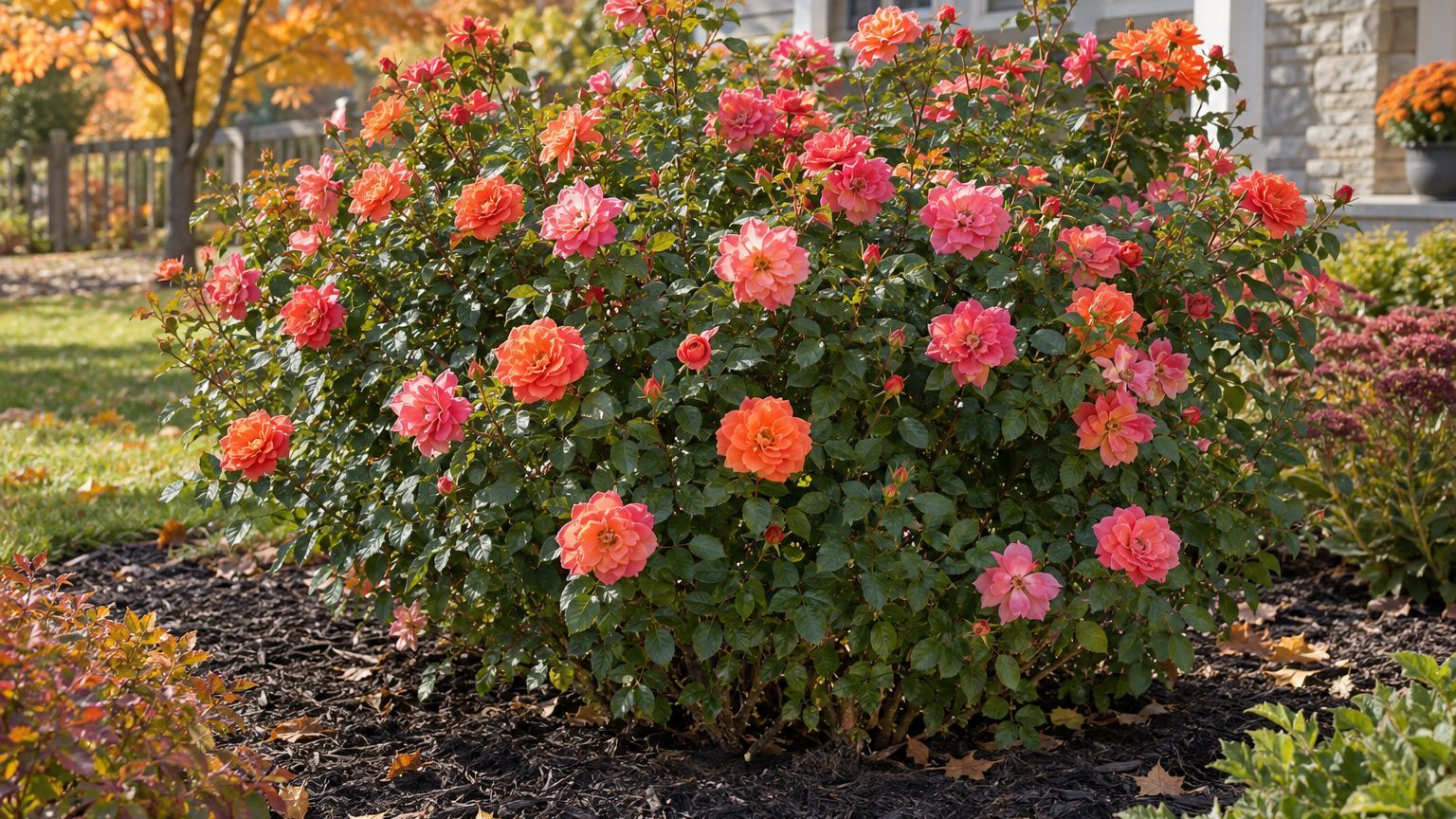

Knock Out is a shrub rose with double orange, coral and pink flowers, and it blooms on new wood. That single fact drives its care. A rose does not ripen in one flush the way a vegetable does, and no catalogue counts days to maturity for one. The useful question is whether the plant and its wood get through the season on schedule where you live. For this rose the answer is usually yes, provided you prune lightly and stop pushing growth before frost.
What Knock Out actually is
Start with the group. Knock Out belongs to the shrub roses, which the source description calls the best-selling group in the United States. Its flowers are double, in orange, coral and pink, and it blooms continuously through the season. The same description calls it very disease resistant, a point the resistance section below takes up in detail.
On timing, there is no catalogue figure to quote. Nothing here counts days from transplant to a first pick, and a rose has no such date, so anyone who gives you one for Knock Out is borrowing it from a vegetable. What the source documents is where the flowers form. Knock Out flowers on new wood, meaning shoots grown this year, and the consequence is stated plainly: light pruning only, because hard pruning costs bloom.
Size is the second decision-maker, and here the documented figures are for the whole genus, not this cultivar. Roses run 1 to 8 feet tall and 1 to 6 feet wide depending on cultivar, with medium growth and HIGH maintenance, according to the NC State Extension Gardener Plant Toolbox entry for Rosa. Knock Out’s own dimensions are not published here, so read the plant tag before you set a spacing.
The fruit is a hip, an accessory fruit holding achenes. It is edible and turns from green to red in fall. Knock Out is also sold own-root, with no graft union, which matters for winter.
What Knock Out is good for

A landscape rose first
This is a rose grown for the show it puts on, not for the kitchen. Continuous bloom on new wood is the whole appeal. Every flush comes from shoots the plant grew this year, so a bush that gets a light trim still has plenty of wood to flower on. A hybrid tea or a once-a-year rambler has a different bloom logic, and the Rose Varieties page sets those groups side by side.
Double means the petal count runs past 20, since the source gives petals from 5 in a single flower to more than 20 in a double. The exact count for Knock Out is not documented here. Fragrance is the same story. The source sorts rose scent into five groups (old rose, fruity, tea, myrrh and musk), and none is assigned to this cultivar, so treat any scent claim as unverified.
Hips, and cutting for the vase
Because the hip is edible, Knock Out can double as a small fall harvest. Flavor is not documented for this cultivar, and nothing on this site says how it tastes, so I will not guess. The mechanism does have a practical cost. Hips form only on flowers left on the bush, and every deadheading cut pushes a new shoot. A bush you deadhead all season flowers more, and a bush you stop deadheading trades bloom for hips.
For a vase, cut once the sepals have folded back and the first one or two petals are unfurling. A bud cut tighter than that often never opens, and the stem sits there green and closed for a week.
Where it ripens in time, and where it is a gamble
What this page can and cannot cross
A frost table matched to a variety needs two inputs: a catalogue maturity figure and a frost window measured at a named station. Here the first does not exist, and no frost dates or reference cities are published on this page. Naming a station and a date I cannot source would be worse than leaving the gap. Dates and zone-specific timing live on the state pages, and the one you need is the one for your state.
The documented range is broad. The source lists USDA zones 5a through 11b for the genus, and that figure covers roses in general, not Knock Out alone. It is enough to say that a rose of this type is a candidate almost anywhere in the lower 48, with no region where the numbers rule it out.
The arithmetic, in words
For a rose, “in time” means two things: bloom on this year’s shoots, and wood that matures before the first hard freeze. You can work the second out for your own yard.
- Find your average first fall frost date from the nearest weather station.
- Work backward to the day you stop feeding and deadheading, so no new soft shoots start.
- Whatever stretch remains is what the wood has to ripen.
- Check that your pruning date, set by your zone, leaves room for new wood to grow before it flowers.
Where the calendar is generous, this is easy. Where the growing season is short, you gain most by pruning lightly and stopping the cuts on schedule. The gamble in the north is not whether Knock Out blooms. It is whether the last flush of growth is still tender when the freeze arrives.
The wood ripens and the plant hardens on its own once feeding and cutting stop. You cannot speed it along, only avoid slowing it.
The two ways a season goes wrong
The temperature limits vegetable growers quote, nights under 50F and days above 86F, are not documented for roses on this site, and I will not borrow them. Knock Out’s season can go wrong in two other ways that a frost table cannot show.
The first is hard pruning. Since Knock Out flowers on new wood, a hard cut does not remove old flowering wood the way it would on a rambler. The source says plainly that it costs bloom, so the plant rebuilds before it flowers again. The other groups in the source behave differently: ramblers flower from old wood and climbers from new, and the type decides the pruning date, so a date that suits one rose can ruin another.
The second is soft late growth. Every deadheading cut pushes a new shoot, and so does a late feeding. Those shoots are too soft to ripen in time, and a freeze catches them before they toughen. Dormancy itself follows day length and cold, not a signal from the hips. What you control is whether you keep adding tender growth in the final weeks.
For Knock Out, the pruning error matters more in most yards, because it costs flowers whether the frost window is long or short. The soft-growth error matters more toward the cold end of the zone range, where the margin before frost is thinnest. In the warm end, the pruning date is the thing to check first.
What it resists, and what it does not
The source description calls Knock Out very disease resistant, and that is all it says. It does not grade the resistance disease by disease, so I cannot tell you whether it is high or intermediate for any single one. No such grading is published here, and it would be dishonest to imply one.
The source names the diseases roses face: botrytis, blights, powdery mildew, leaf spots and anthracnose. A resistant rose is not an immune one. Resistance slows a disease, and conditions can still push it through. Crowding, wet foliage and stagnant air are the usual helpers. Resistance also belongs to the cultivar, not the group. Knock Out was bred for it as a shrub rose, but that says nothing about every other shrub rose, and several classic ramblers are mildew-prone.
The source also names the pests: Fuller rose beetle, Japanese beetle, rose chafer, rose thrips, southern red mite and two-spotted mite. The two mites are arachnids, not insects. Nothing in the source says Knock Out resists any of them. If the catalogue silence on pests bothers you, it should: assume the plant is on the menu and scout it.
Growing it without the usual mistakes
Site, soil and spacing
Give it full sun, meaning 6 or more hours of direct light a day. The source lists clay or loam, with pH from acid (below 6.0) to neutral (6.0-8.0). Iron chlorosis shows up on strongly alkaline soil, above about 7.5, so a yellowing bush on limy ground is a soil problem before it is a feeding problem. Spacing comes from the tag, since the genus spans 1 to 8 feet tall and 1 to 6 feet wide.
Being a shrub, it needs no trellis. Its habit asks for room and airflow, which do more for disease than any spray.
Pruning, feeding and winter
Prune lightly, and take the date for your zone from the page for your state. Stop feeding and deadheading in time for shoots to ripen before your first frost, using the arithmetic above. The mistake its timing invites is a late tidy-up, because a bush that keeps blooming all season makes late cutting feel natural.
When you do cut dead stems, remove what is diseased or unsafe, but leave dead stems cut back to 12-24 inches standing for stem-nesting native bees. The sharp bits on the stems are prickles, not true thorns, and gloves handle them.
Knock Out is own-root, so winter protection guards the crown, not a graft union. Check the tag, because a budded rose such as a hybrid tea is protected differently. For a comparison with other landscape and garden roses, see Peace Rose: When to Plant the Tomatoes That Ripen All at Once and Bonica Rose: When to Plant the Tomatoes That Ripen All at Once. Expect HIGH maintenance overall, a documented figure for the genus, even with a tough variety.
Common questions
When should I prune Knock Out?
Lightly, and the date depends on your zone, so use the page for your state. What is fixed is the wood: Knock Out flowers on new wood, and hard pruning costs bloom.
Is Knock Out grafted?
Most landscape shrub roses sold today, Knock Out and Drift among them, are own-root and have no union. Hybrid teas, grandifloras and many climbers are budded onto a rootstock. Check the tag, because it decides whether you protect a union or the crown.
Are rose thorns a problem on Knock Out?
They are prickles, not true thorns. They grow from the outer skin of the stem, which is why they can be rubbed off. How many Knock Out carries is not documented here, so wear gloves either way.
Can I eat the hips?
The source says the hip is edible and turns from green to red in fall. Flavor for this cultivar is not documented, and hips only form on flowers you leave undeadheaded. If you want them, stop cutting spent blooms and accept fewer new flowers. Fall is also the moment to leave dead stems standing at 12-24 inches for native bees.