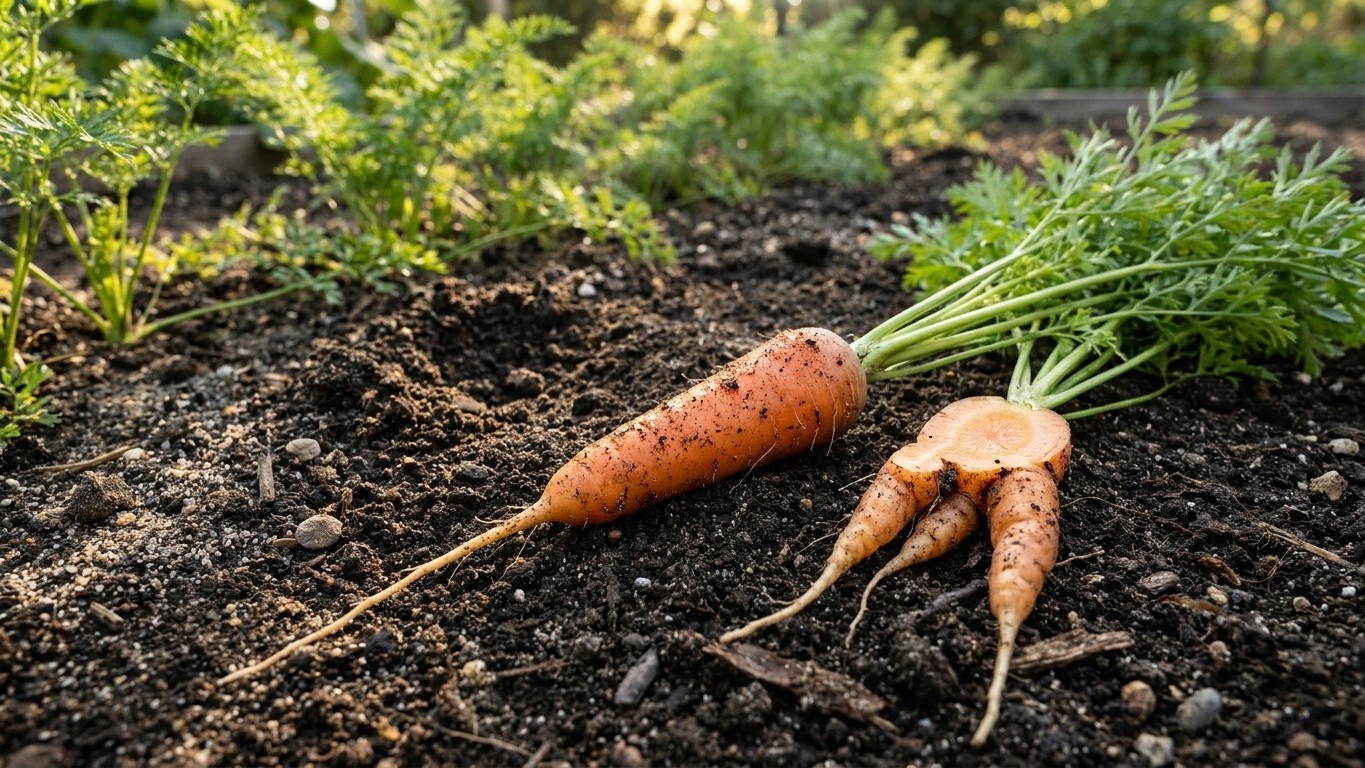

The verified facts behind this page name no pest species for Pennsylvania and no service that documents them. So there is no honest bug-by-bug list here, and inventing one would be worse than having none. What can be said with confidence is how to read the season. The clock starts at seeding, carrots are never transplanted, and damage that looks like an insect’s often isn’t. The rest of this page covers what to look for and where to get a name for it.
Which pests attack carrot in Pennsylvania
Start with the list, because the list is the honest problem. The facts this page rests on document no carrot pest species for Pennsylvania, and they name no extension service that publishes one. That is a gap in what is sourced here, not proof that carrots go untouched. Any species named below would be a guess dressed up as a fact, so none is named.
What can be offered is a way to sort a list when you find one. Any species that lives on trees, shrubs, orchard fruit or stored grain has no business on a carrot page. A gardener who sees an orchard pest in a vegetable bulletin should stop trusting the bulletin. A species belongs on a carrot list only if the source says it feeds on carrot foliage or roots, or on close relatives in the same crop family.
The soil side is better documented. Carrots want deep, sandy, well-drained soil rich in organic matter, according to Utah State University Extension (Carrots in the Garden). Heavy or rocky ground makes the root fork. Pennsylvania’s representative soil, the Hazleton series, is loam to silt: 46 percent sand, 12 percent clay, 42 percent silt, with about 3.0 percent organic matter, and it is well drained. That is a decent starting point on paper, though the surface pH of about 4.6 is strongly acid. Read that as a description of the state’s typical ground, not as a measurement of your bed. Pennsylvania spans hundreds of soil series, and river bottoms, hill country and builder-scraped lots can look nothing like it.
Why does soil belong in a pest article? Because a forked, stunted or scarred root gets blamed on insects far more often than the evidence supports. Ruling the ground in or out comes first. You can read more about that in Will Carrots Fork in Pennsylvania Soil? and about the crop overall in Growing Carrots in Pennsylvania.
When each one shows up, and what it does first
Since no species is sourced, the calendar has to hang on the crop, not on the insect. Carrots are sown in place, so there is no transplant date to count from. Everything runs from the day the seed goes in. The crop needs 70 to 100 days from seeding to harvest, and Clemson Cooperative Extension puts harvest at about 65 to 75 days after planting. That is a long exposure, and it splits into three stages that each show a different first symptom.
Weeks one and two after seeding belong to the seedling stage. The first sign here is a gappy row: bare patches, missing seedlings, or thread-thin sprouts that vanish overnight. Gaps can come from something eating them, but also from a crusted surface, dry seedbed or seed buried too deep. Check the soil surface and the moisture before you suspect an animal.
Next comes the leafy stage, when the tops fill out. Watch for ragged or notched leaf edges, curling, or foliage that yellows unevenly. Chewed tissue with a definite edge points to something feeding. Uniform paling across the whole row points more toward water or fertility. Nothing on this page assigns a particular insect to either sign, and the timing of any given species in Pennsylvania is not published here.
The last stage is the root-swelling stretch, running up to harvest. Roots are out of sight, so the first symptom often arrives late: a sound-looking top over a scarred, tunneled or notched root. Because you can’t see below ground, pull one test carrot when the tops look healthy rather than waiting for the full harvest window to close. Compare it against the seed packet’s stated days to maturity, counted from seeding.
Your frost-free window sets the outer edge of all this. This page does not carry a Pennsylvania last-frost date, so work it out with When to Sow Carrots in Pennsylvania: Counting Back From the Last Frost, then note your seeding date on the calendar. Every symptom you log after that is measured in days from that mark, which is exactly what an extension agent will ask you.
Telling the damage apart from everything else
Misdiagnosis wastes more carrot crops than any insect does. The table below pairs what you see with the usual non-insect explanation and the check that separates it from feeding damage. It does not tell you what is in your garden, only what to look for.
| What you see | Possible cause | What settles it |
|---|---|---|
| Root split into legs, twisted or stubby | Heavy or rocky soil (forking) | Surface is smooth with no tunnels or chewed tissue; a stone or clod sits where the root bent |
| Notches, tunnels or cavities inside the root | Possible feeding damage | Cut the root open; keep the sample and take it to extension |
| Tops droop by afternoon, and recover by evening | Water shortage | Dig beside the row and feel the soil at root depth |
| Stunted, pale tops across the whole row | Fertility or acidity problem | A soil test through extension, not a guess |
| Clean, straight cuts or bruises on roots | Mechanical damage from thinning or harvest tools | Edges are neat, with no chewing, and the pattern follows where you dug |
| Limp, soft roots after harvest | Storage: tops left on or storage too warm | Check whether tops were cut and whether storage sits at 33 °F |
The storage row deserves a second look. Clemson’s figure is 33 °F with high humidity to prevent wilting, which is just above freezing and colder than any basement. Store carrots at 50 °F and they sprout and soften far sooner. The tops are the catch, too. Leaves keep drawing moisture out of the root, which is why bunched carrots with tops on keep only about 10 to 14 days. Cut the tops first, and trimmed roots keep far longer.
For the pH question, use a soil test. The Hazleton figure of about 4.6 describes a surface horizon in a soil survey, and your bed may sit far from it. A jar of soil shaken with water and left to settle will show you sand, silt and clay in layers, which helps you judge texture at home. The lab test tells you pH and organic matter.
What actually works here, and what is a waste of time
A physical barrier set at the right moment beats a treatment applied late. For carrots that moment is seeding day, because the crop is sown in place and the seedlings can’t be moved or sheltered indoors first. A lightweight cover over the bed from the start keeps flying insects from reaching the row, and you lift it only for weeding. Put it on after damage appears and you may be sealing the problem in.
Calendar discipline does more than any product. With 70 to 100 days from seeding to harvest, and no transplant to shorten the exposure, every week you delay pulling a mature crop is a week the roots stay in the ground. Note your seeding date, pull a test carrot as the earliest maturity date approaches, and harvest when the roots are ready.
Soil work also counts as pest management, in a roundabout way. Heavy soil needs plenty of compost and double digging. If your ground is heavy, the fix is a raised bed or deeper digging, not a different seed. A root that grows straight and fast in loose ground is simply exposed for less time in a stressed state.
Now the things that waste effort. Spraying on a guess is the big one. If you haven’t confirmed what is feeding, you can’t know whether anything you apply matches the problem, and this site names no product, active ingredient or dose. What is registered for home use in Pennsylvania changes, and only extension can tell you what is currently allowed. Fixing forking with insect control is the second waste, since forked roots come from soil, not from anything feeding. The third is storing carrots with the tops on because they look fresher. They look fresher and keep worse.
Where to check this for your own county
Your county’s Cooperative Extension office is the right place to take this question. This page does not carry a named Pennsylvania extension publication, so use the state’s land-grant extension service and find your county office through it. Staff there know which pests are active locally and what is currently registered for home gardens.
The reason to go local is that pest presence varies inside a single state. What is documented statewide does not tell you what lives in your yard. A ridge-top garden, a river-bottom plot and a suburban lot behind a new house can each face a different set of problems, on different soil, with a different frost-free window. The same applies to the state soil. Hazleton represents Pennsylvania in the USDA record. It does not represent your bed.
Bring the right material. Take a whole affected plant, roots included, plus the seeding date, since every diagnosis runs from it. Photograph the damage before the plant wilts. If you also bring a soil test result, the agent can rule out the ground in one look.
Your next move: put a note on the calendar with the day you seeded, pull one carrot when the tops look healthy, and cut it open. If what you find doesn’t match the smooth, forked or dry-stress rows in the table, wrap the plant in a damp paper towel and carry it to your county office.
Common questions
Can I tell which insect ate my carrots from the damage alone?
Not reliably, and this page won’t try. The same scar can come from feeding, soil or handling. Save an affected plant with its roots and take it to your county extension office for an identification.
Should I start carrots indoors and transplant them to avoid pests?
No. Carrots are sown in place, and there is no transplant date on this crop. The 70 to 100 days run from seeding. A cover over the bed on seeding day is the practical alternative.
Is a forked carrot a sign of insects?
Forking comes from heavy or rocky soil, according to Utah State University Extension. Insect feeding leaves chewed tissue, tunnels or notches, and a forked root with a smooth surface points to the ground. Compost, double digging or a raised bed addresses it.
How should I store carrots once they’re harvested?
Clemson Cooperative Extension recommends 33 °F with high humidity to prevent wilting. Cut the tops off first, since leaves keep drawing moisture from the root. Bunched carrots with tops on keep about 10 to 14 days.