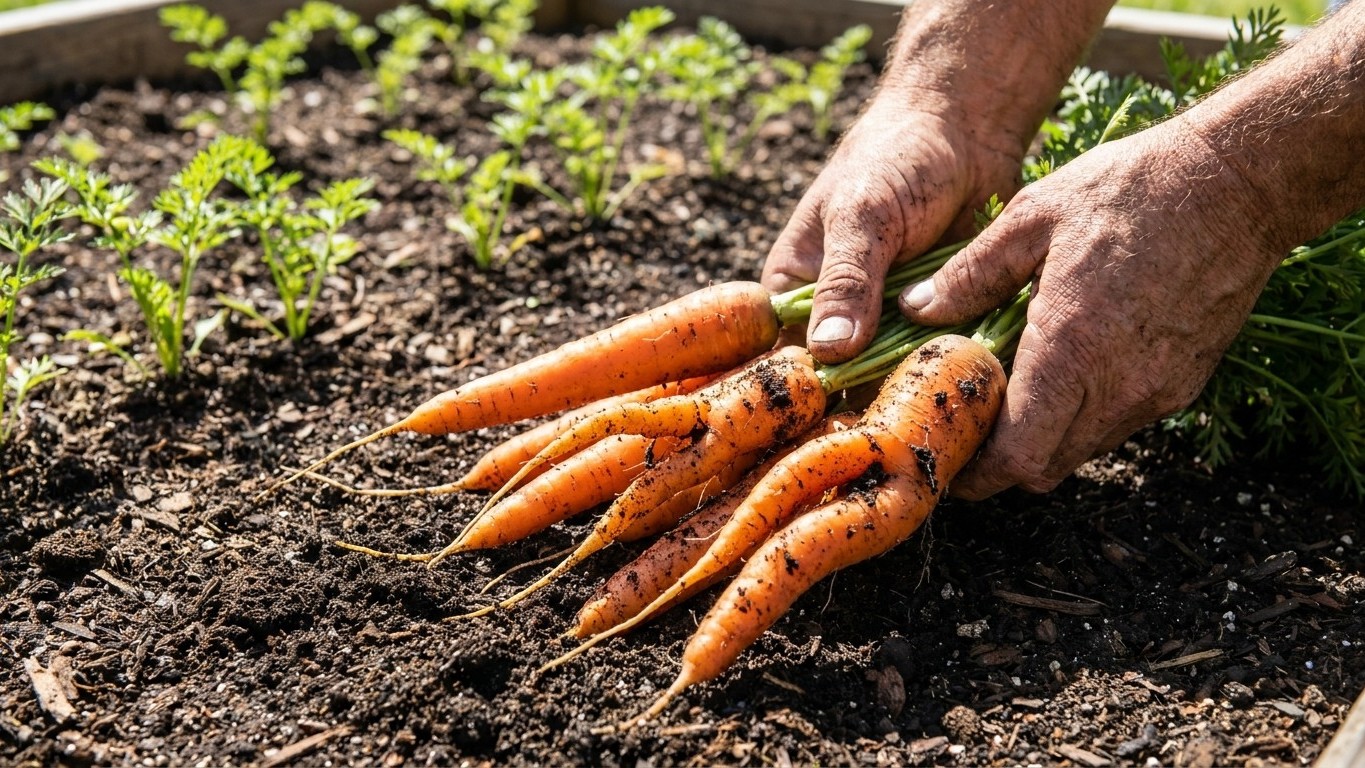

Pennsylvania gardeners sow carrot seed directly into the ground, counting backward from their local last-frost date since this root crop skips the transplant step entirely. Days to maturity run 70 to 100, counted from the day seed goes into soil, never from a seedling stage. But that count only works if the ground underneath lets a taproot run straight, and across much of the state the soil brings its own conditions to the math before the calendar even gets a say.
The short answer
The soil that USDA lists as representative of Pennsylvania is the Hazleton series, an Inceptisol, which is a young soil that hasn’t had time to develop the strong layered horizons older soils show. Its surface runs 46 percent sand, 12 percent clay and 42 percent silt, which puts it in loam to silt loam territory, with organic matter around 3.0 percent and a drainage class of well drained. The surface pH sits around 4.6, which is strongly acid.
What that means for a carrot row
Carrots want deep, sandy, well-drained soil rich in organic matter, according to Utah State University Extension, and heavy or rocky ground is what makes a root fork instead of running straight. On paper, the Hazleton profile isn’t the heavy clay that causes the worst forking. At 12 percent clay it drains well and has enough sand to let a root push down without much resistance. The organic matter figure, at 3.0 percent, sits below what Utah State recommends building toward, so working in compost still pays off even where the base texture is workable.
The number that should actually get a gardener’s attention here is the pH. At 4.6, this ground is more acid than most root vegetables prefer, and strongly acid soil can tie up nutrients a carrot needs to size up evenly, even when the texture itself is fine. A soil test that comes back anywhere near that reading points toward lime, not toward a raised bed, since the drainage and texture aren’t the problem. Where a garden sits in a poorly drained pocket, or on ground a builder has compacted or filled with a heavier subsoil, double digging or a raised bed with amended fill is the fix Utah State points to, and it may be needed even where the mapped series looks favorable.
None of this is a diagnosis for a specific backyard. Pennsylvania spans hundreds of mapped soil series, and the ground under any one garden, especially in a river valley, on a hillside, or on a lot that’s been graded and filled, can look nothing like the Hazleton profile. This is a starting point for what the region’s soil tends to do, not a stand-in for what’s actually under a specific carrot bed.
The test that settles it in your own garden
The only way to know what a carrot root will meet on its way down is to look, and the checks that matter don’t require a lab.
- Dig a hole at least a foot deep where the carrot row will go. Note where the color or texture changes, since a shift from loose topsoil to dense, compacted subsoil close to the surface is exactly what stops a root and makes it fork or stub out.
- Check for stones and rubble in that same hole. Small pebbles scattered through loose soil rarely matter, but a layer of rock, construction debris, or a hardpan a few inches down will deflect a taproot every time.
- Feel the texture between your fingers. Grab a handful of moist soil and squeeze. Soil that forms a slick, sticky ribbon is heavy in clay and will resist a root pushing through it. Soil that falls apart and won’t hold any shape at all is closer to pure sand, which drains fast but may need more organic matter to hold moisture. Soil that holds a loose ball and crumbles easily is closer to the loam a carrot wants.
- Watch how water drains. Fill that same hole with water and time how long it takes to disappear. Water still standing after several hours points to a drainage problem worth solving with raised beds or added organic matter before seed goes in the ground.
- Send a sample to a soil test lab for the one number none of the above can tell you: the actual pH and nutrient levels in that specific bed, rather than the surface reading mapped for the county’s dominant series.
What goes wrong here
Most carrot failures trace back to one of a handful of predictable causes, and each one has a fix that doesn’t require starting over.
- Forking in heavy or compacted ground. A root meets resistance, a stone, a clay layer, or a patch of soil packed down by foot traffic or old construction fill, and it splits around the obstruction instead of growing straight. The fix Utah State University Extension points to is working in plenty of compost and double digging the bed before sowing, or building a raised bed filled with loosened, amended soil where the native ground is too tight to fix in place.
- Poor germination during a hot stretch. Carrot seed is small and sits shallow, which means the top inch of soil can dry out fast once temperatures climb, and dry soil at that depth simply won’t sprout the seed. Keeping that top layer consistently damp until seedlings appear, with light, frequent watering rather than one heavy soak, is what gets a stand up in warm weather.
- Splitting from uneven watering. A root that grows for weeks in dry soil and then gets a sudden heavy rain or deep watering will often crack along its length as it swells too fast. Steady, even moisture through the growing season, rather than a feast-or-famine pattern, keeps the root growing at one pace instead of two.
- Stunted or twisted roots in strongly acid soil. Where the native ground runs as acid as the Hazleton series does, at a surface pH near 4.6, nutrient uptake can suffer even in soil with otherwise good texture. A soil test that flags a low pH points to lime worked in ahead of sowing, not to a change in variety or a raised bed.
Common questions
Does carrot seed need to be started indoors in Pennsylvania?
No. Carrots are sown directly into the garden bed where they’ll grow to harvest. There’s no transplant stage, so any timing plan is built around a seeding date in the ground, not a start date for indoor trays.
How long until carrots are ready to harvest once seeded?
Days to maturity run 70 to 100, counted from the day the seed goes into the soil. That range covers the spread across different growing conditions, and a gardener working from a specific seed packet should use the number printed there alongside this general range.
Is Pennsylvania soil generally good for carrots?
The soil representative of the state, the Hazleton series, is well drained with a loam to silt loam texture, which is closer to what carrots want than heavy clay ground is. Its main drawback is a strongly acid surface pH near 4.6, which a soil test and lime can correct. Any individual garden may differ substantially, since the state holds hundreds of distinct soil series.
What’s the fix if a home soil test shows heavy clay instead?
Utah State University Extension points to two remedies for heavy or rocky soil: working in generous amounts of compost and double digging the bed to loosen it well below where the root will grow, or building a raised bed filled with amended, loosened soil where the native ground can’t practically be reworked in place.