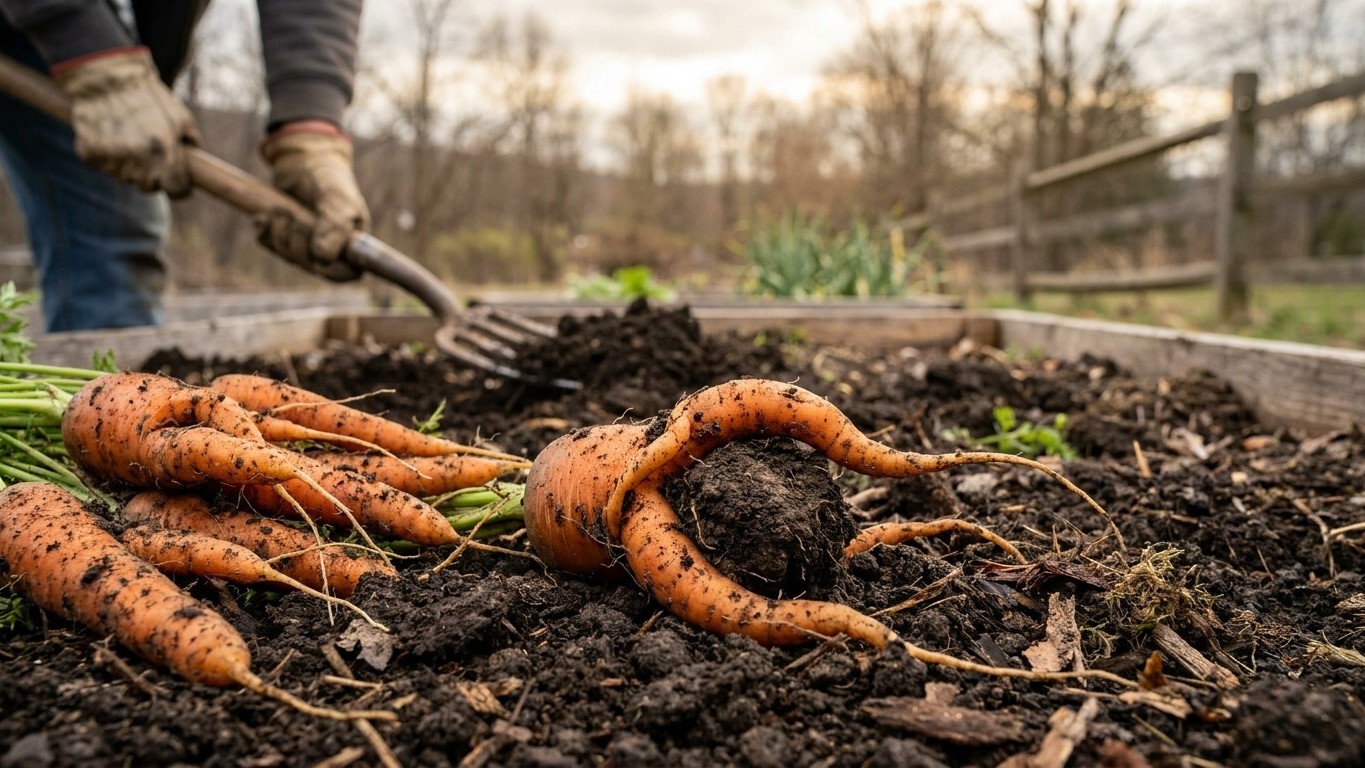

Pennsylvania’s representative soil runs strongly acid and carries just enough clay to raise forking risk if it’s never been loosened. Compost worked into the top foot, double digging, or a raised bed answers that. Add the state’s short, cool spring window (soil at 40°F, sowing 2 to 3 weeks before the March 29 to April 6 frost date) and carrots get the start they need. For the exact timing, see When to Sow Carrots in Pennsylvania. The state figure is only a starting point; a soil test on your own plot is what actually decides the outcome.
The short answer
The soil USDA lists as representative of Pennsylvania is the Hazleton series, an Inceptisol, meaning it’s a young soil that hasn’t had time to develop strong horizons. Its surface reads 46 percent sand, 12 percent clay, and 42 percent silt, which puts it in loam territory, not heavy clay. It’s rated well drained, carries about 3.0 percent organic matter at the surface, and runs strongly acid, with a pH around 4.6.
That texture is closer to the sandy loam Utah State University Extension recommends for carrots than to the dense clay that typically forces roots to fork. On paper, a 12 percent clay reading shouldn’t stop a carrot from growing straight, but the question of Will Carrots Fork in Pennsylvania Soil? deserves a second look before anyone calls this soil carrot-ready.
Why the reading isn’t the whole story
First, this is an Inceptisol. Weak horizon development often means the loosened, organic-rich layer near the surface sits over denser, less worked material not far down, exactly where a carrot root runs into resistance and splits into two legs. Second, the organic matter figure, about 3.0 percent, describes native ground, not a bed that’s been cultivated, composted, and turned over seasons of gardening. A carrot bed needs depth and looseness the raw survey number doesn’t guarantee.
The fix Utah State University Extension gives for anything short of ideal, whether it’s clay content or compaction, is the same: work in plenty of compost and double dig the bed, loosening the soil roughly a foot to 15 inches down so the taproot has nowhere to meet resistance. Where a yard sits over fill, ledge, or genuinely heavy ground, a raised bed filled with a loose, sandy loam mix sidesteps the problem outright rather than fighting it every season.
None of this is a diagnosis of any one garden. A state spans hundreds of soil series, and the Hazleton series is simply what USDA records as representative under its State Soils programme. River bottoms, hill country, and any lot a builder has cut, filled, or graded will read completely differently. Treat these numbers as a description of what the region’s ground tends to do, not a stand-in for what’s actually under your feet.
The test that settles it in your own garden
The state soil survey can’t tell you what’s under your own raised bed or backyard plot. A short afternoon with a shovel will.
- Dig a test hole. Go down about a foot to 15 inches, the depth a carrot root wants to travel, and set the soil aside in a pile so you can see the profile as you go.
- Check the depth and look for obstructions. Note where the loose, dark topsoil ends and where you hit denser subsoil, rock fragments, or a hardpan layer. Any of these near the surface is where forking starts.
- Feel the texture. Take a moist handful and squeeze it. Soil that forms a sticky, moldable ribbon leans toward clay and needs loosening. Soil that falls apart and feels gritty leans sandy, which drains fast but may need more organic matter to hold moisture. Soil that holds a loose ball and crumbles easily is the loam texture carrots do best in.
- Watch how water drains. Fill the hole with water and time how long it takes to disappear. Water that sits for hours points to poor drainage and a case for raised beds; water that vanishes almost immediately points to sandy, fast-draining ground.
- Repeat in more than one spot. Soil can change within the same yard, especially where a builder has graded, filled, or compacted part of the lot. One hole tells you about one spot, not the whole garden.
None of these steps replaces a lab soil test for nutrients or pH, but they answer the one question that matters most before sowing a carrot: will this ground let a root grow straight down, or will it hit something and fork?
When to sow here
Carrots are sown directly into the ground. There’s no transplanting step, so every count of days to harvest, typically 70 to 100 days depending on the variety, runs from the day the seed goes in, not from any later date.
- Start with the frost window. Across Pennsylvania, the last spring frost falls between March 29 and April 6, based on NOAA NCEI’s 1991-2020 climate normals. That date is the anchor for everything that follows.
- Count backward 2 to 3 weeks. Carrot seed goes into the ground before the last frost, not after it. Counting Back From an April 1 midpoint puts sowing somewhere in the second week of March for much of the state.
- Check the soil, not the calendar. Seed needs the ground at 40°F minimum to germinate at all. A cold, wet March can push that date later no matter what the calendar says, so a soil thermometer settles the question faster than guesswork.
- Aim for the germination sweet spot. Carrots come up fastest and most evenly when the soil sits between 55°F and 65°F. Sowing right at the 40°F minimum will work, but expect slower, patchier emergence than sowing once the ground has warmed closer to that range.
- Adjust for where you are in the state. The frost window above describes the milder end of Pennsylvania’s spring. The northern tier and the Alleghenies typically run two to four weeks later, which pushes both the safe sowing date and the point where soil reaches 40°F back accordingly.
What goes wrong here
- Forking in unamended or compacted ground. Heavy or rocky soil, or a topsoil layer that sits over denser material not far down, stops a taproot cold and sends it splitting into two or more legs. The remedy is compost worked in generously and double digging to loosen the bed a foot to 15 inches deep, or a raised bed filled with loose, sandy loam where the native ground is too dense to fix easily.
- Poor germination during a hot, dry stretch. Carrot seed germinates best between 55°F and 65°F. A sudden warm spell that pushes surface soil well above that range, especially combined with a dry week, can leave a row spotty or slow to come up. Keeping the seedbed consistently moist during germination, with light, frequent watering rather than one heavy soak, keeps the surface from crusting and overheating.
- Splitting from uneven watering. Roots that get a dry stretch followed by a heavy rain or deep watering swell too fast and crack. Steady, even moisture through the growing season, rather than feast-or-famine watering, avoids this far more reliably than watering more overall.
Checking this against your own county
The Hazleton series and the statewide frost dates describe Pennsylvania in broad strokes. Your county’s actual soil map, local frost history, and planting guidance for your specific region come from Penn State Extension, the university’s land-grant extension service, at extension.psu.edu. A call or visit to your local county office can also point you toward a soil testing service and help interpret the results against what carrots specifically need.
Between a shovel test in your own bed and a conversation with your county extension office, you’ll have a far more reliable answer than any statewide soil series can give on its own.
Common questions
Does Pennsylvania’s acidic soil hurt carrots directly?
The representative state soil reads about pH 4.6, strongly acid, at the surface. That figure describes native, unworked ground, not necessarily a cultivated garden bed that’s been limed or amended over past seasons. A soil test on your own plot is the only way to know your actual pH.
Can I sow carrots earlier than the frost date to get a head start?
Sowing depends on soil temperature reaching at least 40°F, not on the calendar alone. If the ground hasn’t warmed to that minimum, seed sown early will simply sit without germinating, and a cold, wet spell can rot it before it sprouts.
Is a raised bed necessary if my soil tests as loam like the state figure?
Not necessarily. A well-drained loam with modest clay, like the state’s representative reading, is closer to what carrots want than heavy clay is. A raised bed becomes the more reliable fix when your own test hole shows compacted subsoil, poor drainage, or heavy clay close to the surface.
How long until carrots are ready to harvest after sowing?
Most varieties run 70 to 100 days from the day seed goes into the ground, since carrots are sown directly and never transplanted. The exact number depends on the variety chosen, so check the specific days-to-maturity listed for whatever seed you’re planting.