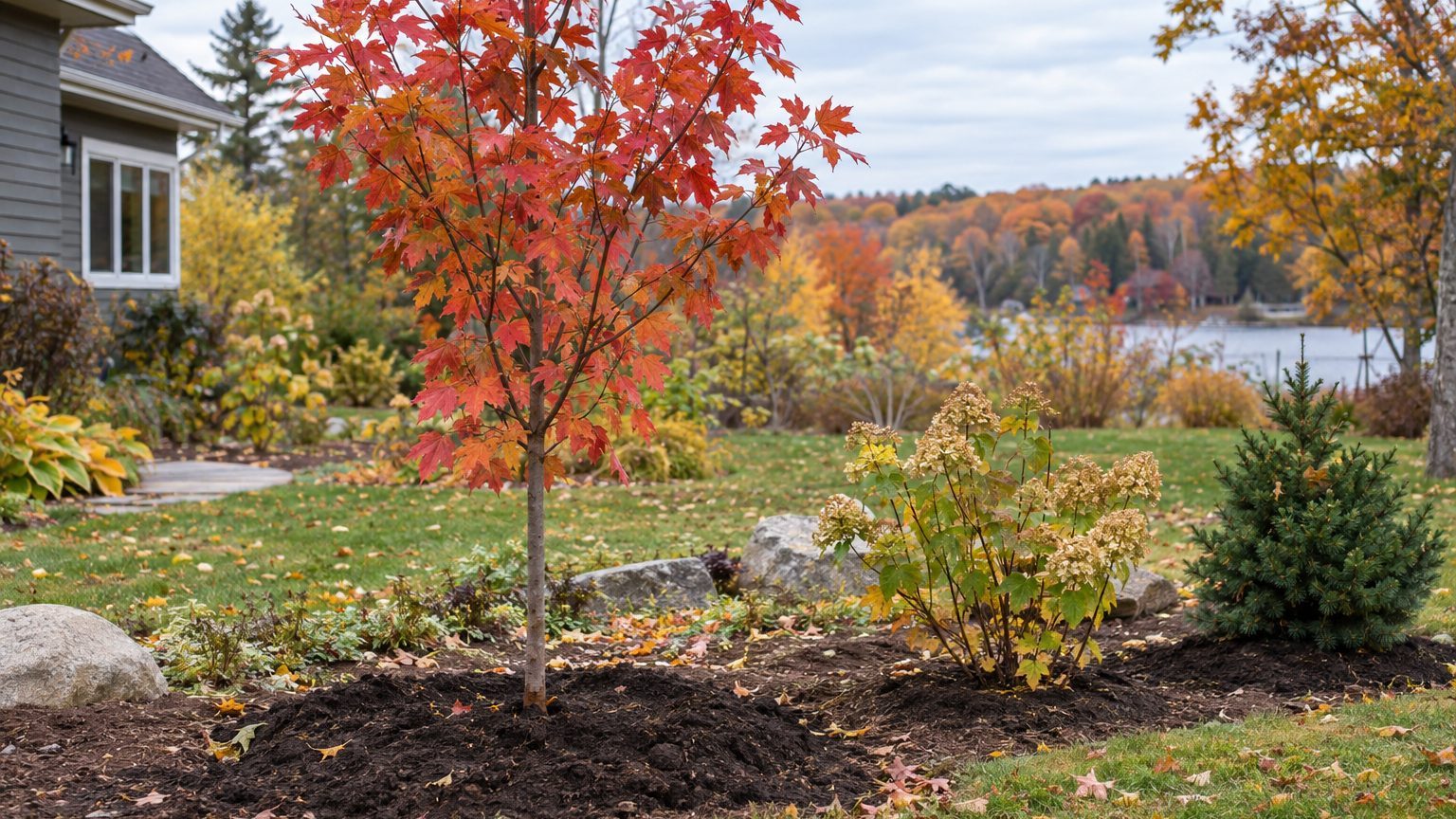

The safe target for fall planting in Connecticut is September 16 to September 29, six weeks before the first fall frost of October 28 to November 10. That is the conservative date, not the hard stop. The true limit, the day the ground freezes, comes later, so a container or balled plant that goes in after the safe window can still work with good care. Near the coast the window runs later. In the inland and northwest hills, treat these dates as a ceiling and plant earlier.
The deadline in Connecticut
Roots don’t follow the air. Once leaves drop, the top of a tree or shrub goes quiet, but the roots keep growing as long as the soil is workable and above freezing. Soil holds summer heat and gives it up slowly, so a frosty morning in late October doesn’t shut anything down underground. That gap between air and soil is what makes fall planting work at all. A young plant gets weeks of root growth without the stress of leaves, sun and heat pulling water out of it.
The frost range comes from NOAA’s National Centers for Environmental Information. Its 1991-2020 Climate Normals for the Bridgeport station put the first 32°F freeze at October 28 to November 10, using the 30-70% probability band. Bridgeport sits on Long Island Sound and is the mildest part of the state. Inland and northwest Connecticut freeze noticeably earlier in fall and later in spring, so if you garden in the hills, your dates move earlier. Your own local frost history is worth checking against the first and last frost dates in Connecticut.
Counting back from the frost
Cornell Cooperative Extension states the rule this way: “Fall is an excellent time for transplanting, provided you get them to their new home at least 6 weeks before the ground freezes, allowing them time to establish roots before winter dormancy.” Note what it counts from. It counts from frozen ground, not from the first frost, which is an air temperature.
Ground freezing arrives later than the first frost. Counting six weeks back from the frost range instead gives a cautious answer: September 16 to September 29. Plant inside that window and you’re on the safe side of Cornell’s rule, with a cushion. Plant after it and you’re borrowing against that cushion, which is a gamble that gets worse the further north and inland you live, because the colder parts of the state reach both the first frost and the frozen ground sooner.
Does the deadline apply here?
Yes, everywhere in Connecticut. NOAA’s normals give a mean daily minimum of 24.4°F for the coldest month at Bridgeport. That is the average overnight low, not a record, and it sits well below 32°F even at the mildest reference point. The ground freezes here, so the winter is a real test of what you plant. Some warm southern states can keep planting through winter, but Connecticut can’t.
Hardiness matters too. The USDA Plant Hardiness Zone Map (2023 edition, built on 1991-2020 normals) places Connecticut at 6a to 7b. That map rests on a single variable, the average annual extreme minimum temperature, and your zone depends on where you live in the state. Look up your own before buying anything marginal. Colder states run on an even earlier clock, as the piece on How Late Can You Plant Trees and Shrubs in Fall in Wyoming? shows.
What to plant late, and what to wait on
After the safe window closes, plant type matters more than the date on the calendar. Two groups do well. Container-grown and balled-and-burlapped plants that are fully hardy for your zone have intact root systems, so they’re less shocked at planting than bare-root stock. They can spend the remaining weeks pushing roots into the surrounding soil. Two groups struggle: plants at the edge of their hardiness, and evergreens that keep losing water through their leaves all winter.
The safe bets after the window
A hardy deciduous tree or shrub is the easiest late job. With no leaves left to feed, it can put everything into root growth while the soil stays workable. Maples, many flowering shrubs and most native trees sold in containers fit this pattern. If you’re planting in the first week or two after September 29 and the fall is not unusually cold, the odds stay decent. Balled-and-burlapped trees fit too, though their root balls are heavy, so the hole and the watering both need care.
Check the plant tag before you buy. If the label lists a zone at or colder than yours, you’re fine. Connecticut’s cold is real: Bridgeport’s coldest-month nights average 24.4°F, and that is the mild end of the state.
The risky group
Evergreens keep their foliage, and foliage keeps losing water in winter wind and sun while frozen soil can’t replace it. A late-planted evergreen has few roots to pull water from cold ground. Broadleaf evergreens like rhododendron, boxwood and holly are the classic casualties. Needled ones like arborvitae and hemlock are tougher but still lose water. Plants rated at the marginal edge of your zone have no cold tolerance to spare, and a fresh planting is less able to take a hard winter.
| Plant type | After September 29 | Reason |
|---|---|---|
| Hardy deciduous trees and shrubs, container-grown | Usually fine, water until freeze-up | No leaves to support, roots keep growing |
| Hardy trees, balled and burlapped | Usually fine with deep watering | Intact root ball, but heavy and slow to settle |
| Broadleaf evergreens | Risky, safe window or spring is better | Leaves lose water all winter |
| Needled evergreens | Moderate risk, more so inland | Foliage keeps drying in wind and sun |
| Plants borderline for your zone | Wait | No cold tolerance to spare while roots are new |
The rule to write down: hold borderline plants and evergreens for spring once the safe window has closed, and keep late planting for hardy deciduous stock. Nurseries discount stock in late fall, and that’s the trap. A cheap rhododendron planted in November is usually a poor bargain.
Watering and mulch until the ground freezes
The job after planting is the same for every tree and shrub. Keep the root zone evenly moist and cover it with mulch. The first winter is about roots, not growth. A newly planted shrub doesn’t need to gain height this year. What it needs is a root system that reaches out of the original hole, because roots anchor the plant and take up water when the soil thaws in spring. A plant that spends its first cold months building roots leafs out strongly. One that arrives with the roots still tight in the container or ball spends that spring struggling.
Water deeply, until the ground locks up
Fall in Connecticut can turn dry even as the air cools, and new plants can’t cope with a lean soil. Give a slow, deep soaking so water reaches the root ball and the soil around it, rather than a light sprinkle that only wets the top of the mulch. A root ball dries out faster than the soil around it, so the ball itself needs attention, especially with balled-and-burlapped trees. Keep watering through the fall, and stop when the ground actually freezes and the water can no longer soak in. A dry November is when this matters most.
Evergreens benefit from it more than anything else. Moist soil going into winter gives them a reserve to draw from when cold winds pull water from their needles. The general rules of planting and caring for trees, shrubs and perennials cover hole size and soil prep.
Mulch: a ring, not a volcano
NC State Extension’s Gardener Handbook gives two guidelines that agree on depth. On weeds: “A 2-inch to 3-inch layer of mulch suppresses most annual weed seeds and makes it easy to hand-pull any that do germinate.” On trees: “Provide a 3-inch layer of mulch to reduce water loss and maintain uniform soil moisture and temperature around roots.” That is the range: 2 to 3 inches, spread in a wide ring.
More isn’t better. A deep pile against the trunk, the so-called volcano, holds moisture on the bark, invites rot and gives rodents cover. Keep the mulch pulled back so it doesn’t touch the trunk, and spread it out across the root zone instead. Full details on materials and placement are in mulching without killing the plant. Mulch also slows the soil’s temperature swings, which matters for the heaving problem covered next.
What goes wrong
Most fall planting failures trace back to four mistakes, and all of them come from planting too near the freeze. None of them is a mystery. The cure is timing plus follow-up care.
Planting too late for the climate
Connecticut’s ground freezes, so a plant that goes in when the soil is already cold has no time to root. The Cornell rule of six weeks before the ground freezes exists for a reason, and the safe window of September 16 to September 29 gives you a buffer on top of it. Inland and northwest gardeners lose that buffer faster, since their first frost and frozen ground both arrive earlier than Bridgeport’s. Before planting, push a spade into the soil. If the ground is frozen or turning stiff, the season is over and the plant should wait, in its pot, for spring.
Winter burn, heaving and a dry fall
Winter burn shows up as brown, scorched foliage on evergreens in late winter. Wind and sun pull water from the leaves while frozen roots can’t send any back. Deep watering before freeze-up and a sheltered planting spot reduce the risk. Choosing hardy species matters as much as anything.
Heaving is different. Repeated freezing and thawing pushes shallow root balls up out of the soil, exposing roots to drying air. It hits small, newly planted stock hardest, because the roots haven’t anchored yet. A proper mulch layer helps by keeping the soil temperature steadier. After a thaw, check newly planted shrubs and press any lifted root ball back into place.
A dry fall does its own damage. When rain stays away through October and November, a new plant can enter winter already short of water, and a stressed plant handles cold worse. Check the soil a few inches down rather than trusting the surface, and water when it’s dry.
Common questions
Can I plant trees after the first frost in Connecticut?
Often, yes, as long as the soil can still be dug. A light frost in the air doesn’t freeze the ground, and roots keep growing in cool soil. Hardy, container-grown deciduous trees have the best chance. Evergreens and marginal plants are the ones to hold back.
Is the six-week rule counted from the first frost or from frozen ground?
Cornell’s rule counts from when the ground freezes. The September 16 to September 29 date here counts six weeks back from the first fall frost, October 28 to November 10, so it is the safe, conservative target. The real limit comes later, though the exact date varies each year and by location.
Does the deadline change across the state?
It does. The frost range comes from the Bridgeport station on the coast, the mildest part of the state. Inland and northwest Connecticut get frost earlier, so the deadline moves earlier there too. Gardeners in the hills should plan for the start of the window or before it.
What should I do if I missed the window?
Choose hardy deciduous plants in containers or balled and burlapped, plant them while the soil is still workable, water deeply until the ground freezes, and mulch 2 to 3 inches deep in a ring. For evergreens and borderline plants, wait for spring. More state-specific timing is collected in the Connecticut guides, and your local extension office can confirm your zone, since USDA puts the state at 6a to 7b.