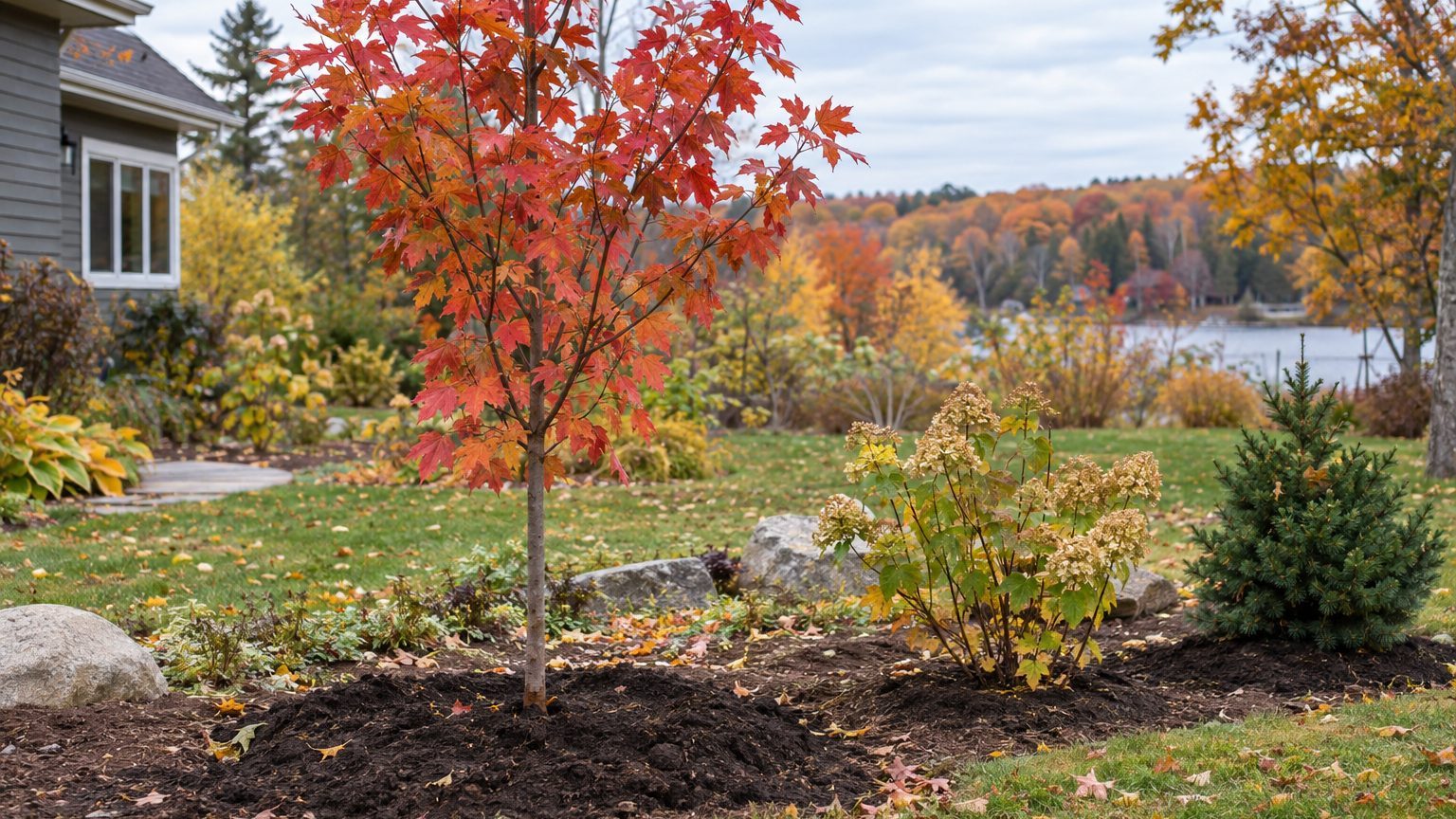

The conservative deadline for planting trees and shrubs in Massachusetts is September 22 to October 3, which is six weeks before the first fall frost. NOAA’s 1991-2020 Climate Normals put that frost at November 3 to November 14 at Boston’s Logan Airport. Miss the window and the tree isn’t doomed, because roots keep working until the soil freezes, and the ground holds out longer than the air does. But the farther inland or uphill you garden, the earlier your clock runs out.
The deadline in Massachusetts
Roots keep growing as long as the soil is workable and above freezing, which is long after the air turns cold enough to finish off the tomato vines. That’s the whole logic of fall planting. The limit is set by the ground, not by the first night you need a jacket. Cornell Cooperative Extension (Orleans County) states the rule this way: “Fall is an excellent time for transplanting, provided you get them to their new home at least 6 weeks before the ground freezes, allowing them time to establish roots before winter dormancy.” Nobody has a thermometer buried in the yard, though, so the practical move is to count backward from a date you can look up.
The date to use comes from NOAA’s 1991-2020 Climate Normals. Their 32°F freeze probabilities (the 30-70% band) put the first fall frost at November 3 to November 14. Count six weeks back from that range and you get the safe target: September 22 to October 3. Treat it as the comfortable date, the one that leaves the tree a full cushion, not as a cliff.
Why the real limit falls later
Cornell counts from the day the ground freezes, and that day comes after the first frost of the air. Soil is a big, slow-cooling mass. It can stay workable for weeks after the first nights below 32°F. So a shrub that goes in after the safe window may still get some root-building time. It simply has less margin, and margin is what pays for a dry October or an early cold snap.
Massachusetts is not a place where you can plant all winter and shrug. The mean daily minimum of the coldest month in Boston is 23.1°F (NOAA NCEI Climate Normals 1991-2020). That’s well below freezing, so the ground here does freeze, and the six-week rule applies in full.
Moving the date for your town
Logan sits on the waterfront, and it is the mildest spot in the state. Inland suburbs and the Berkshires frost noticeably earlier in fall. Colder ground means earlier deadlines, so if you garden away from the coast, expect your own cutoff to land at the early end of that September 22 to October 3 range, or before it. Look up the frost dates for your specific town in First and Last Frost Dates in Massachusetts, then count back from those.
Hardiness zones are a separate question. The USDA Plant Hardiness Zone Map (2023 edition, built on 1991-2020 normals) runs from 5a to 7b across the state, and it measures winter cold, not planting time. For dated advice, Boston is the reference here. Your town may differ, sometimes by a lot.
What to plant late, and what to wait on
Container-grown and balled-and-burlapped plants that are fully hardy for your area are the best late-season bets. Their roots are already intact and will push into cool soil without much fuss. Borderline plants and evergreens that keep losing water through winter are the risky ones. If you’re past the safe window, that difference matters more than the calendar does.
Good candidates after the safe window
Deciduous trees and shrubs are the easiest. Once the leaves drop, the plant has no foliage to keep watered, so all its energy goes underground. Maples, oaks, and flowering shrubs such as viburnums fit this pattern, as long as they’re rated for your zone. Perennials and ornamental grasses are forgiving too, though they benefit from as much time as you can give them. For the broader mechanics of getting a root ball in the ground, see Planting and Caring for Trees, Shrubs and Perennials.
Hardiness is the first check. USDA zones rest on one number, the average annual extreme minimum temperature, and the state spans 5a to 7b. A plant sold as hardy to a zone colder than yours has room to spare. A plant that only just qualifies has none, and a first winter with a freshly disturbed root system is the wrong time to test it.
Better left for spring
Broadleaf and needled evergreens (rhododendrons, boxwood, hollies, arborvitae) keep transpiring all winter. When the soil is frozen they can’t replace the water they lose, and a young plant with a small root system runs out first. Marginally hardy plants belong in the same group. If you miss the window, hold borderline plants and evergreens until spring and put hardy deciduous stock in instead.
| Plant type | Late fall verdict | Reason |
|---|---|---|
| Hardy deciduous trees and shrubs | Good, even past the safe window | Leafless plants put their energy into roots |
| Hardy perennials and grasses | Fine with time to settle | Small root systems, easy to water |
| Evergreens | Plant early or wait for spring | They lose water all winter, and frozen soil can’t replace it |
| Borderline-hardy plants | Wait for spring | No margin for a cold first winter |
Watering and mulch until the ground freezes
Water deeply until freeze-up, then mulch in a ring, not a volcano. The first winter is about roots, not growth. A newly planted tree has a fraction of the root system it will eventually need, and everything you do this fall should protect that underground network.
Water deeply, then keep going
Fall rain in Massachusetts is unreliable, and a dry October is common enough to plan around. Cool air fools people into thinking the plant doesn’t need water. It does. Roots are still expanding into the surrounding soil, and dry soil stops them cold. Soak the root ball and the soil just beyond it with a slow trickle, so the water goes down instead of running off. Push a trowel into the soil beside the plant to check. If it’s dry a few inches down, water again. Keep this up until the ground freezes, because that is the moment the roots go dormant and the plant can no longer take up water.
Skip fertilizer in fall. Nitrogen pushes soft top growth that winter will punish, and what you want is roots. A tree that looks like it did nothing above ground this first year has probably done exactly the right thing below it.
A ring, not a volcano
Mulch does two jobs. NC State Extension’s Extension Gardener Handbook (chapter 11, Woody Ornamentals) says: “A 2-inch to 3-inch layer of mulch suppresses most annual weed seeds and makes it easy to hand-pull any that do germinate.” On trees, it adds: “Provide a 3-inch layer of mulch to reduce water loss and maintain uniform soil moisture and temperature around roots.” Both give the same order of depth. Spread it a 2-inch to 3-inch layer deep in a wide, flat ring.
More is not better. Pile mulch against the trunk in a cone and it holds moisture against the bark, invites rot, and gives rodents a cozy place to sit. Pull it back so the trunk flare stays visible and bare. The ring should look like a doughnut, with the tree in the hole. More on materials and technique in Mulching Without Killing the Plant.
What goes wrong
Four problems account for most failed fall plantings in Massachusetts: planting too late for the local climate, winter burn on evergreens, frost heave of shallow root balls, and plain old drying out.
Planting too late is mostly a matter of misjudged geography. The September 22 to October 3 safe range is built from Boston’s frost dates, and Boston is the mild end of the state. In the Berkshires and other cold inland pockets, the ground freezes earlier and the window closes sooner. A gardener there who follows the coastal calendar can end up planting into soil that is nearly done for the year.
Winter burn shows up in late winter as brown, scorched needles or leaves on the side facing wind or sun. Frozen soil cuts off the water supply while the foliage keeps losing moisture. Late-planted evergreens are the most exposed, since they lack the roots to compensate. Put evergreens at the front of the September 22 to October 3 window, or wait until spring.
Heaving is what freeze-thaw cycles do to a shallow root ball. The soil expands and contracts, and the plant can be pushed slowly upward until roots are exposed to air. It hits hardest in late winter, when nights freeze and afternoons thaw. A steady ring of mulch keeps the soil temperature more uniform and cuts the risk. If you find a plant sitting high in March, press it back in gently once the soil softens, then water.
Drying out is the quietest failure. A dry fall with no watering leaves a plant walking into winter thirsty, and it may not show until leaf-out in spring. Roots that never got the chance to expand can’t feed the crown when growth resumes.
Common questions
Can I still plant after October 3?
Yes, with caveats. September 22 to October 3 is the conservative target, and the ground freezes later than the air does. Hardy container and balled plants can still go in, especially deciduous ones, as long as you water them until freeze-up and mulch properly. Inland and at elevation, that margin is thinner, so don’t push it there.
Is fall better than spring for planting in Massachusetts?
Cornell Cooperative Extension calls fall “an excellent time for transplanting,” provided the plant is in the ground at least six weeks before the ground freezes. Roots get a full dormant season to settle, and the plant faces less summer heat stress in its first year. Spring works too. Evergreens and borderline-hardy plants simply tend to do better with the spring start.
Do the Berkshires follow the same dates?
No. Colder areas, meaning farther inland or at higher elevation, get an earlier first fall frost, so fall planting deadlines move earlier there. The September 22 to October 3 range comes from Boston’s Logan station, the mildest spot in the state. A colder state shows the same pattern more sharply, as in How Late Can You Plant Trees and Shrubs in Fall in Michigan?. For more local guidance, browse the Massachusetts guides.
Does the 23.1°F winter minimum mean my plants are safe?
Not by itself. That figure is the mean daily minimum of the coldest month in Boston, from NOAA’s 1991-2020 Climate Normals. It’s an average, not a record low, and it describes Boston, not your yard. USDA hardiness zones use a different number, the average annual extreme minimum, and the state runs from 5a to 7b. Check the zone for your own location against the plant tag, and choose plants rated at least for that zone.