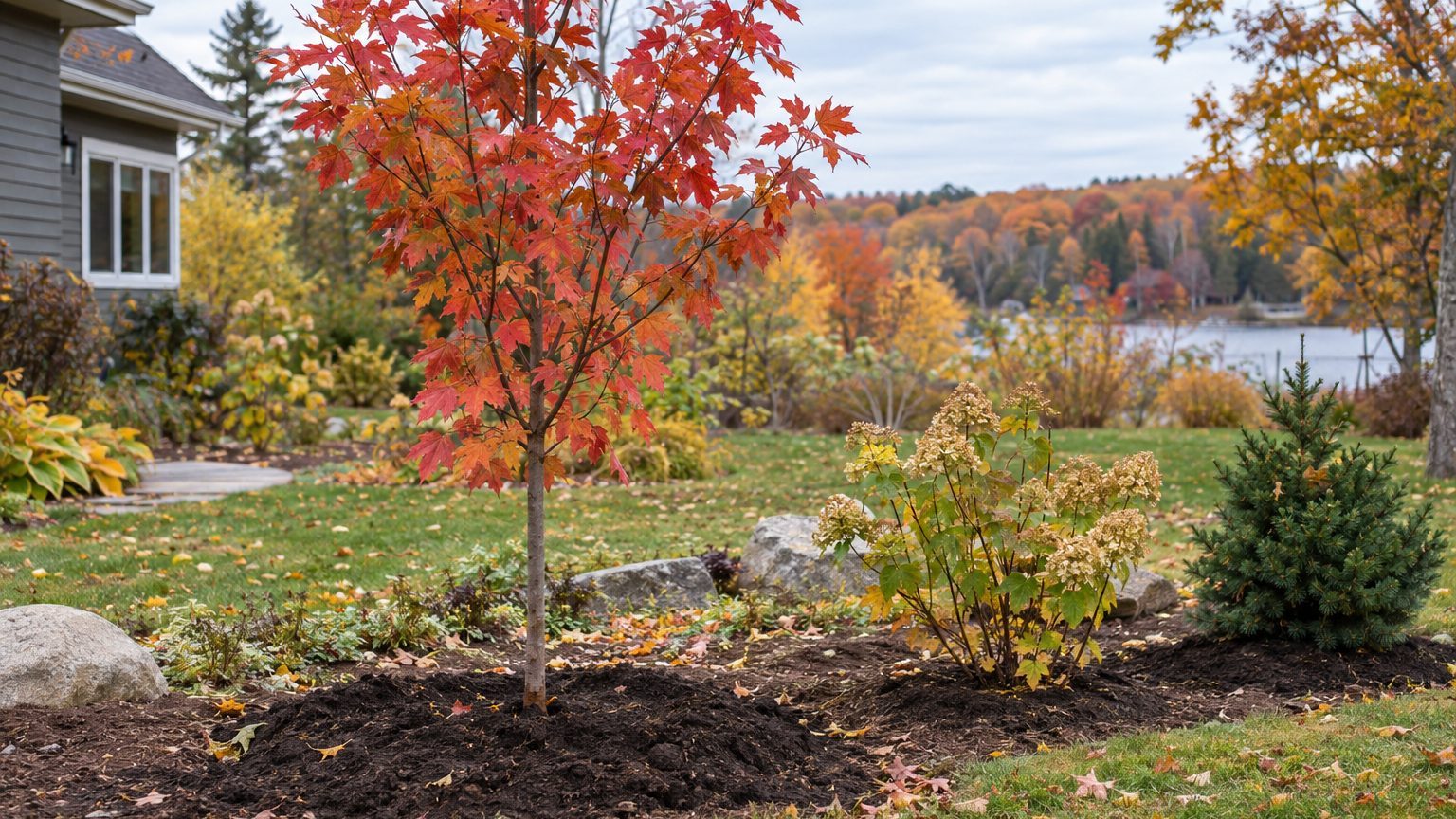

In Wyoming, the safe target for planting trees and shrubs in fall is six weeks before the first fall frost. At the Cheyenne reference station that works out to mid-to-late August. You can still plant after that date, because roots keep working until the soil freezes, but every week past it leaves less time to settle in. Colder, higher parts of the state hit the limit earlier.
The deadline in Wyoming
Air temperature isn’t what stops a root. Roots keep growing as long as the soil is workable and above freezing, which is usually well after the first frost has blackened the tomato vines. A tree planted in fall spends the weeks before winter pushing roots into the surrounding soil, so that spring growth has something to draw on. The deadline is about leaving enough of those weeks.
How the date is worked out
Cornell Cooperative Extension puts the rule this way: “Fall is an excellent time for transplanting, provided you get them to their new home at least 6 weeks before the ground freezes, allowing them time to establish roots before winter dormancy.” The clock runs back from frozen ground, not from the first frost. Ground freezes later than the air does, so the rule is more forgiving than a frost-based date would suggest.
NOAA’s 1991-2020 Climate Normals (NCEI) put the first fall freeze at 32°F in a band from September 24 to October 5, using the 30 to 70 percent probability range at the reference station. Count six weeks back from that range and you get a conservative target:
| Item | Date range |
|---|---|
| First fall frost (NOAA NCEI, 1991-2020) | September 24 to October 5 |
| Six weeks earlier: the safe planting target | August 13 to August 24 |
Aim to have trees and shrubs in the ground between August 13 and August 24, and treat that as the safe target, not the hard cutoff. The true limit, the day the ground freezes, usually falls later. That gives you a cushion for hardy plants, but not an open-ended one.
Why your own date may be earlier
Wyoming is not one climate. The USDA Plant Hardiness Zone Map (2023 edition, built on 1991-2020 normals) runs from 3a to 6a across the state, so a yard near Cheyenne and a yard in a high mountain valley have little in common. At about 6,000 feet you can count on roughly 130 frost-free days, and at higher elevations frost can show up in any month. In the colder, higher, or more northern parts, the first frost arrives sooner and the ground locks up sooner. Shift your planting date earlier, not later. You can check your own town on the page covering first and last frost dates in Wyoming.
The deadline definitely applies here. At the Cheyenne reference station, the average daily minimum in the coldest month is 18.1°F (NOAA NCEI, 1991-2020), well under freezing, so the ground does freeze. This is not a place where you can plant all winter. Readers comparing notes with another cold-winter state can look at how late you can plant trees and shrubs in fall in Connecticut.
What to plant late, and what to wait on
Not every plant handles a late start equally. The ones that do best are fully hardy for your spot and arrive with an intact root system: container-grown and balled-and-burlapped deciduous trees and shrubs. They have a head start underground and can use whatever warm soil is left.
The coldest-month figure matters here. The 18.1°F mean daily minimum is what decides whether a plant survives winter at all, and the USDA zone system is built on the average annual extreme minimum. Because the state spans 3a to 6a, check the tag against the zone where you actually live, not the statewide range. A plant rated for your zone with no room to spare is a poor candidate for a late start, since it will face its first winter with a small root system and no margin.
| Plant type | Late-fall outlook | Reason |
|---|---|---|
| Hardy deciduous trees, container or balled | Good, if planted before the ground freezes | Dormant tops lose little water; roots keep growing in cool soil |
| Hardy deciduous shrubs | Good | Smaller root balls settle quickly, but need steady moisture |
| Perennials rated well below local winter lows | Fair to good | Fast to root, but roots must be established before the freeze |
| Borderline-hardy plants | Poor | A new root system has no cushion against the cold |
| Evergreens (conifers, broadleaf types) | Risky after the safe target | Foliage keeps losing water all winter while frozen roots can’t replace it |
Evergreens are the catch. A maple drops its leaves and coasts through winter, but a spruce or juniper keeps its needles and keeps losing moisture to wind and dry air. Frozen soil can’t resupply that water. Establishing the roots earlier, ideally in the August window, gives evergreens a fighting chance. If you are past the safe target, they are the first thing to hold back.
Borderline plants follow the same logic. A shrub that is marginal for your zone can sometimes get through with a mature root system in its second winter, but not as a September or October transplant. For anything borderline or evergreen planted after the safe target, wait until spring. The nursery will still have it, and it loses nothing by sitting. For the mechanics of setting plants in the ground, the guide to planting and caring for trees, shrubs and perennials covers it.
Watering and mulch until the ground freezes
The first winter is about roots, not growth. A newly planted tree may barely add a leaf the first season, and that is fine. What it is doing is spreading roots into native soil, and those roots are what carry it through next summer’s heat. Anything that interrupts that work, including a dry soil, costs more than the top growth you can see.
Fall in Wyoming is often dry, and a new root ball dries out faster than the surrounding soil. Plan on deep, slow watering through autumn, and keep it up until the ground freezes. Soak the whole root zone rather than sprinkling the surface, then let the top of the soil dry slightly before you water again. Keep watering deeply until freeze-up, including on warm days in November after the leaves are gone, because dormant plants still need moisture at the roots.
Mulch does the rest of the job, and the depth matters. The NC State Extension Gardener Handbook (chapter 11, Woody Ornamentals) says: “A 2-inch to 3-inch layer of mulch suppresses most annual weed seeds and makes it easy to hand-pull any that do germinate.” On trees specifically, it advises: “Provide a 3-inch layer of mulch to reduce water loss and maintain uniform soil moisture and temperature around roots.” Two different purposes, one depth. More is not better.
Shape matters as much as thickness. Spread the mulch in a wide, flat ring, thinning toward the trunk and leaving the bark and root flare exposed. A mound piled against the trunk, the infamous mulch volcano, holds moisture against the bark and invites rot and gnawing pests. The ring should look like a doughnut, with the trunk sitting in the hole. A longer walkthrough is in mulching without killing the plant.
Mulch also does something specific to a Wyoming winter. It evens out soil temperature, which softens the swings that push shallow plants up out of the ground. It works best when applied after the soil has cooled, over soil that is already well watered.
What goes wrong
Planting too late is the most common failure, and it is quiet. A tree set in as the ground is about to freeze may look fine in December and then leaf out weakly, or not at all, in May. The roots never got their weeks. In colder or higher parts of the state, the safe target comes even earlier than the August range, and the ground freezes sooner than at the reference station. A plant that would have made it near Cheyenne can fail in the mountains on the same calendar date.
Winter burn is next. Evergreens lose water through their needles on windy, sunny days while their roots sit in frozen soil. The result is tan or brown foliage by late winter. Newly planted evergreens are the most exposed, since their roots have not yet reached deeper moisture. The remedy is to get them in early, water well into fall, and avoid planting them late.
Frost heave catches shallow root balls. When soil freezes and thaws repeatedly, it expands and contracts and can lift a small plant partly out of the ground, tearing roots and exposing them to the air. Mulch in a proper ring moderates the swings. Check new plantings after thaws and press any lifted root ball back into place.
The last problem is drying out in a dry fall. If autumn brings little rain or snow, a new planting can slip into winter thirsty without any visible sign. Plant evergreens in the August window, or hold them until spring. For hardy deciduous plants, the deciding factor is whether you can water them until freeze-up. If you can’t commit to that, spring is the safer season.
Common questions
Is it too late to plant a tree in Wyoming in early October?
It is past the conservative target of August 13 to August 24, but not necessarily too late. The true limit is when the ground freezes, which comes after the first fall frost (September 24 to October 5 in NOAA’s normals). A fully hardy deciduous tree in a container can still go in if the soil is workable and you will water it deeply. Evergreens and borderline plants should wait until spring.
Does the six-week rule count from the first frost or from frozen ground?
Cornell Cooperative Extension counts from when the ground freezes. The August dates here count six weeks back from the first fall frost, which comes earlier, so they are deliberately conservative. Treat them as the safe target, with the frozen-ground date as the outer edge.
Do the dates change in northern or mountain Wyoming?
Yes, and they move earlier. Colder, higher, and more northern areas get their first frost sooner and their ground freezes earlier. At around 6,000 feet there are roughly 130 frost-free days, and at higher elevations frost is possible in any month. Count back from your own first frost date, and give yourself extra margin.
How much mulch should go around a new tree?
NC State Extension recommends “a 2-inch to 3-inch layer” for weed suppression, and “a 3-inch layer of mulch” around trees to hold moisture and even out soil temperature. Keep it in a ring with the trunk and root flare clear. Piling it higher does not add protection, and it can harm the bark.